


Gospel in Art: The tax collectors and the prostitutes believed him
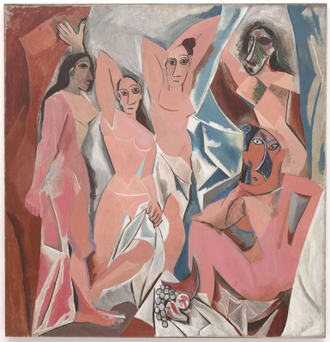
Les Demoiselles d'Avignon, by Pablo Picasso © Museum of Modern Art, New York
Source: Christian Art
Gospel of 16 December 2025
Matthew 21:28-32
At that time: Jesus said to the chief priests and the elders of the people, 'What do you think? A man had two sons. And he went to the first and said, "Son, go and work in the vineyard today." And he answered, "I will not", but afterwards he changed his mind and went. And he went to the other son and said the same. And he answered, "I go, sir", but did not go. Which of the two did the will of his father?' They said, 'The first.' Jesus said to them, 'Truly, I say to you, the tax collectors and the prostitutes go into the kingdom of God before you. For John came to you in the way of righteousness, and you did not believe him, but the tax collectors and the prostitutes believed him. And even when you saw it, you did not afterwards change your minds and believe him.'
Reflection on the painting
At the end of today's Gospel reading, Jesus says something that must have shocked His listeners. He tells the chief priests and elders that tax collectors and prostitutes are entering the kingdom of God ahead of them. In doing so, He overturned the usual assumptions about who was close to God and who was not. People presumed that holiness was found among the religious leaders, the outwardly respectable, those who kept the rules. Jesus suggests the opposite: that God may be at work in the very people society dismisses or judges.
We too can be so quick to judge others, especially in a religious context. It is easy to assume who is "in" and who is "out," who is close to God and who is far away, based on what we see on the surface. Yet, only God knows the real story... the hidden battles, the quiet acts of kindness, the longing for grace that lies beneath a person's life.
In this context, it is interesting to think of Pablo Picasso's Les Demoiselles d'Avignon, one of the most famous and controversial depictions of prostitutes in Western art. Painted in 1907, it shows five women from a brothel in Barcelona, confronting the viewer with bold, unidealised faces and angular bodies. Picasso was not painting them to celebrate their profession, but to challenge viewers to confront the humanity often hidden behind labels, judgement, and social shame, something not unlike the very people Jesus welcomed in today's Gospel.
What shocked the art world in 1907 was not only the subject matter, but the radical way Picasso painted it. Les Demoiselles d'Avignon is considered by many to be the first great step into Cubism, the movement Picasso later developed with Georges Braque. Cubism broke away from traditional perspective; instead of showing one viewpoint, it fractured forms into sharp facets, presenting multiple angles at once. It was a way of saying that reality is more complex than a single viewpoint can capture, much like the human soul itself.
In a way, this mirrors what Jesus does in today's Gospel: He asks us to see beyond outward appearances, to look past the labels society gives, and to recognise the dignity, depth, and sacred worth of every person, especially those whom the world is quickest to judge.
LINKS
Gospel in Art: https://christian.art/
Today's Reflection: https://christian.art/daily-gospel-reading/matthew-21-28-32-2025/
 Facebook
 Twitter
 LinkedIn
 Print
Print Email
Email














 Facebook
 Twitter
 YouTube
 LinkedIn
 Pinterest