


Gospel in Art: I will give you the keys of the kingdom of heaven
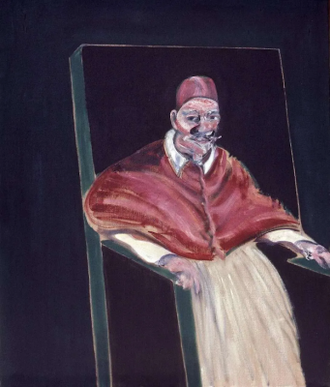
Study for Velazquez Pope II, by Francis Bacon, 1961 © Vatican Museum
Source: Christian Art
Gospel of 7 August 2025
Matthew 16:13-23
At that time: When Jesus came into the district of Caesarea Philippi, he asked his disciples, 'Who do people say that the Son of Man is?' And they said, 'Some say John the Baptist, others say Elijah, and others Jeremiah or one of the prophets.' He said to them, 'But who do you say that I am?' Simon Peter replied, 'You are the Christ, the Son of the living God.' And Jesus answered him, 'Blessed are you, Simon Bar-Jonah! For flesh and blood has not revealed this to you, but my Father who is in heaven. And I tell you, you are Peter, and on this rock I will build my Church, and the gates of hell shall not prevail against it. I will give you the keys of the kingdom of heaven, and whatever you bind on earth shall be bound in heaven, and whatever you loose on earth shall be loosed in heaven.' Then he strictly charged the disciples to tell no one that he was the Christ.
From that time Jesus began to show his disciples that he must go to Jerusalem and suffer many things from the elders and chief priests and scribes, and be killed, and on the third day be raised. And Peter took him aside and began to rebuke him, saying, 'Far be it from you, Lord! This shall never happen to you.' But he turned and said to Peter, 'Get behind me, Satan! You are a hindrance to me. For you are not setting your mind on the things of God, but on the things of man.'
Reflection on the painting
In today's reading, Jesus appoints Peter as the leader of the Church. The popes are Peter's direct successors, called to carry out his mission of shepherding God's people. In this light, we reflect on a striking painting of a pope by Francis Bacon, known for his emotionally raw and sometimes unsettling style. This particular work, part of the Vatican Collections and based on Velázquez's Portrait of Innocent X (1650), was donated by Gianni Agnelli (founder of Fiat Motors). Bacon saw the original as one of the greatest paintings ever made and returned to it obsessively over two decades, reinterpreting the image of the Pope through the lens of his own struggles and shifting moods.
Francis Bacon never offered a single, definitive explanation for his obsession with painting popes. Our painting is set against a stark black background, with the Pope staring directly at us the viewer. The portrait is stripped of grandeur and surrounded by silence. This version is among his more restrained works, yet it still carries deep psychological intensity. While Bacon's Catholic upbringing may have instilled in him a respect for the papal office, he also wrestled with the Church, and his paintings reflect that inner conflict. His repeated portrayals of the Pope reveal not only Bacon's fascination with power and authority, but also reveal the artist's vulnerability. Reverence but also unease. These paintings are less about the papal office itself and more about the weight, isolation, and humanity of those who bear it.
The Pope, as the successor of Peter, is first and foremost a pastor, one who embodies Christ's love and care for every soul. Yet, in many traditional portraits, that pastoral heart is sometimes lost beneath layers of splendour and formality. Bacon's portrait, for all its intensity, brings us back to something more basic, more real, more human.
In light of today's Gospel, where Christ entrusts Peter with the keys of the Kingdom, we pray for our new Pope Leo, called to carry that same pastoral authority with courage, wisdom, and compassion. As we reflect on Francis Bacon's haunting portrait of a pope, stripped of splendour and shown in raw human vulnerability, we are reminded that behind the office lies a man, bearing the weight of the Church on his shoulders.
LINKS
Gospel in Art: https://christian.art/
Today's Reflection: https://christian.art/daily-gospel-reading/matthew-16-13-23-2025/
 Facebook
 Twitter
 LinkedIn
 Print
Print Email
Email







 Facebook
 Twitter
 YouTube
 LinkedIn
 Pinterest