

Gospel in Art: Solemnity of The Immaculate Conception of the Blessed Virgin Mary
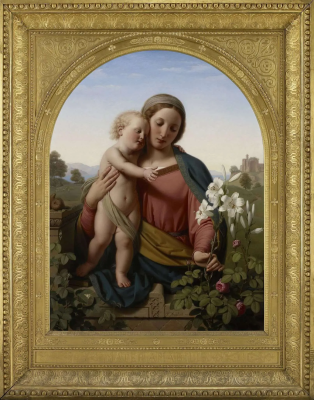
Madonna and Child by Franz Ittenbach, 1855 © Minneapolis Institute of Art
Source: Christian Art
Gospel of 8 December 2025
Luke 1:26-38
At that time: The angel Gabriel was sent from God to a city of Galilee named Nazareth, to a virgin betrothed to a man whose name was Joseph, of the house of David. And the virgin's name was Mary. And he came to her and said, 'Hail, full of grace, the Lord is with you!' But she was greatly troubled at the saying, and tried to discern what sort of greeting this might be. And the angel said to her, 'Do not be afraid, Mary, for you have found favour with God. And behold, you will conceive in your womb and bear a son, and you shall call his name Jesus. He will be great and will be called the Son of the Most High. And the Lord God will give to him the throne of his father David, and he will reign over the house of Jacob for ever, and of his kingdom there will be no end.'
And Mary said to the angel, 'How will this be, since I am a virgin?' And the angel answered her, 'The Holy Spirit will come upon you, and the power of the Most High will overshadow you; therefore the child to be born will be called holy - the Son of God. And behold, your relative Elizabeth in her old age has also conceived a son, and this is the sixth month with her who was called barren. For nothing will be impossible with God.' And Mary said, 'Behold, I am the servant of the Lord; let it be to me according to your word.' And the angel departed from her.
Reflection on the painting
Today we celebrate the Solemnity of the Immaculate Conception, the feast that honours Mary's own conception, not the conception of Jesus. This can easily be confused. The Immaculate Conception refers to Mary being conceived in the womb of her mother, St Anne, free from original sin. Today's feast, coming exactly nine months before Mary's Nativity on 8th September, celebrates the beginning of her sinless life. Since God chose Mary to welcome His Son into the world, He fashioned her as a sinless vessel: the spotless womb, the living tabernacle, in which the Word would quietly take flesh.
From the earliest centuries, the Church Fathers recognised Mary's unique role in salvation history. They understood that God prepared her in a special way to be the Mother of the Saviour, and that salvation could not have unfolded without her "yes." The dogma of the Immaculate Conception teaches that from the very first moment of her existence, Mary was preserved by God from the stain of original sin. This "singular grace" allowed Mary to be a pure, unstained vessel for the Incarnation.
Our German painting from 1855, by Franz Ittenbach, reflects this purity beautifully. A devout Catholic artist, Ittenbach often painted religious subjects in a style reminiscent of Raphael: gentle, luminous, and full of harmony. Here, Mary's skin is almost porcelain-like as she holds the Christ Child. Both reach toward a white lily, the classic symbol of Mary's purity. Behind them, a flock of sheep hints at the Christian community gathered around the Good Shepherd. Beneath the lilies, red roses foreshadow Christ's future Passion, while the figs beside Him recall Old Testament images of Israel's prosperity. Even the frame, designed by Ittenbach himself, honours her with the title Mater Amabilis: "Mother Most Lovable."
LINKS
Gospel in Art: https://christian.art/
Today's Reflection: https://christian.art/daily-gospel-reading/luke-1-26-38-2025-3/
 Facebook
 Twitter
 LinkedIn
 Print
Print Email
Email








 Facebook
 Twitter
 YouTube
 LinkedIn
 Pinterest