


Gospel in Art: Give me the head of John the Baptist here on a platter
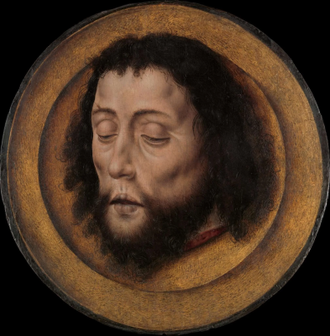
Head of Saint John the Baptist on a Charger by Aelbert Bouts © Metropolitan Museum, New York
Source: Christiant Art
Gospel of 2 August 2025
Matthew 14:1-12
At that time Herod the tetrarch heard about the fame of Jesus, and he said to his servants, 'This is John the Baptist. He has been raised from the dead; that is why these miraculous powers are at work in him.'
For Herod had seized John and bound him and put him in prison for the sake of Herodias, his brother Philip's wife, because John had been saying to him, 'It is not lawful for you to have her.' And though he wanted to put him to death, he feared the people, because they held him to be a prophet.
But when Herod's birthday came, the daughter of Herodias danced before the company and pleased Herod, so that he promised with an oath to give her whatever she might ask.
Prompted by her mother, she said, 'Give me the head of John the Baptist here on a platter.' And the king was sorry, but because of his oaths and his guests he commanded it to be given. He sent and had John beheaded in the prison, and his head was brought on a platter and given to the girl, and she brought it to her mother. And his disciples came and took the body and buried it, and they went and told Jesus.
Reflection on the painting
The beheading of St John the Baptist occurred on Herod's birthday. However, this day is remembered not for Herod's celebration, but for the martyrdom of the Lord's forerunner. For Gospel readers, this event cemented Herod's reputation as a weak and malevolent ruler. Despite knowing John to be a righteous and holy man, Herod, driven by worldly desires and Salome's seductive charm, ordered John's execution. In a moment of recklessness, he transformed John into a symbol for all who would be martyred in future for their faith in Jesus Christ. This passage underscores the profound tragedy of Herod's actions, motivated by fleeting desires and leading to enduring infamy this day.
Our panel by Aelbert Bouts, painted around the year 1500, presents a hauntingly vivid image of the severed head of John the Baptist. Though unsettling to modern eyes, such depictions were once immensely popular, particularly in the late Middle Ages, when devotion to the saint grew rapidly. The panel is one of over twenty known versions, produced using a shared workshop pattern circulated among followers and collaborators in the artistic circles of Dieric Bouts and his son Aelbert. Here, oil paint is masterfully employed to heighten realism: the textures, flesh tones, and shadows come together to evoke the chilling 3D-illusion of a real head resting on a real platter.
The Bouts family played a significant role in the development of Early Flemish painting. Dieric Bouts the Elder (c. 1415-1475) was a leading painter in Leuven and one of the early adopters of oil painting techniques pioneered by Jan van Eyck. His works are marked by serene composition, emotional restraint, and a luminous clarity that became hallmarks of the Northern Renaissance. His son, Aelbert Bouts (c. 1452-1549), inherited his father's workshop. Aelbert developed a more expressive and sometimes dramatic style, often producing emotionally charged devotional images designed to stir the viewer's piety. Together, the Bouts workshop spanned two highly successful generations.
LINKS
Gospel in Art: https://christian.art/
Today's Reflection: https://christian.art/daily-gospel-reading/matthew-14-1-12-2025/
 Facebook
 Twitter
 LinkedIn
 Print
Print Email
Email















 Facebook
 Twitter
 YouTube
 LinkedIn
 Pinterest