


Gospel in Art: Was it not right to untie her bonds on the sabbath day
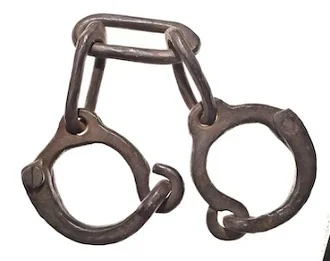
Shackles, Made in North America, 1750-1850, © The New York Historical Society Museum & Library
Source: Christian Art
Gospel of 30 October 2023
Luke 13:10-17
One sabbath day Jesus was teaching in one of the synagogues, and a woman was there who for eighteen years had been possessed by a spirit that left her enfeebled; she was bent double and quite unable to stand upright. When Jesus saw her he called her over and said, 'Woman, you are rid of your infirmity' and he laid his hands on her. And at once she straightened up, and she glorified God.
But the synagogue official was indignant because Jesus had healed on the sabbath, and he addressed the people present. 'There are six days' he said 'when work is to be done. Come and be healed on one of those days and not on the sabbath.' But the Lord answered him. 'Hypocrites!' he said 'Is there one of you who does not untie his ox or his donkey from the manger on the sabbath and take it out for watering? And this woman, a daughter of Abraham whom Satan has held bound these eighteen years - was it not right to untie her bonds on the sabbath day?' When he said this, all his adversaries were covered with confusion, and all the people were overjoyed at all the wonders he worked.
Reflection on the shackles
In our gospel reading today we hear the synagogue official insisting that no work be done on the Sabbath. In reply Jesus insists that God's work can be done on any day of the week. Jesus had just released a woman from a condition that prevented her from standing upright. He untied her bonds; he set her free from what was holding her back. Jesus insisted in a way that the same should happen with the synagogue official: he should be set free from the shackles of what held him back to do the work of God at all times.
Jesus untied the woman's bonds and also wanted to release the synagogue official from his own shackles that were preventing him from fully doing the work of God. The artwork we are looking at is a set of heavy shackles used to bind a prisoner's ankles. During the slave trade, such restraints would have been used to inhibit slave escapes and rebellions. According to Olaudah Equiano, who was sold into slavery in the mid-eighteenth century from Nigeria, the sight of the chains alone was enough to provoke "horror and anguish." Even looking at our image today makes us feel highly uncomfortable.
The shackles we are looking at are a symbol of slavery. They bind and restrict freedom. They can't be removed by the one wearing them. They cause pain and discomfort. They are a constant reminder that our whole being belongs to someone else or in our Christian faith to something else - sin. A slave can't break his own chains and be free. But we can. All we need to do is turn to Jesus and ask him to set us free from the shackles of sin.
LINKS
Gospel in Art: https://christian.art/
Today's Reflection: https://christian.art/daily-gospel-reading/luke-13-10-17-2023/
 Facebook
 Twitter
 LinkedIn
 Print
Print Email
Email










 Facebook
 Twitter
 YouTube
 LinkedIn
 Pinterest