


Gospel in Art: Divine Mercy Sunday
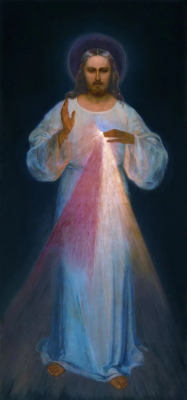
Divine Mercy, by Kazimirowski Eugeniusz,1934 © Divine Mercy Sanctuary, Vilnius
Source: Christian Art
Gospel of 16 April 2023
John 20:19-31
In the evening of that same day, the first day of the week, the doors were closed in the room where the disciples were, for fear of the Jews. Jesus came and stood among them. He said to them, 'Peace be with you', and showed them his hands and his side. The disciples were filled with joy when they saw the Lord, and he said to them again, 'Peace be with you.
'As the Father sent me,
so am I sending you.'
After saying this he breathed on them and said:
'Receive the Holy Spirit.
For those whose sins you forgive,
they are forgiven;
for those whose sins you retain,
they are retained.'
Thomas, called the Twin, who was one of the Twelve, was not with them when Jesus came. When the disciples said, 'We have seen the Lord', he answered, 'Unless I see the holes that the nails made in his hands and can put my finger into the holes they made, and unless I can put my hand into his side, I refuse to believe.' Eight days later the disciples were in the house again and Thomas was with them. The doors were closed, but Jesus came in and stood among them. 'Peace be with you' he said. Then he spoke to Thomas, 'Put your finger here; look, here are my hands. Give me your hand; put it into my side. Doubt no longer but believe.' Thomas replied, 'My Lord and my God!' Jesus said to him:
'You believe because you can see me.
Happy are those who have not seen and yet believe.'
There were many other signs that Jesus worked and the disciples saw, but they are not recorded in this book. These are recorded so that you may believe that Jesus is the Christ, the Son of God, and that believing this you may have life through his name.
Reflection on the painting
Divine Mercy Sunday (also known as the Feast of the Divine Mercy) is celebrated on the Second Sunday of Easter, which concludes the Octave of Easter. The devotion was actively promoted by Pope John Paul II. On April 30, 2000, the Canonisation of Faustina Kowalska took place and the second Sunday of Easter was officially designated as the Sunday of the Divine Mercy in the General Roman Calendar.
I think most of us are familiar with this image of the Divine Mercy. This is the original painting we are looking at now, painted in 1934. Jesus is shown raising his right hand in a blessing pose. His left hand is pointing to his Sacred Heart, from which two rays of light emanate: the red ray is symbolic of the blood Jesus shed for us and the pale ray symbolises purification (which is why some more recent copies of this painting depict this ray more in a light blue for water/baptism). This image is based on Saint Faustina's vision of Jesus in 1931. She wrote in her diary:
"The two rays denote Blood and Water.
The pale ray stands for the Water which makes souls righteous.
The red ray stands for the Blood which is the life of souls…
These two rays issued forth from the very depths of My tender mercy when My agonized Heart was opened by a lance on the Cross."
This is indeed the very first painting of the Divine Mercy, executed by Eugene Kazimierowski in Poland. It currently hangs in the Shrine of Divine Mercy in Vilnius, Lithuania. Kazimierowski was commissioned to paint this holy Image by St Faustina's spiritual director and confessor, Blessed Fr Michael Sopocko. Our painting was first displayed in public during the Easter ceremonies in April 1934. Many prayer cards with this image printed on one side were printed for the occasion, which helped the widespread distribution of the image. Especially after the canonisation of Faustina in April 2000, the devotion to the Divine Mercy and the popularity of this image increased dramatically.
Note also the gentle walking pose of Jesus. One foot is slightly in front of the other. He keeps moving, just as his mercy and grace keep moving towards us as well. If we keep moving towards him, then we will be saved 'not because of righteous things we have done, but because of his mercy' (Titus 3:5).
'Not in the beauty of the colour,
nor of the brush lies the greatness of this image,
but in His grace'.
- Words attributed to Faustina in her diary.
LINKS
Gospel in Art: https://christian.art/
Today's reflection: https://christian.art/daily-gospel-reading/john-20-19-31-2023/
 Facebook
 Twitter
 LinkedIn
 Print
Print Email
Email













 Facebook
 Twitter
 YouTube
 LinkedIn
 Pinterest