


Sunday Reflection with Canon Robin Gibbons - 9 October 2022
Twenty-eighth Sunday in Ordinary Time
We are well aware that in the gospels Jesus always notices somebody in need and then heals the hurts and brokenness of characters that are not really perceived by others. This insight of the Lord is also shared by certain categories of marginal people who understand that he is the living manifestation of God's healing and mercy. They see what other people concerned with such matters as law, government, position and faith cannot.
We also know that these insightful characters are often at the bottom of the human pile, and there they have remained throughout history, the lepers, outcasts, unwanted, all whom we tend to shun. But there at the base of all things, in the detritus and rubbish heaps of life they find a greater insight and connection to real love than most of us ever know, for these are the 'little ones', very dear to the heart of the Most High.
These are those, like the innocent and much put upon creatures that we humans have used and abused, that have a special relationship and connection with to the Holy One and the Kingdom. For these are all the emptied ones, who through life's unkindness's or misfortune also share in the total vocation of Jesus who became lower than any of us, but they are blessed for being so and become like Him, utterly filled with the love and glory of the Most High.
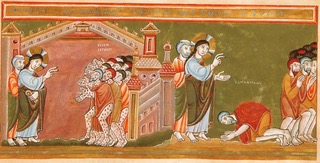
The story of the ten lepers is one which we can enjoy on several levels; firstly of hope, where those outcasts seeing Jesus have the insight that comes from self awareness, that here is one greater and more loving than anybody they have yet met and can do great things for them. Hope springs up from the well of their human pain and loneliness and they are impelled to call on his mercy. For those like them these words of Paul ring true:
"This saying is trustworthy:
If we have died with him
we shall also live with him"
(2 Tim 2:11) In this way those lepers as with all who cast our hopes on Christ find life where there was despair.
A second level to consider is that aspect of faith in the `Jesus who can radically change us. The Lepers are told to go and show themselves to the priests and so fulfil the law of cleansing, and en route they find themselves restored to life again. That might help us realise there is no place, no event which the Spirit cannot utilise for the sake of Christ's love, but it requires persistence and fidelity, and who knows persistence and fidelity more than those who have nothing, yet ask for the smallest comfort from us. Paul again:
"if we persevere
we shall also reign with him.
But if we deny him
he will deny us".(2 Tim 2:12)
We trust that like the lepers we persevere in our relationship , making ourselves open to Christ of the little ones who comes to us through them, lepers, outcasts and yes the animal creation so badly put upon.
But a third level is that surprise of thankfulness from a double outcast, leper and Samaritan, a double recognition that healing has taken place, that through Jesus' love, this person is restored to something worthy again.
We can see that in him, we ourselves are revealed, for persevering, holding on to faith in Christ brings us to this image of Divine Love revealed in the third part of Pauls statement, for in these lepers, outcasts, in our hidden darkness , the part of ourselves we dislike, we also find identification and connection with the Jesus who belongs to and with us always: '
If we are unfaithful
he remains faithful,
for he cannot deny himself'. (2 Tim 2: 13)
Amen.
Lectio
Thomas Aquinas
Notes for a sermon on the ten Lepers
The tenth leper is he who is obstinate and desperate, and who finally sins: "When the plague of leprosy is in a man …. if the rising be white in the skin, and it have turned the hair white …. it is an old leprosy," Levit 13:9-11. S. Jerome observes, that he who despairs of pardon for sin is more bound -by his desperation than by the sin which he has committed. Desperation increases despair, and is a greater tyrant than any sin. He who wishes to be cured from sin's leprosy runs to the fountain of precious blood, which the ineffable charity of our Lord Jesus Christ opened for us: Who washed us in it, and will cleanse all those who fly unto Him from the leprosy of all sin. "Unto Him that loved us and washed us from our sins in His own blood …. to Him be glory and dominion for ever and ever. Amen." Rev 1:5, 6.
Karl Barth
"Grace and gratitude belong together like heaven and earth. Grace evokes gratitude like voice an echo, and gratitude follows grace like thunder lightening."
Poem
The Leper, by John Newton
Oft as the leper's case I read,
My own described I feel;
Sin is a leprosy indeed,
Which none but Christ can heal.
Awhile I would have passed for well,
And strove my spots to hide;
Till it broke out incurable,
Too plain to be denied.
Then from the saints I sought to flee,
And dreaded to be seen;
I thought they all would point at me,
And cry, Unclean, unclean!
What anguish did my soul endure,
Till hope and patience ceased?
The more I strove myself to cure,
The more the plague increased.
While thus I lay distressed, I saw
The Saviour passing by;
To him, though filled with shame and awe,
I raised my mournful cry.
Lord, thou canst heal me if thou wilt,
For thou canst all things do;
O cleanse my leprous soul from guilt,
My filthy heart renew!
He heard, and with a gracious look,
Pronounced the healing word;
I will, be clean - and while he spoke
I felt my health restored.
Come lepers, seize the present hour,
The Saviour's grace to prove;
He can relieve, for he is pow'r,
He will, for he is love.
 Facebook
 Twitter
 LinkedIn
 Print
Print Email
Email
















 Facebook
 Twitter
 YouTube
 LinkedIn
 Pinterest