

London: 80th anniversary of UN marked with Thanksgiving Service
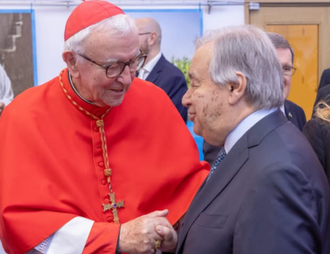
Cardinal Nichols with UN Secretary General Antonio Guterres
"On 10 January 1946, as the echoes of the Second World War still reverberated across a shattered continue, representatives from fifty-one nations gathered here, not as victors and vanquished, but as wayfarers on a shared path towards peace. They came to shape the United Nations, an audacious dream born of necessity: that humanity, scarred by unimaginable loss, could choose cooperation over conflict and dialogue over destruction".
These were the opening words of the homily delivered on Saturday 17th January by Cardinal Vincent Nichols at a Service of Thanksgiving marking the 80th anniversary of the inaugural meeting of the United Nations General Assembly at Methodist Central Hall, Westminster.
The service itself was moving with a wide array of clerics from various Christian denominations joined in prayer with representatives of the Muslim, Buddhist, Sikh, Jewish and Hindu faiths.
As the Cardinal alluded to - the very first meeting ever of the United Nations General Assembly was held in London in the immediate aftermath of WWII and in the bombed out shell that was the city at the time. The first act was to remember all those peacemakers, mediators and humanitarians, who had lost their lives in the service of the UN's global mission of ending conflict, promoting peace and combatting hunger and disease. Then in an act of dedication and commitment to the future, the more than one thousand people present reminded themselves of the initial aims of the UN praying that "We the peoples of the United Nations are determined to save succeeding generations from the scourge of war ...and to reaffirm faith in the fundamental human rights, in the dignity, and worth of the human person, in the equal rights of men and women, and of nations large and small".
Alluding to the efforts of the United Nations around the world, the cardinal noted: "Moments from these eighty years come flooding back: blue helmets in Cyprus, mediating the Cuban missile crisis, feeding millions in Ethiopia, and vaccinating billions in the shadow of Covid. These are not metrics: they are mercy made manifest, threads woven into a tapestry of hope."
His homily did not merely rest on the laurels of the past but noted that "As people of faith, we cannot shy away from honest reckoning. Today multilateralism faces fierce headwinds.......the very idea of nations working with trust, purpose, accountability and patience feels, at times, like a whisper against the clamour of nationalism and protective isolation."
Drawing on the readings St Paul's Letter to the Romans and the Beatitudes, the cardinal also cited remarks by Pope Leo the previous week "in a world facing complex challenges such as geopolitical tensions, inequalities and climate crises, the UN should play a key role in fostering dialogue and humanitarian support, helping to build a more just future".
The rest of the day was addressed in person by the UN's Secretary General Antonio Guterres, leading UK government officials, and expert panels discussing the big issues of the day - peace, security, justice, climate change, and how to build a UN fit for future generations.
Speaking for myself I signed up immediately as a member (£10 only!) of the UK section of the United Nations Association agreeing entirely with their call - "More than eight decades after its formation the need for the UN has never been greater. The United Nations Association makes the case for a strong, credible and effective UN and inspire people to support multilateral cooperation".
For the full text of the Cardinal's homily see: www.indcatholicnews.com/news/54166
For more information on the UNA-UK: see https://una.org.uk/
Maggie Beirne is coordinator, West London Justice and Peace Network.
 Facebook
 Twitter
 LinkedIn
 Print
Print Email
Email





 Facebook
 Twitter
 YouTube
 LinkedIn
 Pinterest