


Queen's Gallery: Masterpieces from the Royal Collection
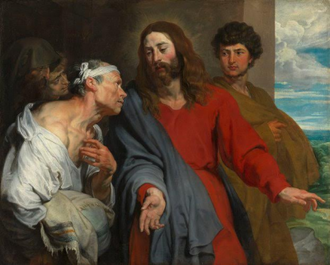
Christ Healing the Paralytic by Anthony Van Dyck. Image Royal Collection Trust
A rich feast of masterpieces from the Royal Collection is on view at The Queen's Gallery during reservicing at Buckingham Palace. Sixty five exceptional paintings can be seen in a modern setting, as opposed to being hung in the antique manner, above each other in the Palace Picture Gallery. Noted Dutch, Flemish and Italian works displayed side by side offer a unique opportunity to study them closely.
The first room covers the Golden Age of Dutch Painting from Dou to Vermeer. Three exceptional Rembrandts face the viewer at the far end.
In the centre is Christ and Mary Magdalen at the Tomb,1638, Wearing a gardener's hat and holding a spade, he reflects Mary's initial belief that he is the gardener. Angels sit on the open tomb. A crouching Mary's face is lit by the rising sun over Jerusalem's temple in the background, as she looks up at Jesus . The light of recognition dawns when he speaks her name . Rembrandt's use of light conveys spiritual metaphor.
On the left is an aged Rabbi with a Cap,1635, a probable model for Biblical scenes. Light enhances the silver and gold threads of his plaited kippur and hairs of his beard. On the right is a self portrait wearing a flat cap in 1642 , with bulbous nose and theatrical stare .Rembrandt was not afraid to portray his own foibles and ageing.
Heindrich Poe in 1632, depicts Charles I, his Catholic Queen, Henrietta Maria, and baby Prince Charles, later Charles II. Focusing on the continuity and symbolism of monarchy, Crown and sceptre lie on the table beside an olive branch, symbolic of peace. Ironically ten years later Civil War occurred and much of the famed Royal Collection of paintings Charles had amassed were dispersed. The King is standing to the side of the table where he has placed his hat, and his queen seated on a dais at its head, with the infant prince perched on a cushion on the table beside his mother.
Room 2 offers wonderful narrative paintings and portraits from Rubens , Rembrandt and Van Dyck. Echoes of Breughel the Elder are seen in Ruben's Summer Peasants going to Market,1618, in its vast landscape and prolific activity. An analogy of humanity's relationship to nature, God's blessing is indicated by church spires in the background and dramatic light breaking through the clouds.
Rubens' preparatory sketches were worked in colour, a novelty for the age, as black and white was the norm. An example is Assumption of the Virgin,1611-12, an oil sketch for an altarpiece at Antwerp cathedral. The apostles are depicted alongside three women registering both amazement and ecstacy at the empty tomb whilst Mary is borne aloft by numerous cherubs to heaven.
Christ Healing the Paralytic,1618-19, a striking early painting by Anthony Van Dyck, whilst working at Ruben's studio, dominates the room. Echoes of Caravaggio abound in the dramatic and emotive enactment between a rosy cheeked, compassionate Christ and the paralytic who humbly points to his heart.
The final room concentrates on Italian masterpieces. Vast Canaletto canvases transport one to Venetian glories. The Bacino di San Marco on Ascension Day,1733-4, depicts the colourful ceremony of Venice's annual marriage to the sea, commemorated by the Doge throwing a wedding ring into the waters .His boat, bearing some resemblance to Gloriana, the Queen's Diamond Jubilee barge, dominates the right of the scene.
Gaspard Dughets' dramatic Seascape with Jonah and the Whale, 1654, vividly portrays the Biblical tale in the midst of a violent storm, whilst a monstrous whale awaits open mouthed to swallow Jonah as he is sacrificially cast overboard.
The oldest painting is Titian's Madonna and Child in a Landscape with Tobias and the Angel , circa 1537. Symbolic of his future passion, a rose is proffered to his mother by the infant Christ . The tenderness between them is mirrored in Tobias embraced by the Angel in the opposite corner.
A lavishly illustrated book, co-authored by The Surveyor of the Queens Pictures and the exhibition curator, details the history of the Royal Collection. In an otherwise excellent account it must be pointed out that the mother is not divine in Titians painting - only her child.
Not to be over looked is Claude Lorraine's significant View from the Campagna from Tivoli, 1645, a scene that so inspired Turner in its intense depiction of reflective light at sunset. The dome of St Peter's Basilica is glimpsed on the horizon.
This outstanding exhibition is not to be missed.
There are daily gallery talks at noon and 3pm on selected pictures. Online is the opportunity to vote for a people's Masterpiece each month.
Until 13 February 2022.
Admission charges.
For more details see: www.rct.uk.
 Facebook
 Twitter
 LinkedIn
 Print
Print Email
Email
















 Facebook
 Twitter
 YouTube
 LinkedIn
 Pinterest