

Hull: Catholic culture and education feature in professorial lecture
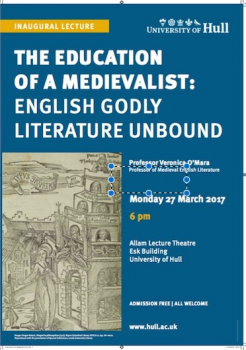
In the course of her inaugural public professorial lecture at the University of Hull on Monday 27th March, Professor Veronica O'Mara remembered affectionately the Presentation Sisters who had taught her in Ireland; quoted from Cardinal Newman's definition of a liberal education in his Idea of a University, and traced out her own distinguished contribution to the advancement of
Professor O'Mara informed her audience that the 1503 illustration on the poster advertising the lecture was by the German Carthusian Gregor Reisch. It showed the eponymous Margarita philosophica ushering a student into university where a stratified tower depicted a hierarchy of learning and the complementarity of disciplines.
Professor O'Mara joked that her free, convent education provided a 'direct line to the Middle Ages'. It also provided a 'passport to freedom' and led to a place at University College Dublin which had been founded by Cardinal Newman.
Here she drew attention to the following passage, drily noting the cardinal's gender-exclusive language:
'It is a great point then to enlarge the range of studies which a University professes, even for the sake of the students; and, though they cannot pursue every subject which is open to them, they will be the gainers by living among those and under those who represent the whole circle. This I conceive to be the advantage of a seat of universal learning, considered as a place of education. An assemblage of learned men, zealous for their own sciences, and rivals of each other, are brought, by familiar intercourse and for the sake of intellectual peace, to adjust together the claims and relations of their respective subjects of investigation. They learn to respect, to consult, to aid each other. Thus is created a pure and clear atmosphere of thought, which the student also breathes, though in his own case he only pursues a few sciences out of the multitude. He profits by an intellectual tradition, which is independent of particular teachers, which guides him in his choice of subjects, and duly interprets for him those which he chooses. He apprehends the great outlines of knowledge, the principles on which it rests, the scale of its parts, its lights and its shades, its great points and its little, as he otherwise cannot apprehend them. Hence it is that his education is called "Liberal." A habit of mind is formed which lasts through life, of which the attributes are, freedom, equitableness, calmness, moderation, and wisdom; or what in a former Discourse I have ventured to call a philosophical habit. This then I would assign as the special fruit of the education furnished at a University, as contrasted with other places of teaching or modes of teaching. This is the main purpose of a University in its treatment of its students.'
Professor O'Mara paid homage to female academic pioneers in English, such as the first female professor of the subject, Caroline Spurgeon (1869-1942) who had researched her doctorate on Chaucer at the Sorbonne, and the medievalist Edith Morley (1875-1964) who really should have been the first but for gender politics, and who did a great deal to straddle the tedious philological-literary divide in the discipline.
Professor O'Mara noted the importance of the humanities, quoting with approbation: 'Without us, there would be no full understanding of what it means to be human.' She also noted that the study of sciences had begun in the Middle Ages via the studia humanitatis.
She showed an illustration from a 1439 Syon Abbey illuminated manuscript of St Brigitte of Sweden writing out the rule of her order, the Brigittines, but proceeded to insist that medievalists didn't spend all their time admiring illuminated manuscripts. Much time was spent deciphering manuscripts tout court.
She also warned against simplistic binary oppositions and artificial boundaries, remarking that there was no distinction between religious literature and 'literature' in the Middle Ages. Academics needed to be more adventurous in their terms of study, Professor O'Mara advised.
She had led an Arts and Humanities Research Council project to provide a 'repertorium' of all extant Middle English prose sermons, both in Latin and the vernacular, and said she had read every one in existence, noting that they had much in common with theatrical performance and were 'hugely significant in the development of written prose'.
Professor O'Mara was also a key collaborator in the Nuns' Literacies in Medieval Europe project, which provided crucial textual evidence of female literacy. She recalled that she had become tired of seeing Christine de Pizan on covers of books which had nothing to do with her and tired of the lack of interest in nuns by male historians.
Professor O'Mara showed a slide which demonstrated how her painstaking forensic palaeographic scrutiny had enabled her to establish the identity of a scribe as Mary Nevel who had entered Syon Abbey around 1538. (A conversation after the lecture suggests that there is now only one surviving sister in England of this celebrated 'coroneted' order which has contributed so much to the Catholic culture of the country.)
Some 90 scholars worldwide are participating in the Nuns' Literacies project and Professor O'Mara spoke of a forthcoming development which would involve a network spanning Bristol, Hull and Antwerp universities, and the Centre for Monastic Studies at Downside.
With a nice nod to Hull, currently the UK's City of Culture, Professor O'Mara showed a slide of John Alcock, Bishop of Ely, preaching. Bishop Alcock was the son of a Hull merchant. This image, first printed in 1496, was 'the first genuine portrait in an English printed book,' said the professor. She proceeded to show a page from the Sermon on the Death of Margaret Beaufort (d. 1509), the mother of Henry VII, which had been preached by her dear friend Bishop John Fisher of Rochester who was a relative of John Alcock and who hailed from nearby Beverley. Fisher was later martyred for championing Katherine of Aragon and opposing Henry VIII's declaring himself Supreme Head of the Church in England.
Professor O'Mara concluded with an eloquent plea for patience. 'Research develops incrementally; good scholarship can take a long time,' she said, and noted, finally, that a phrase most famously associated with Isaac Newton, 'If I have seen further, it is by standing on the shoulders of giants,' was first attributed to the twelfth-century Bernard of Chartres ('nanos gigantum humeris insidentes') who was expressing his indebtedness to the learning of the Ancients.
 Facebook
 Twitter
 LinkedIn
 Print
Print Email
Email















 Facebook
 Twitter
 YouTube
 LinkedIn
 Pinterest