

Water from rocks - Seven days in Turkana
We are flying over vast, dry brushland in Turkana, Kenya. The harsh landscape is interlaced by dry rivers parched by drought. Suddenly, we see a few turquoise roofs as our little plane approaches the landing strip.
"That is our school" says Lillian Omari, who is seated next to me in the little Cessna. Lillian is the principal of the newly established school in the mission.
A gift from a donor, the plane is brought to a perfect landing by Fr Antonio Aguirre, the head of the Nariokotome Mission of the Missionary Community of St Paul the Apostle (MCSPA). On his right is Fr Avelino, who oversees pastoral work in the mission and the surrounding villages. My wife Jill and our son Trevor complete the passenger list.
"Hello and welcome to Nariokotome!" beams Patrizia happily as our luggage is loaded onto her pick-up by her equally friendly assistants. We learn soon enough, that everything in this remarkable corner of the world is exceptionally warm - our hosts, the villagers, the weather.
When the mission was founded in 1987, this was an undulating, rocky and barren site - unclaimed and unwanted. The thirsty land is now quenched with water from wells, bore holes and dams built by the mission. We pass the women's quarters and marvel at the plots of kale, kangkong, tomatoes, lemons, sorghum, dates and watermelons. Donkeys, cows, goats and poultry complete the irresistible comparison to an oasis brimming with activity, people, and life.
In the late afternoon, Lillian takes us on a walking tour of the mission. The 20 missionaries and 60 staff members provide nutrition, water facilities, healthcare, education, and pastoral care to about 35,000 villagers living in the 3,600 sq. km surrounding the mission. Located 3.5 hours away by road from the nearest town Lodwar, the mission strives to be self-sufficient in food, electricity, water, construction, carpentry, and even vehicle repairs. Even nuts and bolts are forged in their own metal workshops.
We hop onto Fr Avelino's truck the next morning, bound for Kokuselei village, 35 km away. He makes a few stops along the way to pick up his altar servers, assistants and finally, a group of boisterous boys, eager to attend Mass in the village. There are too many boys and some are disappointed, waving dejectedly as the truck leaves them at the gates.
Along the way, we pass manyattas (Kenyan huts), herds of grazing camels, goats, sheep, donkeys, giant termite pillars, and young shepherds and herdsmen, barely in their adolescence.
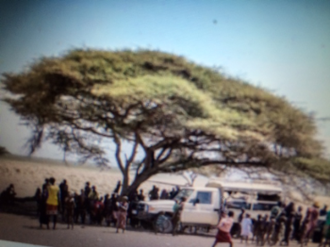
We arrive at Kokuselei and look for the village church - it is a large tree, its branches outstretched in welcome. The village congregation is waiting in its shade, seated on pews of tree trunks and rocks. They are resplendent in their Sunday best - colourful native costumes with elaborate beaded necklaces. Our dowdy T-shirts and shorts fail miserably to meet their parish dress code.
Our first Turkana Mass soon erupts with rhythmic singing and dancing to the beat of bongo drums. The joyful passion and fervour of the congregation is infectious and never recedes. This is the Mass, gloriously celebrated in the fullest sense of the word. Worship the Lord with your whole heart, soul, mind and strength, and let us not be reticent. Trevor and I try our best to accompany the singing with our guitars, tripping over the unconventional time signatures and melodies, and inviting curious stares from our hosts.
The following day we attend Mass in the nearby village of Nachukui. Words cannot describe the ethnic majesty of their church (which has been beautifully decorated).
A new Kenyan dawn brings us to the mission dispensary. We stroke a newborn baby, barely a few hours old, as his mother looks on proudly. Outside, the queue begins to form.
George, the nurse in charge, gives us a mini tour of both the existing and newly completed facilities. His mobile medical team loads the truck with vaccines, medicines, huge record books, and some folding tables. We hop onboard. Trevor is a trained combat medic. Jill is a trained teacher and brings some craft to occupy the children. I am none of the above so I bring my guitar.
We arrive at the village of Annam and learn that you do not need a building or room to operate a clinic. All you need is a shady tree, a weighing scale from a low branch, 2 tables, a cooler box of medicines and a heavy dose of dedication.
For our second trip with the mobile clinic we travel 41 km with Fr Andrew, Scholastica and the medical team to the MCSPA mission in Todonyang and across the border into Koro, an Ethiopian village. The Todonyang mission was established by MCSPA in 2006 in the throes of armed conflict between the Turkana in Kenya and the neighbouring Dassanech in Through the intercession missionaries, led by Fr Francis Teo and his successor Fr Andrew Yakulula, the once bitter enemies now worship at the same church and their children study side by side in the same school. While peace has prevailed in recent years, the painful memories of war are still fresh, and lend a palpable tension to the area.
Our tea, biscuits and happy banter at the dining hut in Todonyang are suddenly interrupted by the rat-tat-tat of an automatic weapon coming from the perimeter of the mission compound. We freeze. Outside in the grounds, the well-trained mission staff have already taken cover. We glance nervously at our hosts for cues.
"It is ok", they say calmly, "there is no return fire". Pass the biscuits.
We make the short trip to Koro, the Dassanech village across the border. The village is large but the hygiene and living conditions do not match those in the Kenyan villages.
While the medical team tends to the sick, we accompany Fr Andrew to the village chief's manyatta.It is a fragile peace, still raw with the memory of the last fatal skirmish just a few years ago. They are trading with the Turkana now. Maybe money can root out some evil.
Back in Todonyang, we watch and listen in awe as the children of the Dassanech and the Turkana, once bitter foes, sing in harmony, as one school choir, as friends.
The wolf shall dwell with the lamb, and the leopard shall lie down with the young goat ... and a little child shall lead them. War is cheap and can be had with a mere flick of the trigger finger. Peace is hard-won and wrested from years of unflinching faith, dogged patience and shrewd diplomacy. Blessed indeed are the peacemakers.
It is evening, and we are back at Nariokotome, basking in the crown jewel of the whole mission - the Church of St Paul The Apostle. Eight years in the making, its elegant natural beauty is as breathtaking as it is indescribable. These pictures do not do it justice:
We spend two days in Lillian's school. There are 200 children in five classes from pre-school to Grade 3. Despite having to walk 10km or more to school they are still energetic and restless.
On our last day at the mission, the children are treated to a puppet show by their teachers and mission volunteers.
Patrizia and her team arrive with fresh milk from the mission's cows. There is a nutritional programme for the children. Many parents send their children to school just to be fed. Nourished in body, mind and soul, the children receive more than they have bargained for.
There many other schools and nutritional units run by the mission. Education is one of the surest ways to break the poverty cycle.
On one of our road trips, Scholastica points out a few empty school buildings built by the government. While the mission's schools are bustling with activity, these government schools have been abandoned for lack of a water source.
"First you find the water," says Scholastica, "then you build the school, the nutritional unit, the mission."
The book of Exodus recounts how God brought forth water in the desert for his chosen, by making Moses strike a rock.
Here in this parched, impoverished brushland of Turkana, water and indeed life itself, bursts forth from the many rocks struck by the MCSPA. Here surely, is God's plan relived and retold for the people of Turkana.
If you would like to read the original version of this article - with lots of beautiful pictures- see: http://mcspa.org/water-from-rocks-seven-days-in-turkana-by-wilson-wong/
To make a donation to the work of the MCSPA, see: https://mydonate.bt.com/charities/newways
 Facebook
 Twitter
 LinkedIn
 Print
Print Email
Email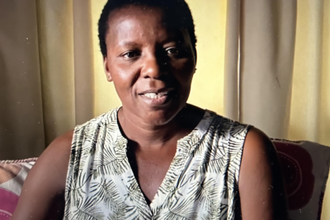







 Facebook
 Twitter
 YouTube
 LinkedIn
 Pinterest