

Book: Unravelling DNA
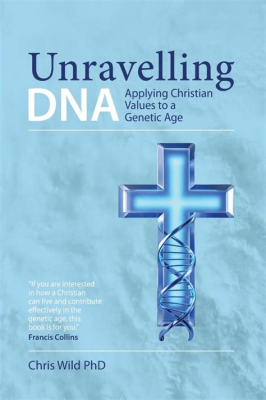
Unravelling DNA: Applying Christian Values to a Genetic Age by Christopher Paul Wild, published by GBG Books.
Professor Chris Wild, a practicing Christian, was formerly Director of the World Health Organization's cancer agency. He kindly gifted me a copy of his book, Unravelling DNA, and invited me to provide a Catholic perspective.
Wild's book aims to first explain, in simple language, the state of genetic technology; and then to look at the ethical issues arising. Each half of the book divides into four categories. Genetic technology can be used to read, copy (clone), edit and store (database) human DNA. These techniques all have implications for our relationships with ourself, our families, wider society and with nature. As an active researcher, Wild himself was confronted with the question of "how far can I go" in working with human cells and genetic technology.
As an introductory-level primer to the technology and the ethical issues arising, Wild does well. He wears his Christian faith with a light touch - though occasionally tipping his hand to reveal personal stances - with most of the moral issues raised being valid concerns regardless of one's religious affiliation. There is perhaps evidence of a bias of faith over science in his assertion (pp92-95, 111) that the human brain represents a 'step change' from our predecessor primates, and that when Jesus took on flesh, it matters that he took on 'this kind of brain'. As a scientist, I am wary of claiming a step change emerging from any gradual development of DNA. As a Catholic, I am worried that we might logically deny human dignity to a human offspring suffering genetic damage affecting precisely those brain characteristics? An anencephalic child is not what Jesus was, but we still honour it as human.
Wild's aim is to look at general ethical issues, not to highlight the particular views of religions or denominations. So there are few references to Catholic teaching, though he does briefly consider the development of teaching in Christianity and Islam about the changing status of the embryo as it goes from 'unformed' to 'formed' (an important distinction in Exodus 21:22-25). He does not reference Catholic Social Teaching per se, but takes a similar trajectory of applying the Golden Rule and concepts of stewardship to wider society. He also occasionally notes Christian influence on European values without adding a wider global perspective.
Ethics often suffers from grey areas. As a physicist I know that many problems can be reduced to 'ideal cases' for practical purposes. Two billiard balls bounce off one another with a satisfying click. But that click is not instantaneous (nothing physical ever is) and were you to zoom in to the atomic level, that clean bounce becomes a momentary slowing and repulsion due to a myriad of electrons. Even the attempt to replace the 'moment' of bouncing with the inflection point of a smooth curve of repulsion becomes frustrated by the intrinsic fuzziness of space and time at the quantum level. Zoom out, and it's a clean click. Zoom in too much, and you can't distinguish 'before' and 'after'. Between two certainties is always a boundary layer of uncertainty; but when it comes to human dignity, the uncertainty deserves the benefit of the doubt in the direction of protection. So while we recognize that we could ask 'does fertilisation mean sperm-meets-egg, male zygote fuses with nucleus, or first division?' the conservative answer is that protection applies the moment sperm meets egg.
One curious omission from Wild's introduction to cloning was any mention of immortalized cell lines. Naturally mutated cells taken without consent from Henrietta Lacks in 1951 proved to have an unusual capacity to reproduce without tiring. These 'HeLa' cells have now been used in medical research for 75 years, raising issues not only of consent (Lacks was not asked) but of the privacy of her descendants, whose genome can be partially inferred from published studies sequencing certain HeLa strains. Among other cell lines, HEK 293 cells derive from a foetus, possibly aborted, in 1973. Other cell lines commonly used in medical research, such as WI38 and MRC5, also derive from abortions in the 20th century and while abundant, will eventually die out, possibly requiring new foetal tissue. The issues around consent, access to knowledge, and the possible 'requirement' for occasional resupply of foetal tissues are significant, even absent the Catholic aversion to abortion.
The question of species is also treated quite lightly, and a little more depth would be desirable. Wild expresses the opinion that breeding tigons, ligers and mules (oh my!) would not violate the Biblical commandment against the mixing of 'kinds', but does not gives reasons. He documents the first human embryo created by somatic nuclear cell transfer in 2001, but does not mention the 1998 achievement of placing the nucleus of a human cell into a cow's egg, which arguably has the greater moral significance. And he makes a passing comment about 'human genes' in the chapter on genetic engineering of the natural world, which again merits a more nuanced definition. Are these genes which happen to be only found in human beings, or are they genes which cause us to display features which make us distinctively human? The Bible assumes creatures exist in 'kinds'. Our genetic understanding treats DNA as an alphabet and genes as a dictionary, such that any sentence which makes sense produces a viable organism, and our classifying things into 'species' is primarily a way of grouping sentences with common features (which in most cases is a sign of common origin).
Distinct from genetic engineering is the creation of chimeras, where actual cells from one embryo are placed into the embryo of another species, usually in locations expected to become particular organs or regions of the body. Wild expresses reservations about whether human embryonic cells should ever be used in this way (elevating the 'specialness' of human beings over the distinctiveness of two animal species from each other) but makes no comment about whether the specific creation of human brain tissue would be a particular red line, despite his earlier claims for a 'step-change' in evolution concerning our brains. Nor does he mention the possibility of human stem cells migrating into the brain of a chimera intended to grow only a particular human organ.
From a Catholic point of view, many genetic technologies are forbidden. The Catholic Church says NO to any destructive testing of human embryos, and NO to any techniques reliant on conception taking place outside of natural marital intimacy. Many observers can sympathise, if not agree, with the Catholic stance that as soon as conception takes place, an entity has everything necessary and sufficient to become a distinct human, and must therefore be treated as a protected person even allowing for the possibility of twinning or mosaicism. Fewer would intuitively agree with the Catholic ban on IVF, especially where the intention is to create life exclusively from the gametes of a married couple without disposing of any viable embryos. In dealing with the social consequences of genetic selection or engineering, Wild fails to mention that in some societies where it is expected or enforced that you should screen out unhealthy embryos, Catholics and others with a religious or moral objection to IVF (as well as to abortion) would become an oppressed underclass. Only true believers will raise children with congenital disabilities - likely attracting opprobrium for being a 'drain on society'.
If a similar book were written from a Catholic point of view, it would need to deal with a world where these techniques will be used, ahead of and against laws, as well as where states have made lawful what Catholic teaching considers against God's law. So all of the general issues Wild considers will still be highly relevant. However, a Catholic text might divide out or at least highlight what would be permitted for Catholics. There is no fundamental problem with somatic gene therapies, nor with treating a foetus in the womb. Even germline therapy is not forbidden in theory, as long as the safety case is proven. Inducing pluripotency in cells seems within limits (though developing neural tissue might not be); if it became further possible to induce totipotency, that would be a red line.
Wild's book, in summary, provides a helpful summary of the state of the art concerning what we can do now and what we will likely be able to do a generation hence. As a British author, his book reflects the state of the law in the UK, though also with awareness of US practices. It provides a Christian perspective on many ethical issues, focussing strongly on social consequences. For Catholic use, it would benefit from supplementary material to supply the formal teaching of the Magisterium. However, Rome has less to say about the social impact of those techniques it forbids, and in this area, Wild's text is a useful complement. I was slightly unsettled by the stylistic choice to not italicize titles of any books or articles cited, which made citation-heavy sentences harder to read; but on the whole, this book is a useful addition to a studious Catholic's library. It should, of course, be stored and read without unethical duplication or editing!
Professor Wild was given first sight of this review; in the light of his feedback, one factually incorrect sentence was removed and minor grammatical changes were made.
Dr Gareth Leyshon is a Catholic priest of the Archdiocese of Cardiff who holds a doctorate in physics from Cardiff University. He serves as a parish priest in South Wales and is involved in evangelism and bridging science and faith.
 Facebook
 Twitter
 LinkedIn
 Print
 Email










 Facebook
 Twitter
 YouTube
 LinkedIn
 Pinterest