

Gospel in Art: When you see Jerusalem surrounded by armies
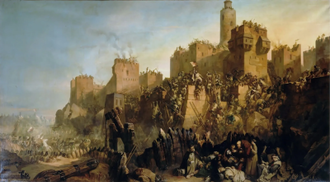
The taking of Jerusalem by Jacques Molay in 1299, by Claude Jacquand, 1846 © Musée de Versailles, Paris
Source: Christian Art
Gospel of 26 November 2026
Luke 21:20-28
At that time: Jesus said to his disciples, 'When you see Jerusalem surrounded by armies, then know that its desolation has come near. Then let those who are in Judea flee to the mountains, and let those who are inside the city depart, and let not those who are out in the country enter it, for these are days of vengeance, to fulfil all that is written.
'Alas for women who are pregnant and for those who are nursing infants in those days! For there will be great distress upon the earth and wrath against this people. They will fall by the edge of the sword and be led captive among all nations, and Jerusalem will be trampled underfoot by the Gentiles, until the times of the Gentiles are fulfilled.
'And there will be signs in sun and moon and stars, and on the earth distress of nations in perplexity because of the roaring of the sea and the waves, people fainting with fear and with foreboding of what is coming on the world. For the powers of the heavens will be shaken. And then they will see the Son of Man coming in a cloud with power and great glory. Now when these things begin to take place, straighten up and raise your heads, because your redemption is drawing near.'
Reflection on the painting
The new millennium in 1000 AD brought a lot of disappointment in Christendom. Many scholars at the time had predicted the return of Jesus Christ, assuming this would happen roughly one millennium after his birth. As nothing happened in 1000 AD, they then next expected it might happen around 1030-1035 CE, a millennium after His death and resurrection. But, again, nothing happened. All these predictions proved wrong. Then generation of Popes expressed that the Messiah failed to return maybe because Jerusalem was in the hands of the Muslims. So the crusades started with the objective of recovering the Holy Land from Islamic rule. In 1095, Pope Urban II proclaimed the First Crusade at the Council of Clermont.
Our painting depicts the battle of Jerusalem that never was. The painting was commissioned in 1846 following French rumours and a legend that hailed Jacques Molay as having captured Jerusalem in 1299. In reality, after Jerusalem was lost in 1244, it wasn't under Christian control till 1917, date at which the British Empire took it from the Ottomans. In our Gospel reading today, Jesus gives His prophetic description of the end of time and the destruction of Jerusalem. Indeed in just under 40 years after Christ's death and Resurrection, Jerusalem was sacked destroyed by the Roman armies. Jerusalem has been attacked 52 times, captured and recaptured 44 times, besieged 23 times, and destroyed twice.
The purpose of Christ's words about Jerusalem in today's Gospel is to help us look towards eternal life. The city's long history of siege, destruction and rebuilding teaches us how fragile even our greatest cities and achievements can be. Generations have fought to possess its walls, yet every conqueror has eventually passed away. We too can spend our lives trying to secure things we cannot keep. Jesus invites us to consider what will endure when everything we cling to is taken from us. The love we have given, the mercy we have shown and the faith we have lived can all be taken to the next life. So that is what our focus should be on.
Our painting, Jacques de Molay Takes Jerusalem, 1299, was completed by Claudius Jacquand in 1846 for the Crusades Rooms at Versailles. Holding a banner, the Grand Master of the Knights Templar rallies his warriors as they storm Jerusalem's citadel in the light of dawn. The scene has all the drama of a decisive historical moment. Yet this victory never happened. Jacquand painted an account accepted by many historians of his day, which later scholarship exposed as a confusion of events and a legend. That makes the painting unexpectedly thought-provoking. We can be captivated by a stirring image and become certain of something that in fact has no foundation. As we contemplate this imagined conquest, we might ask whether the news and stories we believe in are actually even true.
LINKS
Christian Art: www.christian.art
Today's reading: https://christian.art/daily-gospel-reading/luke-21-20-28-2026/
Christian Art Conference 2026: www.indcatholicnews.com/news/56313
 Facebook
 Twitter
 LinkedIn
 Print
 Email








 Facebook
 Twitter
 YouTube
 LinkedIn
 Pinterest