


Gospel in Art: Saint Catherine of Alexandria, Virgin, Martyr
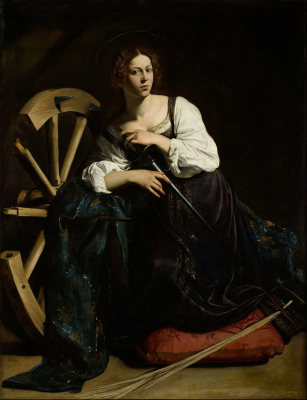
Saint Catherine of Alexandria, by Caravaggio 1598-99 © Thyssen-Bornemisza Museum, Madrid
Gospel of 25 November 2026
Luke 21:12-19
At that time: Jesus said to his disciples, 'They will lay their hands on you and persecute you, delivering you up to the synagogues and prisons, and you will be brought before kings and governors for my name's sake. This will be your opportunity to bear witness. Settle it, therefore, in your minds, not to meditate beforehand how to answer, for I will give you a mouth and wisdom, which none of your adversaries will be able to withstand or contradict. You will be delivered up even by parents and brothers and sisters, and relatives and friends, and some of you they will put to death. You will be hated by all for my name's sake. But not a hair of your head will perish. By your endurance you will gain your lives.'
Reflection on the painting
Saint Catherine of Alexandria is one of the great virgin martyrs of the early Church, who lived in the late 3rd and early 4th centuries, during the reign of Emperor Maxentius (he would eventually be defeated by Emperor Constantine at the battle of the Melvin Bridge in 312AD). Born of noble lineage and renowned for her eloquence, Catherine converted to Christianity after a vision of the Virgin Mary and the Child Jesus. When she confronted the emperor Maxentius for persecuting Christians, her wisdom was so compelling that she reportedly converted many of his philosophers and close aides. Furious, Maxentius ordered her imprisonment and torture; when the spiked wheel designed for her execution miraculously broke apart, he finally ordered her beheading. The "Catherine wheel" would later become her enduring symbol, not of destruction, but of divine triumph over worldly power.
In art, Catherine is often depicted as a regal young woman crowned and holding a palm of martyrdom, with the broken wheel (the intended instrument of her martyrdom) featuring sharp spikes and a sword at her side (her actual instrument of martyrdom). She stands as a figure of luminous intellect and courage, a saint who dared to speak truth to power. Her story reminds us that faith and reason are not enemies, but companions on the journey to Truth: using our intellect to grow in faith and witness our faith.
Our powerful painting by Caravaggio is a remarkable fusion of martyrdom iconography, stark realism, and devotional intimacy. In our painting we see Saint Catherine richly dressed, kneeling on a cushion, her gaze meeting ours. At her side lies the broken spiked wheel and the sword of her martyrdom. Caravaggio's characteristic chiaroscuro heightens the drama; the saint emerges from a dark background under a strong, almost cinematic light.
Caravaggio chose as his model the notorious Roman prostitute Fillide Melandroni, a woman he was deeply infatuated with and who brought both inspiration and turmoil into his life. Her striking features captivated the artist, and she would go on to model for him again in future works. Fillide was both Carvaggio's muse and lover, and ultimately enemy as well. While her documented personal life was entangled with arrests and scandal (accusations of solicitation, carrying weapons, and conflicts with many political figures), in the paintings she is almost transfigured. We only see her in pure beauty and elegance. In that way she embodies many heroines, lifting images of controversy, into images of redemption.
LINKS
Christian Art: www.christian.art
Today's reading: https://christian.art/daily-gospel-reading/luke-21-12-19-2026/
Christian Art Conference 2026: www.indcatholicnews.com/news/56313
 Facebook
 Twitter
 LinkedIn
 Print
 Email











 Facebook
 Twitter
 YouTube
 LinkedIn
 Pinterest