


Shakespeare's Cousin: Moore's Brightest Heaven of Invention thrills and inspires
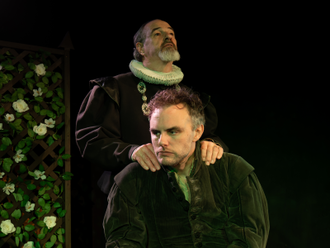
Robin Kingsland and Danny Solomon as Richard Topcliffe and St Robert Southwell
I ascended to the Upper Room of the White Bear Pub in Kennington, London, to see the World Première of Shakespeare's Cousin, written and directed by Jonathan Moore - symbolically, a felicitous location for this deeply moving, superb new play about Shakespeare's kinsman, the great poet and martyr St Robert Southwell.
A polar bear lived in the Royal Menagerie at the Tower of London when Shakespeare wrote The Winter's Tale, perhaps inspiring the world's most celebrated stage direction: 'Exit, pursued by a bear.'
The Winter's Tale examines the disastrous consequences of blinkered patriarchal delusion, paranoia and hardness of heart, and such themes lie at the heart of Moore's prophetic drama.
The audience arrives to a melodious Elizabethan song - actually Byrd's 'Why do I use my paper, ink and pen' - whose lyrics are a tribute to the martyrs by one who would join their ranks, St Henry Walpole. Two gents enter the scene. Birdsong fills the air.
We are in a garden - a place of peace and sanctuary. The host offers his guest hospitality: bread, cake and milk. But beware of hypocrisy in this mime of mortal life.
The seemingly urbane host is none other than the sadistic priest-hunter, Sir Richard Topcliffe, and his guest, clearly famished when presented with the victuals, his long-sought prey, Robert Southwell, SJ.
The brilliant Southwell, who had walked to Rome from Douai while still a teenager to join the Society, was in the third wave of the perilous Jesuit mission to Elizabethan England when priests and faithful were persecuted for treason.
Now, after a six-year pursuit, the gloating Topcliffe has his prey. Robin Kingsland delivers a masterclass in interpretation of this psychopath. He is vain and egotistical; sentimental, thin-skinned, yet bereft of empathy. He harbours daddy issues and an inferiority complex but also a burning sense of injured merit. The theatre-hating Topcliffe is an intolerant Protestant fundamentalist who cannot bear the idea of Southwell praying for his dead son due to his rejection of the doctrine of Purgatory.
In a lovely touch, he is also exercised by a wily fox trespassing in his garden. In contemporary polemical writing, foxes were Catholic priests who dared to trespass in the garden of England.
As a part-time scribbler, prone to obscene rants, he cannot compete with the 'greatest poet in England' in his clutches but consoles himself in his own house's basement torture chamber of horrors such as the scavenger's daughter, thumbscrews, rack and manacles. He rehearses their mechanisms and torments with an exacting, prosaic glee, and dubs himself 'a Petrarch of pain.'
He recounts his ravening pursuit of Southwell and his knowledge of the networks of missionary priests and the safe houses of Catholic England such as Baddesley Clinton where St Nicholas Owen SJ's priest holes saved Southwell from capture.
Danny Solomon plays Southwell with a beautiful sensitivity. His warm, mellow voice complements perfectly his generosity of spirit. He is compellingly Christ-like in his dignified restraint, silence when necessary, and suffering - uttering 'Ad maiorem Dei gloriam' as a reply to the barrage of Topcliffe's questions, not least when under excruciating torture.
The image and sound of Solomon's anguished scream will remain with me, as evocative in its horror as one of Francis Bacon's screaming Popes.
Southwell was eventually moved from Topcliffe's domestic private torture chamber to the Tower of London as 'befitting' a gentleman. But there the tortures continued, just as they did for St Henry Walpole SJ (author of Byrd's opening song) whose screams could be heard directly overhead.
Topcliffe further twists the psychological knife, mocking Southwell's priestly celibacy and unleashing a 'pudenda'-obsessed rant which culminates in his revelation of the torture, rape and impregnating of Anne Bellamy, all to establish Southwell's whereabouts prior to his arrest.
Moore's Southwell, for whom all human life is sacred, is horrified by Topcliffe's vicious misogyny and hatred.
In a coup de théâtre, he receives a visit from Sir Oliver, a mysterious hooded Protestant Divine, who, he is told, has come to confound his Papist Error.
But Sir Oliver is none other than Southwell's kinsman, that 'double-dealing ambodexter' William Shakespeare - to adopt the language of contemporary anti-theatrical Puritan polemicist Philip Stubbes.
Scholarship has long established Shakespeare's Catholic heritage and a crucial Catholic discourse in his work. And scholars have also persuasively argued both the familial ties between the two poets and examined the influence of Southwell's devotional poetry on Shakespeare's work.
Moore's Shakespeare (played with a restless energy and intensity by Alexander Townson) has crypto-Catholic friends in high places who have made this daring, shape-shifting visit possible. (Sir Oliver Martext will later appear of course in As You Like It.)
A hugely moving reunion follows and Moore's superb script dazzles in its breadth of reference to Shakespeare's and Southwell's works, Renaissance scholarship, Tudor humanism, Ignatian spirituality, and ingenious invention.
The two poets range from joy to recrimination and despair. Shakespeare resents having been identified by Southwell in an attack on profane poetry (his Venus and Adonis) while Southwell bridles at being impugned by association with the egregiously named necromantic priest Sir John Southwell in 2 Henry VI.
While the Catholic Shakespeare grapples with the mortal dangers of Elizabethan England, Southwell laments this very England's destruction of itself, not least through the desecration of iconoclasm and the destruction of a whole network of charity in the dissolution of the monasteries.
Earlier, we saw Topcliffe's pride in his Edenic English garden but Moore's Southwell paraphrases Gaunt's dying speech to show how the realm of England, 'this other Eden', hath made a shameful conquest of itself.
This is just one example of Moore's thrilling and inventive engagement with Shakespeare's dramaturgy and his capacious conception of how Shakespeare's ever opportunistic 'shaping imagination' was formed.
Persuasively, he casts both kinsmen-poets as reform-minded critics of Rome's abuses and warmly compassionate humanists. Let us not forget, for example, Thomas More's speech delivered to quell a race riot and protect migrants, written in Shakespeare's own hand.
To the ethereal music of Brian Eno's Ascent, Southwell recounts a Good Friday vision of Christ walking to him over the Thames, the nails of his Crucifixion multiplied into glorious shards of light. With Ignatian discernment, he blesses Shakespeare's creative dramatic genius which, as contemporary Thomas Nashe observed, satisfied a famished spiritual and ritual hunger in the English soul.
Shakespeare emerges inspired and faithful to his cousin's ministry, staying with him in his agony at the hour of his terrible death - when there was no roar at the brandished head of a traitor.
To return to The Winter's Tale, the bear materialises at the crisis of the play when the winter of hate is at its peak - but in accordance with seasonal lore, the bear's emergence from hibernation at this time ushers in the spring. And so Leontes the tyrant's hardened heart melts as he undergoes a 'saint-like contrition'. It is required that he 'awakes his faith' so that that which was lost might be found and a reconciliation with a beloved soul, long believed dead, might be realised. A statue moves and there are tears of joy.
Earlier in the play, a 'tongue-tied' queen spoke words of reason and charity and provoked an inadequate man's rage and ire.
Topcliffe is confounded at the silence of the crowd at Southwell's death. His narrow, implacable, imperialist mind is defeated by the capacious, loving spirit of Southwell and the glorious reconciliation and humanity of Shakespeare's late plays which Moore anticipates here with a gloriously joyful and dynamized Shakespeare ending his play with Prospero's lines: 'As you from crimes would pardoned be, /Let your indulgence set me free.' Loving solidarity, empathy, charity and mercy must prevail over hate.
Contending with brutal censorship and the danger of death, Shakespeare had to 'by indirections find directions out.' And here in our contemporary, hypocritical world, where AI surveillance is rife, where so many power-wielders deny torture and genocide in Gaza, and are enmeshed in the same, where the Other is scapegoated and truth-speakers demonised, Moore has composed both a beautifully written, complex warning from history, full of passion, faith, wonder and empathy, and a crucial, prophetic, state of the nation play. He, like Shakespeare and Jesus, is on the side of the oppressed.
Shakespeare's Cousin runs at the White Bear Theatre, Kennington, London, from 10-28 November 2026, Tuesday to Saturday at 7.30pm. You can buy tickets here.
LINK
ICN April 23 2016: Shakespeare's 'eternal summer shall not fade'
 Facebook
 Twitter
 LinkedIn
 Print
 Email
















 Facebook
 Twitter
 YouTube
 LinkedIn
 Pinterest