


Walking together in hope and peace: Christian-Muslim dialogue in Bangladesh

Fr Joseph Victor Edwin SJ
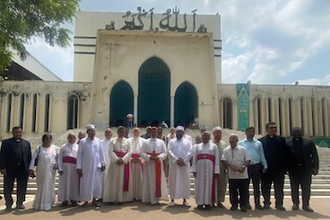
The Catholic Bishops' Conference of Bangladesh, in conjunction with and supported by the Holy See, and the Henry Martyn Institute, Hyderabad organised a three-day seminar on Christian-Muslim Relations entitled "Understanding Islam Through Dialogue: Walking Together in Hope and Peace" for clergy, religious sisters, and lay leaders who serve as members of diocesan Commissions for Interreligious Dialogue and Ecumenism from October 15-18, 2026, at the CBCB Centre in Muhammadpur, Dhaka, Bangladesh. The seminar attracted approximately 90 active participants.
Professor Waheedulla and I received invitations from Archbishop Kevin Stuart Randall, the Apostolic Nuncio to Bangladesh, and Archbishop Lawrence Subrata Howlader, the Archbishop of Chattogram and chairperson of the Episcopal Commission for Christian Unity and Interreligious Dialogue in Bangladesh, to serve as resource persons for the seminar.
Throughout eight sessions of one and a half hours each, we presented Islam as a lived human phenomenon, employing Shahab Ahmad's conceptual framework: (cf. What is Islam: The Meaning of Islamic) Islamic Faith, Beliefs and Practices of Muslims across cultures, with particular emphasis on the mystical dimensions of the religion and its adherents. Both of us underscored the profound spiritual journey of Muslim believers as they progress through _Islam_ (external practices), _Iman_ (interior faith), toward _Ihsan_ (the endeavor to shape one's life according to the Qur'an and the Prophetic example). The seminar's distinctive strength derived from our complementary perspectives: I, a Catholic priest and scholar specializing in Islam and Christian-Muslim Relations, shared insights from my personal experiences with Muslims, while my colleague, a Muslim scholar, offered authentic testimony from within his own religious context. This particular dynamic transformed the seminar from a mere informational program into a genuinely lived experience.
In my presentation addressing Christian-Muslim Relations through the lens of Vatican II, particularly drawing upon Nostra Aetate and the subsequent documents Dialogue and Mission and Dialogue and Proclamation , I encouraged participants to identify contextually appropriate approaches for fulfilling their missionary vocation-namely, bearing witness to Christ's love among their Muslim neighbors through peaceful and courageous engagement. My colleague Waheedulla articulated the Qur'anic perspective, emphasizing that while religious traditions remain distinct from one another, the sacred text mandates adherence to one's received revelation and respect for the beliefs of others. The seminar incorporated structured group discussions addressed questions in Dialogue and Christian-Muslim Relations, with subsequent plenary presentations of these deliberations.
A significant concern that emerged from the group discussion presentations and ensuing dialogue pertained to the precarious circumstances confronting religious minorities in Bangladesh, particularly those encountering Muslims affiliated with Jamaat-e-Islami (JI) ideology, which maintains a demonstrably antagonistic stance toward Hindu, Christian, and other minority communities.
Jamaat-e-Islami, founded by Abul A'la Maududi in 1941, functions as a hierarchically structured, cadre-based organizational movement. The organization's foundational doctrine posits that Islam transcends the boundaries of personal faith, extending beyond individual spirituality and devotional practice to constitute a comprehensive ideological framework encompassing political, economic, legal, and cultural dimensions.
Accordingly, Maududi reconceptualized core Islamic observances (including Salah, Sawm, and Zakat) as transcending mere expressions of individual devotion; he construed them as formative mechanisms conditioning believers for participation in the establishment of an Islamic order (Iqamat-e-Deen).
Within JI's theoretical framework, an institutionalized Islamic state would mobilize governmental authority and juridical instruments to implement Sharia law comprehensively.
Critical scholars and secular analysts argue that instrumentalizing state power to enforce sharia necessarily introduces systemic coercion affecting non-Muslims, religious minorities, and Muslims who oppose theocratic governance.
In summary, we concluded that interfaith dialogue requires two fundamental prerequisites: profound grounding within one's own religious tradition and authentic appreciation for the faith systems of others. Moreover, comprehensive understanding of alternative faith traditions, coupled with sincere compassion for others grounded in the theological principle that all humanity bears the divine image and is therefore ordained for relational engagement, renders dialogue productive within the context of mission among diverse populations. A female participant emphasized that while dialogue may present challenges within certain sociocultural contexts, it constitutes an endeavor that God actively desires. Her observation profoundly affected me, as these formulations precisely echoed the language employed by the Jesuit General Congregation 34 regarding interfaith dialogue.
 Facebook
 Twitter
 LinkedIn
 Print
 Email














 Facebook
 Twitter
 YouTube
 LinkedIn
 Pinterest