


NAZA: Israeli officers admit to barbarism in Gaza
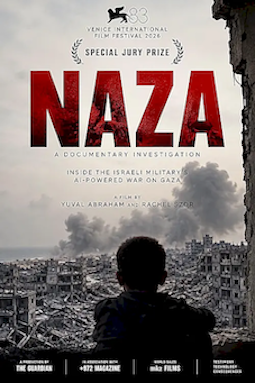
Israel has been committing a genocide in Gaza for three years - and those with the power to stop it have not done so, rather they have armed and abetted the genocide.
So much we know.
NAZA takes us to the executioners - 24 members of the IDF's elite intelligence corps. From the rooftops of Tel Aviv they impart their engagement in this carnage.
The film's single word title is a euphemistic military acronym ( the Hebrew Nezek Agavi) for collateral damage - a vague, impersonal, casual and lazy way of identifying all those innocent lives cruelly cut short, murdered, in fact.
This inspired title foregrounds the hateful dehumanisation of Palestinians which is at the heart of this tragedy. Like the Man of Sorrows, they are 'a thing thrown away.'
NAZA's co-director Yuval Abraham elicits the facts from his 24 military interviewees - who are speaking under the cloak of anonymity - with forensic aplomb. (And up to 100 sources were used in the corroboration of these.)
Yuval and many other dogged journalists have been reporting as much over the last couple of years but here the perpetrators baldly lay out the destructive details in their own words.
We learn that in the quest to eradicate members of Hamas, the IDF sanctioned the killing of first 15 and then 20 non-combatants, (and, staggeringly, up to 500 in one particular operation).
With a blanket surveillance of Palestinian telecommunications already in place, these intelligence officers deployed an AI-generated system (Code Lavender) in order to crunch the data and find their enemies.
If a Hamas fighter lived on the eighth floor of a block of flats, along with all his family, that block would be razed. Bombardments most frequently took place at night - when the foe was weakest, sleeping in the family home - compounding the destruction.
Unguided 'dumb bombs' would not spare surrounding buildings. In fact, these too were considered fair game, and in due course directives came to flatten entire neighbourhoods.
Some of the interviewees were troubled by their acts - troubled enough to testify in this film - but several displayed pride in their elite status, wriggled to extricate themselves from moral responsibility ('just a small cog' obeying orders) and displayed a sickening detachment from the mass human suffering they were inflicting with a blinkered focus on the job.
One spoke of a general hatred of Palestinians in the Israeli military but said that his cohort were not like that and had a reputation as 'leftists'.
The overwhelming impression was of weak individuals surrendering their consciences and critical judgements in bureaucratic compliance with a governing system. Hannah Arendt's phrase 'the banality of evil' came to mind - for here too was an industrialised slaughter.
One nervy interviewee was a compulsive sketcher of childlike images: the grids of buildings and neighbours identified by the AI system, and then destroyed. In a further image, he sketched 'stick men' (who were indeed starving) and described their implacable gunning down from afar as they ran to food distribution centres - apparently for erring from some arbitrary path.
Murderous drone attacks resembled a 'video game', and when Gazans were forced south, anyone left in the north, the sick and disabled among them, was considered 'fair game.'
At the heart of all the surveillance lay the smart phone. One interviewee confessed to listening in to the intimate daily lives of Gazans and hearing prayers, pillow talk and family moments. There was a clear recognition here of a common humanity - a life of the spirit and a life of love.
In a devastating pay-off, this man recounted how certain phones were meant to lead to Hamas fighters. Only his target had gone out without his, and he was left (to quote from the Massacre of the Innocents) hearing a mother 'weeping for her children and refusing to be comforted because they were no more.'
The high-rise interviews allowed the cameras to film surrounding apartment blocks. In an interesting development of the sinister surveillance theme, we saw individuals - it always seemed to be lone bodies - in their homes, most often in front of very large TV screens, watching the news. We heard nothing, just witnessed Edward Hopper-like scenes of anonymity with shades of film noir alienation and Orwellian dystopia.
Just a few kilometres away from the neon city, other blocks in Gaza, full of human lives, were pulverised to rubble.
The film mentioned the so-called miracle of Tel Aviv rising out of the desert then cut to footage of an earlier destruction of Palestinian buildings almost a century earlier. A lone Palestinian ruin was left standing in the hyper-modern metropolis.
In the final scene, all the previous bland comment and prevarication was confronted by a terrible scene of human agony and pain: bereaved family members confronted by the limbs of their loved ones, crushed under the rubble.
In his first encyclical Magnifica Humanitas, Pope Leo denounced the use of AI in war and urged its 'disarmament'. Insisting on the dignity of every human person, he asserted the right of peoples to exist, saying 'any attempt or plan to eliminate or subjugate a nation is gravely immoral and therefore unacceptable.' The incarceration, humiliation, ecocide and genocide of Gazans has also been identified as a remorseless example of necropolitics where despised Others are condemned as 'less than human' (as 'things despised and rejected' to evoke Isaiah again).
Consider these figures: 21,000 child deaths and 44,000 children maimed; 38,000 women and girls killed; the overall death-toll of known bodies is approaching 75,000. Ten percent of Gaza's population has been killed or injured.
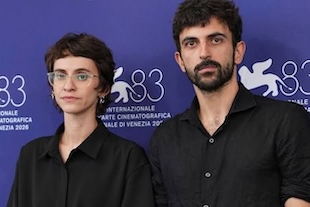
Co-directors Rachel Szor and Yuval Abraham received a 25-minute ovation at the Venice Film Festival and received the special jury prize for this crucial film. Benjamin Netanyahu has demanded that they be stripped of their Israeli citizenship. Their crime? Documenting monstrous crimes against humanity.
Everyone needs to see this film and everyone needs to do everything possible so that, for Palestine, Justice and Peace might come.
Editor's Note: One chilling scene that has stuck with me since I saw this film on Tuesday, was one anonymous member of Israel's Intelligence Corps explicitly describing the intense psychological high and detachment experienced while working within the military machine: "It's like your hormones are going crazy. You aren't sleeping and you're having fun. It's so insanely fun. You complete a mission and you're sharp and there's a sense of meaning. It's really enjoyable. We were fully in it."
Watch a trailer: www.youtube.com/shorts/vwnPh5sbiZ0
 Facebook
 Twitter
 LinkedIn
 Print
 Email


















 Facebook
 Twitter
 YouTube
 LinkedIn
 Pinterest