


Reflection on the Christian origins of Manchester City FC
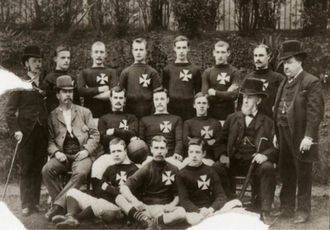
St Mark's FC West Gorton 1880
Starting in 2016 German magazine Der Spiegel began to spill football's putrid guts with the publication of millions of confidential documents (emails, contracts etc) acquired by a computer hacker.
The documents were a nefarious cocktail of greed, corruption and illegality - in which Manchester City (a club supported by several generations of my family) featured prominently. This is the infamous paper trail that led to the recent investigation and subsequent findings against the club in September 2026.
A half mile from the Roman Catholic Friary of St Francis, where my father's family worshipped, stood another church; St Mark's West Gorton. It was demolished in 1974, the year that Denis Law sent United down in the Manchester Derby at Old Trafford with 'that backheel' - although I understand there is no connection between the two events!
In the late 19th century, St Mark's became a remarkable agent of outreach under the leadership of the Rev Arthur Connell and his family. Their Christian dynamic was gifted a profound force by the area's squalor, poverty and injustice - conditions that had inspired Fredreich Engels to write his classic; 'The Condition of the Working Class in England'.
Manchester has a proud history of struggle, radicalism and collectivism - from the slaughter at Peterloo, to the Chartist, Suffragette and Trade Union movements' founding in the city.
In the once heavily industrialised east of the city - characterised by it terraced streets and cavernous factories employing tens of thousands, it was the cooperative societies, the trade union branches and the churches (including St Mark's and Gorton's much-loved Franciscans) that socialized, educated and gave the local working class it's political guardrails and moral bedrock.
Whilst at St Mark's, the Connells are credited with many charitable, educational, pastoral and socio-economic initiatives in the area.
Perhaps most graphically of all in January 1879, Anna Connell set up a soup kitchen and a relief fund for the unemployed, and for workers facing enforced wage cuts. In its first week it distributed over 1,500 gallons of soup, 1,000 loaves of bread and 10 tons of coal.
One year later in November 1880, the football club that would later become Manchester City FC was established at St Mark's.
Faith, collectivism and football would become the existential dimensions of many of Britain's great industrial cities - rendering working class life more bearable.
The contrast between the club's founding fathers and the current regime could not be starker.
Whilst much is made of the regeneration partnership between the city council and Manchester City's owner (Abu Dhabi United Group, ADUG) it has attracted criticism concerning transparency, profit-distribution, offshoring, public value for money and the scarcity of social, or affordable housing in the portfolio.
The current owners have leveraged their obscene wealth to create even greater wealth.
In both a sporting and business context they have indulged the human ego's deadly compulsion to domination and acquisition. In the final analysis, their wealth (and trophies) are all utterly meaningless.
Whilst men continue to prefer the glory that this world has to offer, civilisation will always be characterized by the greed, corruption, poverty and injustice that this 'tale of two city's' has encountered.
The founding fathers of Manchester City FC however gave from their poverty. As Catholic theology has it, their acts of love will endure in eternity, will never be forgotten or lost.
They served the city, and its people well.
Craig RA Hesketh
Greater Manchester.
 Facebook
 Twitter
 LinkedIn
 Print
 Email












 Facebook
 Twitter
 YouTube
 LinkedIn
 Pinterest