

Cardinal preaches on Chicago's legacy of welcoming migrants
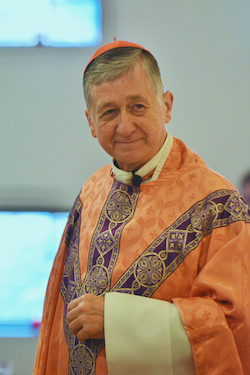
Cardinal Cupich Wiki Image
Source: Chicago Catholic
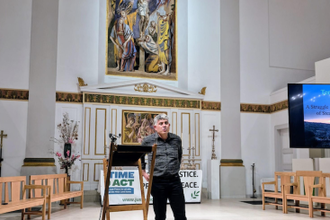
Cardinal Blaise Cupich delivered the following homily during the opening Mass at 'City of Welcome: A Teach-In on Catholic Solidarity and the Journey of Migration' at Old St Patrick's Church.
If you walk through the streets of Chicago, you hear the story of the entire world. You sense it in the rhythm of the L train, in the scents drifting from neighbourhood bakeries and in the languages spoken on our buses and parish steps.
From the early generations of immigrants who built our city's foundations and first parishes to the African American families who migrated north, to the more recent and vibrant Latino and Asian communities that are redefining our neighbourhoods and filling our pews today - Chicago is a city woven from the courageous journeys of people who share so much in common, looking for a place to build a life and have a fresh start for their families. We can be proud of this legacy, and I am delighted to be with you to celebrate Catholic solidarity in this "city of welcome" and reflect on our common journey of migration.
Yet, we cannot ignore the truth that the spirit of welcome and a common journey with newcomers has been greatly diminished in our country. The US bishops did not hesitate to describe the current situation in clear and precise terms last November when we met in Baltimore.
We spoke of the climate of fear and anxiety created by profiling and inhumane immigration enforcement, the vilification of immigrants, the hazardous conditions in detention centres, the lack of access to pastoral care, the abrupt and arbitrary loss of legal status, the threats against the sanctity of houses of worship and the special nature of hospitals and schools and the separation of children from their parents.
We told our migrant brothers and sisters that we stand with them, and we made clear that we oppose the indiscriminate mass deportation of people. Again, we called our elected officials to take up the work of significant immigration reform, as that is the only road ahead for the good of all.
This present reality cannot be ignored, and it requires that we make our gathering on this occasion more than a celebration of our legacy, but a call to action for all the disciples of Jesus. The Word of God given to us today makes clear that our advocacy on behalf of immigrants is no less important for our discipleship of Jesus than our worship.
In fact, these three readings proclaim that what we do as we raise our voices in prayer inside these walls is not separate from the echoes of the world outside these doors, be it the loud cries for justice in dozens of languages on our streets, or the quiet, heavy sighs of families who have walked thousands of miles just to find safety, shelter and a future for their children.
So let us be attentive to God's Word proclaiming that advocacy for immigrants belongs to every single disciple of Jesus, and it is, in its truest sense, an act of divine worship.
First we hear from Moses urging God's command: "Love the stranger, for you were strangers in the land of Egypt." The people are not simply to tolerate the outsider out of pity. No, God tells them: Remember where you came from. Do not forget your own story, for you were once the ones on the outside looking in.
As the people who fled the tyranny and slavery of Egypt, they know the fear of being displaced and hunted. They know what it means to be a people on the move, forced to migrate through uncertain borders, foreign lands and harsh masters.
For us in Chicago, a city built by generations of immigrants and migrants from many cultures, this command hits close to home. Apart from Native Americans whose roots run surpassingly deep in this land, almost all of our ancestors were once the strangers stepping onto unfamiliar shores, facing discrimination and systemic barriers. The message of Moses is meant for us: We cannot pretend to worship God while remaining indifferent to the stranger, because the God we worship is the God of justice who sets the displaced free.
The writer of Hebrews likewise urges his fellow Jewish Christians: Do not neglect to show hospitality to strangers, those who are forgotten, outcast and marginalised, because that is where the sacrifice of Jesus took place: outside the city gates. In the ancient world, to be outside the gates was to be disposable, undocumented, excluded and stripped of rights.
If we want to find Jesus today in the Archdiocese of Chicago, we cannot stay comfortably inside our own walls. We have to go "outside the gate" - to the margins, to the shelters, to the processing centers, to the neighbourhoods where families are trying to start over against immense and daunting odds. From the very start, the sacrifice of Jesus has always taken place outside the city gates.
And then there is Matthew 25. Jesus likewise in the Gospel identifies himself with the lowly and neglected. "What you did to one of the least of these, you did to me." Notice that Jesus does not say, "You did it for me." He says, "You did it to me."
This is the doctrine of the Real Presence expanded to its fullest dimension. We believe that the Eucharist is an encounter with Jesus. According to Matthew 25, when a mother walks thousands of miles with her children to escape violence, Christ is walking. When a young man stands in the cold outside a shelter hoping for a warm meal, Christ is waiting. When undocumented workers are exploited because they lack legal protection, Christ is being exploited. When our parishes step up to provide coats, ESL classes, legal assistance and food, we are not performing mere social work; we are encountering Christ, we are engaging in Eucharistic discipleship.
We are recognising the Real Presence of Christ in the broken, walking bodies of our brothers and sisters. The same Christ who says, "This is my body, given for you," is the Christ who walks alongside us in the vulnerable, bruised, and broken bodies of our neighbours.
Recognising Christ in the broken bodies of our brothers and sisters transforms charity from a mere moral duty into an act of profound adoration. By serving, loving and honouring the least among us we recognise the very face and flesh of the Lord we have just received at the altar.
This is not a new teaching. Centuries ago, St John Chrysostom, one of the greatest preachers of the early church, drew a direct line between the liturgical table and the street when he famously wrote: "He who said, 'This is my body,' is the same One who said, 'I was a stranger, and you did not invite me in.'"
For Chrysostom, the altar inside the church and the "altar" of the marginalised person on the street were two aspects of the exact same reality. To bow before the consecrated host while being indifferent to the stranger is a fundamental breakdown of Eucharistic logic. The brokenness of the Eucharist - which is fractured during the liturgy before being distributed - must always mirror for us as disciples of Jesus the fractured, walking bodies of humanity bearing the marks of poverty, illness, rejection and trauma.
Coming together to celebrate our legacy of welcome and a common journey with newcomers in this city is worth doing, but the urgency of the moment calls us to do more. It must be a call to action for all the disciples of Jesus. As we raise our voices in prayer inside these walls, we must be in tune with the loud cries for justice in our streets and the quiet, heavy sighs of immigrant families, and be willing to advocate for those brothers and sisters who have walked thousands of miles just to find safety, shelter, and a future for their children.
What will our advocacy look like? As a start: calling on legislators to develop and pass significant and common-sense immigration reform; demanding that law enforcement humanely carry out their work and holding accountable those who wantonly violate human rights; insisting on having access to people in detainment centres whose religious liberty is threatened; extending our charitable outreach to feed, clothe, house, and educate those in need.
Regardless, let our North Star always be the firm conviction that our advocacy for immigrants belongs to every single disciple of Jesus, and it is, in its truest sense, an act of divine worship.
LINK
Chicago Catholic - Catholics gather for teach-in on standing with immigrants: www.chicagocatholic.com/web/chicago-catholic/chicagoland/-/article/2026/10/08/catholics-gather-for-teach-in-on-standing-with-immigrants
 Facebook
 Twitter
 LinkedIn
 Print
Print Email
Email











 Facebook
 Twitter
 YouTube
 LinkedIn
 Pinterest