

Lourdes: Pope visits Accueil Notre-Dame centre
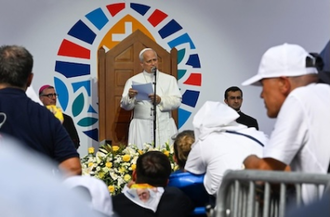
Pope Leo at Accueil Notre-Dame.
Source: Vatican Media
On Sunday afternoon, Pope Francis met with sick and frail pilgrims and pilgrims with disabilities and some of their their carers at the Accueil Notre-Dame centre at the Sanctuary of Our Lady of Lourdes on Sunday afternoon.
The Accueil Notre-Dame hosts pilgrims and groups from around the world in a healthcare facility operated as "a kind of a 'big family home'" by about 50 employees, as well as consecrated men and women and hundreds of volunteers.
In his address, Pope Leo said that at Lourdes, the "fragility is not hidden, but instead becomes the place of a sacred encounter." Recalling the Shrine's theme for this year: "Hail, full of grace, the Lord is with you" , the Holy Father highlighted the "humility and generosity" of Mary that "allowed God to accomplish His work of salvation."
The words of the Archangel Gabriel, "The Lord is with you," are a truth that stands as the foundation of "our dignity as persons," while Mary's recognition of each unique person "reminds us once more that no one is invisible in God's eyes."
Where society sometimes "looks aside or closes its eyes to the dignity of human life," Pope Leo insisted that we must foster, "in ourselves and in others, a contemplative outlook" that allows us to "see life in its deeper meaning," to accept it as a gift, and thus be able to perceive "in the face of every person a call to encounter, dialogue, and solidarity."
In the Annunciation to Mary, he continued, "each one of us" discovers "that we too are personally called and profoundly destined for the love of God, who is the source of life." The human person, he said, "is 'worthy' simply by virtue of existing and being destined for eternity."
Therefore, he said, "Our dignity cannot be measured or debated."
Speaking directly to pilgrims, Pope Leo recognised that illnesses can lead people to uncertainty and feelings of hopelessness. "But no human law should ever make you lose the certainty of your dignity."
Precisely in view of the inalienable dignity of the human person, he said "We must reject the temptation to cause death under the guise of false compassion." And he warned that "what is legal is not necessarily moral."
The Holy Father went on to appeal "to the entire healthcare community to remember the profound meaning of your vocation, which is to care for a suffering person, not eliminate that person."
"Be passionate defenders of life," he enjoined them, adding that no one has the right to "to decide the life of a given embryo or elderly person." He encouraged health care workers to promote authentic palliative care and research, and urged them "to accompany the sick with the tenderness we see at Lourdes."
Finally, turning once again to the sick, Pope Leo told them, "You are not a burden. You are the beating heart of our humanity and a precious treasure for the Church." And he assured them of his prayers, while entrusting them to Mary, "asking her to obtain for you the consolations of her Son, Jesus."
During his visit the Pope heard three testimonies from people whose lives have been shaped by service to the sick, by suffering and by their experience of faith.
Mathias Terrier, Director of the Accueil Notre-Dame centre in Lourdes, welcomed Pope Leo XIV to the facility, which enables people who are sick or living with disabilities to make their pilgrimage to Lourdes.
The Pope's visit to the centre took place in the afternoon of Sunday, 27 September 2026, on the third day of his apostolic visit to France.
Presenting Accueil Notre-Dame, Terrier explained that since its inauguration in 1997, some 750,000 sick or disabled people have stayed there. Yet, he noted, the deepest question is not one of numbers.
"How can it be that their fragility is the cement of the stones of this building?" he asked. And then he widened the question: "How can it be that the most fragile are the cement of this human edifice" made up of volunteers, carers, religious and employees from across the world?
At Lourdes, he suggested, the usual order of things is quietly reversed. Those who appear to need the most help become those who reveal something essential to everyone else.
What becomes important, he said, is "the gesture that relieves; the word that consoles; the look that soothes. The prayer that binds us; the sacraments that carry us in Hope."
Then it was the turn of a doctor from Laval, who has practised medicine for 40 years. He took to the podium to share his experience of caring for patients, and he recalled the words of Ambroise Paré, displayed at the entrance of his hospital: "I dressed his wound; God healed him."
For the doctor, these words express the humility required in medicine. "To care requires giving of oneself, sharing our humanity," he said, adding that the vocation should not be lived simply through "having" or "being", but through "loving".
"Lourdes allows us to make the most beautiful journey by going to meet the other, and particularly the most fragile," he said. The sick, he added, can reveal to others their own vulnerability.
"In serving our sick brothers and sisters, it is God whom we serve," he said, and this includes all the different forms this service can take, from the Good Samaritan and the innkeeper to simply being "the mount" that carries the wounded person.
The third testimony came from Marguerite Hourt, who first came to Lourdes at the age of 20 to accompany sick and disabled pilgrims from the Diocese of Metz. For more than 14 years, she returned during her holidays to help them during their pilgrimage.
In 2016, a bicycle accident left her paraplegic. When she returned to Lourdes the following year, she said that she no longer understood her situation, that her faith had faltered and that she was angry with Mary.
"I often went to pray at the Grotto, to cry out my despair and my rage," she recalled. "And it was at the Grotto that I found consolation from Her."
After returning home, Hourt worked to regain her independence, learning to drive again, finding an apartment, training for a new profession and seeking employment. After sending dozens of applications, she applied for a position as a receptionist at the Sanctuary of Lourdes.
"And that is the grace I received: to work in this place that I love," she said.
Her suffering has not disappeared, she explained, and she continues to struggle each day with her disability. But she now serves at the Sanctuary, welcoming pilgrims and helping them encounter Lourdes.
"I am proud to now be at the service of welcoming pilgrims," she told the Pope, "to enable them to access the grace of this unique place, to pass on my faith."
During his visit, the Pope also met privately with some of the sick people staying at the facility who were unable, for health reasons, to be part of the group outside.
"Life is beautiful and precious. Do not be discouraged: Our Lady of Lourdes is holding you by the hand," he told them, and he expressed gratitude for those serving at the Sanctuary, noting that many pilgrims leave Lourdes "with peaceful hearts, transformed by grace, ready to continue the journey."
The Pope also had words of gratitude for the carers and volunteers of the facility, noting that their generosity, dedication and closeness are themselves part of the experience of Lourdes.
"Is not the first miracle of Lourdes, for them, that they have met you, that they have experienced your generosity, your dedication and your closeness?" he asked. And he encouraged them to share this experience, particularly with young people, "so that they may discover the joy of self-giving and service in the name of Jesus."
Read the text of Pope Francis address:
www.vatican.va/content/leo-xiv/en/speeches/2026/september/documents/20260927-francia-accueil-notredame.html
 Facebook
 Twitter
 LinkedIn
 Print
Print Email
Email






 Facebook
 Twitter
 YouTube
 LinkedIn
 Pinterest