

Gospel in Art: Saint Pius of Pietrelcina (Padre Pio), Priest
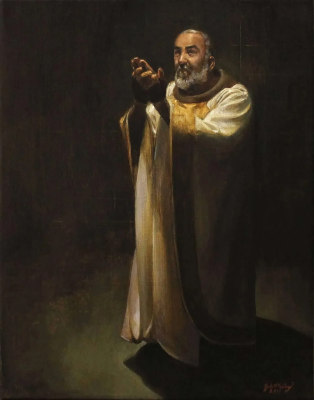
Saint Padre Pio, by John McCoy, 2017 © John McCoy Art, all rights reserved
Source: Gospel in Art
Gospel of 23 September 2026
Matthew 16:24-27
At that time: Jesus told his disciples, 'If anyone would come after me, let him deny himself and take up his cross and follow me. For whoever would save his life will lose it, but whoever loses his life for my sake will find it. For what will it profit a man if he gains the whole world and forfeits his soul? Or what shall a man give in return for his soul? For the Son of Man is going to come with his angels in the glory of his Father, and then he will repay each person according to what he has done.'
Reflection on the painting
Today, we celebrate one of the Church's most beloved and widely venerated saints of modern times: Padre Pio. Born Francesco Forgione in 1887 in Pietrelcina, Italy, he displayed a profound religious devotion from a young age, eventually joining the Capuchin order at the age of 15 and was ordained a priest in 1910. Throughout his life, Padre Pio experienced intense spiritual and physical sufferings, most notably receiving the stigmata in 1918, the wounds resembling those of Christ's crucifixion, which he bore for 50 years. His reputation as a holy man spread rapidly, with thousands flocking to him for confession, guidance, and healing. He also founded a hospital in San Giovanni Rotondo, where he spent much of his life. He died there in 1968, aged 81. He was canonised in 2002 by Pope John Paul II.
Even today, devotion to Padre Pio remains widespread, with shrines, images, and popular devotions dedicated to him in churches across Rome and around the world. San Giovanni Rotondo, where St Pio lived and is now buried, attracts an astonishing eight million pilgrims annually, surpassing even the well-known pilgrimage sites of Lourdes and Fatima. In terms of visitors, it is second only to the shrine of Our Lady of Guadalupe in Mexico.
Our painting by John McCoy depicts Padre Pio with his wrists wrapped in bandages, covering the stigmata he bore. He raises his hands towards a radiant light descending from above, offering his sufferings to God in a gesture of surrender. The subdued brown and beige tones, along with the stripped-back colour palette, mirror the simplicity and humility that characterised Padre Pio's spiritual life.
One of the most touching stories told about Padre Pio concerns a woman who came to him carrying a deep sorrow. Her child had died, and she could not understand why God had allowed it. Padre Pio did not try to give her an easy explanation. Instead, he pointed to the reverse side of an embroidery, where the threads were tangled, knotted and seemingly without order. Then he turned it around. On the other side was a beautiful, carefully woven design. Our lives, he suggested, are often like that. We see only the underside: the loose threads, the knots, the things that seem senseless. God sees the finished work. Faith does not mean that we understand every thread; it means trusting that, even when we cannot yet see the pattern, there may be a beauty known to God that remains hidden from us.
Saint Padre Pio, pray for us.
LINKS
Christian Art: www.christian.art
Today's image: https://christian.art/daily-gospel-reading/matthew-16-24-27-2026/
 Facebook
 Twitter
 LinkedIn
 Print
Print Email
Email





 Facebook
 Twitter
 YouTube
 LinkedIn
 Pinterest