


Gospel in Art: Feast of Saint Matthew, Apostle, Evangelist
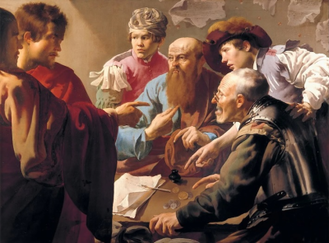
The Calling of Saint Matthew by Hendrick ter Brugghen, 1621 © Centraal Museum, Utrecht
Source: Christian Art
Gospel of 21 September 2026
Matthew 9:9-13
At that time: As Jesus passed on from Capernaum, he saw a man called Matthew sitting at the tax booth, and he said to him, 'Follow me.' And he rose and followed him.
And as Jesus reclined at table in the house, behold, many tax collectors and sinners came and were reclining with Jesus and his disciples. And when the Pharisees saw this, they said to his disciples, 'Why does your teacher eat with tax collectors and sinners?' But when he heard it, he said, 'Those who are well have no need of a physician, but those who are sick. Go and learn what this means: "I desire mercy, and not sacrifice."
For I came not to call the righteous, but sinners.'
Reflection on the painting
Today, we celebrate the Feast of Saint Matthew, a day that reminds us of God's transformative power. Matthew, a tax collector, was called by Jesus to follow Him, proving that no one is beyond the reach of grace. Tax collectors in Jesus' time were viewed with disdain, known for their dishonesty and greed. They collected more than what was required by Roman authorities and pocketed the excess for themselves, making them notorious collaborators with the oppressors. To call someone like Matthew was a very bold move!
Yet, it is precisely this tax collector who responds to Jesus with immediate and radical faith. Without hesitation, Matthew leaves behind his lucrative job and becomes one of Jesus' closest disciples. His response is a testament to the fact that Jesus came for all - not just the righteous, but the sinners, the outcasts, and the forgotten. In Matthew, we see that God's call can transform anyone who is willing to respond.
This moment of transformation is beautifully captured in Hendrick ter Brugghen's 1621 painting The Calling of Saint Matthew. Ter Brugghen, who had been inspired by Caravaggio's masterpiece of the same subject in Rome, became one of the leading Dutch artists painting in Caravaggio's style. His work is characterised by realistic facial expressions and the use of half-length figures, drawing viewers into the intimate moment of Matthew's call. However, unlike Caravaggio's signature use of dramatic contrasts between light and shadow, Ter Brugghen softens the scene with gentle tonalities of blues, pinks, and violets. These colours emphasize the joy and grace present in moments of conversion and revelation.
At the centre of the painting is Matthew, gesturing toward himself with a look of astonishment: "Are you calling me?" His disbelief and wonder mirror our own when we realise that God calls each of us, regardless of our past. To the left, Christ and one of his disciples stand in shadow, their presence quiet but powerful. The true contrast, however, comes from the figure of a soldier seated at the table, fixated on the money in front of him. Dressed in partial armor, his clenched hands and grinding teeth reveal his greed. Oblivious to the divine call happening in his midst, he represents those whose hearts are hardened (hence the metal armour) by material concerns, blind to the grace being offered.
On the table before Matthew, his ink, pen, and paper lie ready: tools he once used to record taxes for personal gain, but now will serve a higher purpose as he prepares to write the Gospel that will proclaim the Good News to the world.
Saint Matthew, pray for us.
LINKS
Christian Art: www.christian.art
Today's image: https://christian.art/daily-gospel-reading/matthew-9-9-13-2026/
 Facebook
 Twitter
 LinkedIn
 Print
Print Email
Email













 Facebook
 Twitter
 YouTube
 LinkedIn
 Pinterest