

'Roots and Refuge' event at historic Wesley's Chapel
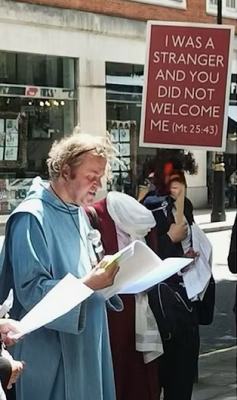
Brother Johannes
London Churches Refugee Fund (LCRF) hosted an information event at the historic Wesley's Chapel in London on Thursday, 17th September. LCRF exists to support projects working directly with destitute asylum seekers in the capital.
The keynote speaker was Brother Johannes Maertens, a monk of the Community of the Good Shepherd and a long-standing member of the Catholic Worker community.
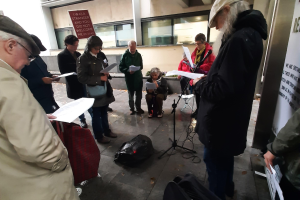
For more than 23 years he has lived in community with homeless and displaced people in Belgium, Calais and London. From 2015-19 he worked in the refugee camp in Calais, where he co-founded the Maria Skobtsova Refugee Safe House, offering sanctuary and accompaniment to those in transit. In London, Brother Johannes helped initiate monthly prayer vigils outside the Home Office, calling for humane treatment of all who seek asylum in this country.
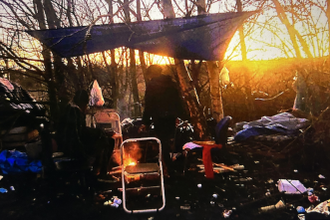
Brother Johannes spoke on the theme of 'Roots and Refuge'. The title, he said, grew out of a short conversation with a refugee from Yemen a few months ago in the Dunkirk camp. 'He was wondering where he belonged. He told me that he and his brother had been imprisoned in Yemen, where he witnessed his brother being tortured to death. His father was Yemeni and his mother from Djibouti. When I met him, he was standing in the rain in the tent camp, the sky heavy and grey, the whole camp soaked. "Where do I really belong?" he asked. "Yemen, Djibouti, France, England?" It wasn't really a question. It was a deep ache - a wound in his sense of humanity.'
Johannes suggested that roots and refuge are not static - they move with us. Roots are important because they tell us who we are and help us maintain some sense of meaning and direction. The disruption to roots when a person has to flee their home can leave trauma, alienation and dislocation. But roots can be protected through memory and social rituals such as the making of tea in Ethiopian culture. Johannes treasures the memory of drinking tea together with refugees in the camp in Calais. The welcoming of visitors, including strangers, with tea was a way of affirming the culture of hospitality which had been disrupted by flight. The making of tea involved the gathering of wood, the lighting of the fire, the collection of water and the boiling of the kettle, a process which might take an hour in all.
Refuge, said Johannes, can be physical, psychological or both. At its heart is safety: protection from what threatens us, and the freedom to be ourselves. 'In my work,' said Johannes, 'presence has been central: simply being with someone in a non-judgemental, non-intrusive way. For that reason, a place of refuge needs both physical and emotional safety. It needs enough boundaries and order to protect people, without becoming controlling, so that each person can still recover a sense of agency.' Safety may enable difficult memories to surface after being repressed. 'A person may first need to feel safe enough to tell their real migration story, not the version they think we need to hear. Sometimes refuge makes a breakdown possible: it is finally safe enough to fall apart.'
Linking roots and refuge is the journey. For many people, said Johannes, 'that journey is perilous. It touches existential fears: hunger, thirst, violence, death and dangerous crossing through deserts, forests, mountains, or across the sea. Such journeys can be terrifying, and they may last for years. At the beginning of the journey, a person may feel certain that they made the right choice. But as the journey becomes painful and inhumane, doubt and guilt can grow.'
Maria Skobtsova House uses art therapy to help refugees tell the story of their journeys without having to explain them directly. This helps increase people's resilience. But the most important element in creating refuge for people is community. Maria Skobtsova House provides shelter, food, clothing and washing facilities, but it also provides community among people on the move and between them and those living and working at the house.
It is equally important to create community when people arrive at their destination - in our case, Britain - where a common experience is profound disappointment, particularly in the face of prejudice, poverty and homelessness. Brother Johannes explained, 'We can offer places where people are met first as human beings - not as cases, numbers, or problems to be processed. These need to be trauma-informed spaces: culturally and religiously sensitive, safe enough to rest in, and familiar enough to feel recognisable. … Above all, these places need to feel human. Not chaotic, not clinical, not institutional. Places where people can build relationships.'
After Brother Johannes had spoken, we heard reports from two of the many projects across the capital supported by LCRF. Chloe White spoke about the work of AFRIL (Action for Refugees in Lewisham), which assists refugees and asylum seekers living in South East London. James Tullett of Refugee and Migrant Justice spoke of East London organisation's work in legal representation of people seeking asylum and precedent-setting legal challenges to specific injustices.
Music was provided by Aisha, Ahmed and Chrisine, who are associated with Migrants Organise. We were welcomed by Chair of LCRF Simon Loveitt and Revd Clare Potter, Minister of Wesley's Chapel. The opening prayer was provided by Jonathan Dean, Co-chair of London Methodist Circuit and a Patron of LCRF, who said that accompanying refugees is one of the most important tasks of the contemporary Church, as there are 43 million refugees worldwide contending with a rising tide of nationalism and exclusion. The closing prayer was provided by Revd Andrew Prasad of the United Reformed Church.
Revd Chris Brice, Anglican priest and a trustee of LCRF, made an appeal for funds for LCRF's work, and particularly to fill the funding gap of nearly £4,000 in this year's grants programme.
To find out about the work of London Churches Refugee Fund and to donate to it online, see: www.lcrf.org.uk/.
 Facebook
 Twitter
 LinkedIn
 Print
Print Email
Email








 Facebook
 Twitter
 YouTube
 LinkedIn
 Pinterest