

Tartuffe (Remixed) - Rylance runs riot as predator priest
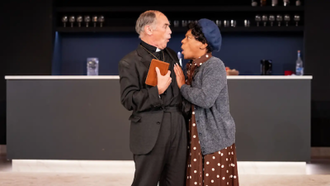
Mark Rylance and Nakeba Buchanan. Image by Suzette Llewellyn
Woe to the hypocritical holy men, Christ warned, 'Because you are like to whitened sepulchres, which outwardly appear beautiful, but within are full of dead men's bones, and of all filthiness.'
The celebrated actor Mark Rylance is currently appearing as just such an impostor in Tartuffe, Molière's hilarious satire against religious hypocrisy.
With characteristic brio, he plays Pastor Blake, an oily white priest ministering to a black flock in Darren Raymond's superb Tartuffe (Remixed) which is interpreted through a post-colonial, black British lens.
This play, the most performed by the Comédie Française, keeps on giving - across faiths, cultures and history. Responding to terrorist attacks in Paris in the mid-90s, Ariane Mnouchkine cast Tartuffe as a baleful Islamist; other British productions have played him as a spiritual guru, shaman or fakir.
The tour de force had a difficult birth. First staged in three acts at Versailles before Louis XIV in 1664, and possibly at his instigation, the Sun King then banned the play, bowing to pressure from the Archbishop of Paris. The French Church was contending with the powerful, austere and reactionary Jansenist movement, itself allied with forces opposed to the king. Echoes of the liturgy and Marian prayers in the script would not have helped.
The third, and five-act, version of the play which we have today finally appeared to huge acclaim in 1669, after religious harmony had been restored. The name Tartuffe itself derives from an old French word for deception, trickery and mockery.
Another reason for the Church's opposition to the play was Tartuffe's clerical status, emphasised by his clerical attire. 'Comme il sait, de traîtresse manière, Se faire un beau manteau de tout ce qu'on révère !' (How well he knows, in a treacherous way, how to make a fine cloak out of everything we revere!)
By 1669, Molière took pains to emphasise that Tartuffe was a 'faux dévot' - not a priest but a spiritual adviser, made popular by St François de Sales's best-seller Introduction à la vie devote (Introduction to the Devout Life). Spiritual advisers were life-coaches of heavenly devotion for the moneyed pious laity.
The predatory Tartuffe has hoodwinked and inveigled his way into the home of Orgon. His entire family and feisty maid Dorine (played here with zest as best friend Kemi by Morenike Onajobi) see the clear deception but the monomaniacal paterfamilias and his equally blinkered mother Madame Pernelle remain obdurate, pious dupes.
In Raymond's inspired re-telling, the young lovers hail from Nigerian and Jamaican families and the patriarch Oga (formerly Orgon, played by Usifu Jalloh) is the credulous disciple of Pastor Blake whom he invites to bless the approaching week-long nuptials.
In Molière's final version, Tartuffe retains clear traces of a priest from a medieval farce, a Friar Tuck-like bibulous gourmand, 'gros et gras, le teint frais, et la bouche vermeille' (stout and fat, with a fresh complexion and cherry lips). Rylance is unmistakably a pastor in dog collar and black 'clericals'. Falstaffian he isn't, adopting an inspired s-shaped, cringing posture of meekness - and honouring Molière's heritage of physical playing from Italian commedia dell'arte. Like Laurence Olivier, Rylance revels in physical add-ons. (I recall a withered arm as Richard III at the Globe.) Here, a would-be seraphic smile reveals stained buck teeth which double as predatory fangs.
Just like his original, Pastor Blake is out to get Oga's house, wealth and wife. Rylance's Dick Emery-like fluting pieties and egregious humility hide a sinister rapaciousness.
Like 'honest Iago' with Othello, the pastor plays racist tricks on Oga, insinuating a shameful lust in the Jamaican fiancé of his daughter - a lust he himself stokes for Oga's wife Elmire whom he corners and propositions.
His ludicrous seaside postcard stripping also conveys powerfully a colonial male concupiscence for the exoticised black woman. Dignified Elmire (Nakeba Buchanan) repulses the 'dutty lickle white man.'
Blake's sinister predilection for sado-masochistic spanking evokes not only slavery days and class domination but is also a fascinating echo of Tartuffe's opening line in Molière: 'Serrez ma haire avec ma discipline' (Grasp my hair-shirt and my whip, for mortifying the flesh). Tartuffe then says he will go to dispense alms among the prisoners, just as Molière's contemporary St Vincent de Paul would have done. His lies are a desecration of the corporal works of Mercy. As Molière wrote in his preface to his third version: 'Nous voyons des scélérats, qui tous les jours abusent de la piété, et la font servir méchamment aux crimes les plus grands' (We see rogues who abuse piety every day, making it serve the greatest crimes with a mischief).
The black actors adopt Caribbean and Nigerian dialect and customs to great, and humorous, effect, magnified by some excellent blank verse and rhyme provided by an inspired Raymond. Blake's use of patois, however, is laced with mockery and menace. As he moves in on pious Grandma (the excellent Suzette Llewellyn), he skanks as if to reggae music and intones 'Jah Rastafari' when ostensibly addressing her Christian faith.
He proceeds to rob her of her hard-saved life savings (a product of the Windrush generation's mutual self-help 'pardner hand' when faced with racist adversity) all the while lying that he will invest it in the 'development' of an impoverished village and its 'pickneys'.
By the time Tartuffe was written, both England and France had started the trans-Atlantic slave trade which lasted for over three centuries. This intermezzo powerfully recalls this shameful period, together with the colonial project, along with the Church's complicity in this self-proclaimed 'civilising mission'.
Molière's Tartuffe gets his come-uppance thanks to a godlike, all-seeing Sun King, 'eldest son of the Church': 'Nous vivons sous un prince ennemi de la fraude,/Un prince dont les yeux se font jour dans les cœurs,/Et que ne peut tromper tout l'art des imposteurs' (We live under a prince who is an enemy of fraud,/A prince whose eyes can see into the depths of hearts,/And who cannot be deceived by all the art of impostors).
Raymond Blake's Tartuffe is incriminated thanks to documents discovered by Oga's daughter in his grand guest-suite. With a delicious twist in the tale, he is revealed as none other than a famous impostor pursued by Interpol.
The beautiful Yoruba wedding garments designed by ULTZ and Maybelle Laye add to the celebration of the culture of the black diaspora in Tartuffe (Re-mixed) played with gusto by a fine company. And bravo the director for casting alumni from his Intermission Youth theatre project - ' a transformative celebration of community and growth' - in this excellent production.
Tartuffe (Remixed) continues at the Marylebone Theatre, London, until 24th October See: https://marylebonetheatre.com
To learn more about the excellent work of Intermission Youth, visit: www.intermissionyouththeatre.co.uk
 Facebook
 Twitter
 LinkedIn
 Print
Print Email
Email
















 Facebook
 Twitter
 YouTube
 LinkedIn
 Pinterest