


Gospel in Art: Saint Cuthbert, Bishop
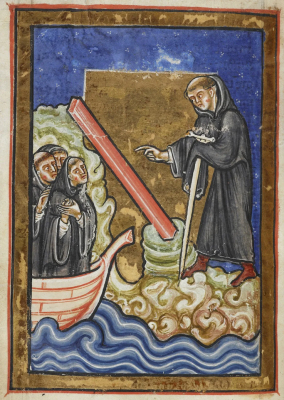
Illumination from The Life of St Cuthbert, Durham, 12th century, f.45v; Yates Thompson MS 26 © British Library, London
Source: Christian Art
Gospel of 4 September 2026
Luke 5:33-39
At that time: The Pharisees and scribes said to him, 'The disciples of John fast often and offer prayers, and so do the disciples of the Pharisees, but yours eat and drink.' And Jesus said to them, 'Can you make wedding guests fast while the bridegroom is with them? The days will come when the bridegroom is taken away from them, and then they will fast in those days.' He also told them a parable: 'No one tears a piece from a new garment and puts it on an old garment. If he does, he will tear the new, and the piece from the new will not match the old. And no one puts new wine into old wineskins. If he does, the new wine will burst the skins and it will be spilled, and the skins will be destroyed. But new wine must be put into fresh wineskins. And no one after drinking old wine desires new, for he says, "The old is good." '
Reflection on the Medieval Illumination
Saint Cuthbert (c. 634-687) was one of the great saints of early Christianity in Britain. Born in Northumbria, he entered the monastery at Melrose after experiencing a vision of Saint Aidan being carried to heaven. Cuthbert became known for his deep life of prayer and his remarkable closeness to ordinary people. As a monk and later prior of Lindisfarne, he travelled through the remote villages of northern England, preaching the Gospel, caring for the sick and bringing encouragement to communities that were often difficult for other missionaries to reach.
Yet Cuthbert increasingly longed for solitude. He eventually withdrew to the tiny island of Inner Farne, where he lived as a hermit, devoting himself to prayer and contemplation. Reluctantly, he was later persuaded to become Bishop of Lindisfarne, in 684, but his episcopal ministry was brief. He died in 687 and was buried on Lindisfarne; his remains were later moved by the community during the Viking upheavals and eventually came to rest at Durham Cathedral. According to Bede's life of the saint, when Cuthbert's sarcophagus was opened eleven years after his death, his body was found to have been perfectly preserved or incorrupt. This miracle led to the steady growth of Cuthbert becoming the most popular saint of Northern
Our 12th-century manuscript illumination, is from a copy of the Life of Saint Cuthbert by the Venerable Bede, now preserved in the British Library. Bede tells how Cuthbert's community needed a large piece of timber to serve as a roof-beam. Cuthbert instructed the brothers to pray and trust that God would provide what they needed. Not long afterwards, the tide brought precisely such a piece of timber to the shore. The miniature captures that wonderfully simple moment: something as ordinary as a piece of wood washed up by the sea becomes a sign of divine providence.
It is a charming story, but it also tells us something important about Cuthbert's spirituality. He saw creation itself as belonging to God. Sea, land, animals and human beings were all part of one created order, held together by God's care. The manuscript therefore illustrates more than a medieval miracle story. It invites us to develop Cuthbert's attentive way of looking at the world: trusting that God can sometimes answer our prayers through the most ordinary things, wood.
LINKS
Christian Art: www.christian.art
Today's image: https://christian.art/daily-gospel-reading/luke-5-33-39-2026/
 Facebook
 Twitter
 LinkedIn
 Print
Print Email
Email










 Facebook
 Twitter
 YouTube
 LinkedIn
 Pinterest