

Gospel in Art: Get behind me, Satan!
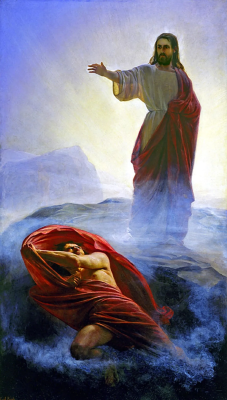
Jesus casting away Satan, by Carl Heinrich Bloch, painted in the 1870's © Frederiksborg Palace, Copenhagen
Source: Christian Art
Gospel of 30 August 2026
Matthew 16:21-27
At that time: Jesus began to show his disciples that he must go to Jerusalem and suffer many things from the elders and chief priests and scribes, and be killed, and on the third day be raised. And Peter took him aside and began to rebuke him, saying, 'Far be it from you, Lord! This shall never happen to you.' But he turned and said to Peter, 'Get behind me, Satan! You are a hindrance to me. For you are not setting your mind on the things of God, but on the things of man.'
Then Jesus told his disciples, 'If anyone would come after me, let him deny himself and take up his cross and follow me. For whoever would save his life will lose it, but whoever loses his life for my sake will find it. For what will it profit a man if he gains the whole world and forfeits his soul? Or what shall a man give in return for his soul? For the Son of Man is going to come with his angels in the glory of his Father, and then he will repay each person according to what he has done.'
Reflection on the painting
'Get behind me, Satan!' These are probably among the strongest words Jesus ever spoke in the Gospels. What makes them even more striking is that they were addressed to Peter, one of his closest friends and disciples. Just imagine Jesus saying those words to you or to me. We would be shocked, hurt and utterly mortified.
To understand why Jesus speaks so forcefully, we need to look more closely at the context. At the beginning of today's Gospel, Jesus explains to his disciples what lies ahead: that he must go to Jerusalem, suffer, be put to death, and rise again on the third day. Jesus knows the path that the Father has prepared for him. Peter, unable to bear the thought of his friend suffering and dying, immediately protests. Surely there must be another way. In trying to protect Jesus, Peter is unknowingly urging him to turn away from the very mission for which He came. Of course, Peter has the best of intentions. His warm-hearted spontaneity gets the better of him once again.
Jesus, however, hears Peter's words for what they imply. They are a temptation to abandon the Father's will. That is why Jesus uses the word 'Satan'. The word satan literally means 'adversary' or 'one who opposes'. Jesus is not saying that Peter is evil (of course not). Rather, Jesus is saying that Peter's suggestion was in direct opposition to God's plan of salvation. Jesus refuses even the slightest temptation to turn away from the Cross. His whole life is directed towards fulfilling the Father's will, whatever the cost.
Our powerful painting by Carl Bloch captures Jesus casting away Satan. Jesus stands with quiet authority, his hand raised as he dismisses the tempter. His gaze is fixed, resolute and utterly peaceful. There is no hesitation, no inner struggle, only complete trust in the Father's plan. Bloch reminds us that Christ's victory over evil did not begin on Calvary but already long before, each time he freely chose obedience over comfort, truth over compromise, and love over self-preservation. The same choice lies before us each day: will we follow our own plans, or will we have the courage to embrace God's will, even when it leads us along a more demanding path?
LINKS
Christian Art: www.christian.art
Today's image: https://christian.art/daily-gospel-reading/matthew-16-21-27-2026/
 Facebook
 Twitter
 LinkedIn
 Print
Print Email
Email





 Facebook
 Twitter
 YouTube
 LinkedIn
 Pinterest