

A Walk of Faith in Bethlehem
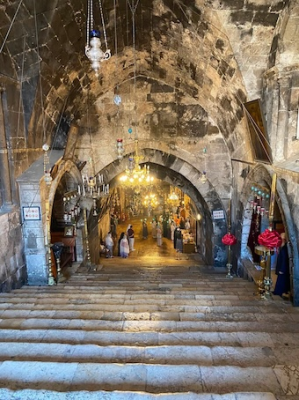
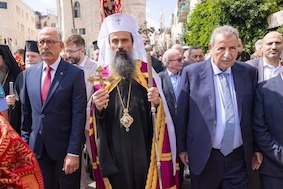
Image from Bethlehem Updates
Source: Bethlehem Updates
Usama Nicola writes in Updates from Bethlehem:
The Feast of the Dormition of the Most Holy Mother was for many years among the holiest and most beloved of traditions for us as Christians in Bethlehem. It was no ordinary day. It was a walk of faith, a walk a journey of our land, our community and also our Heavenly Mother Mary.
A devout group of faithful would march at 3am on August 28 each year, on foot toward the Church of the Assumption (Church of the Tomb of the Virgin Mary), a march that would begin at exactly that time. The church is located in the Kidron Valley, close to the Garden of Gethsemane, on the road paths that lead to the Lions' Gate, Silwan and Mount of Olives. It is revered by Christians as the traditional site of the Virgin Mary's Dormition and tomb. Traditionally it is believed that the tomb of the mother and father or Our Lady, Anna and Joachim, are also located within the church, as is the tomb of Joseph the Carpenter from Nazareth.
I can recall dozens of times that I walked this path with family, friends, neighbours from Bethlehem, Beit Sahour and Beit Jala since childhood. As we walked through the night we would pray, sing hymns, carry candles for those who were ill, for grieving mothers, and for our oppressed people for healing, protection, and peace. It was a spiritual act of devotion, a connection to a higher power, something beyond ourselves.
A lot of the participants made promises or Nithr, which means in Arabic to walk on earth from Bethlehem to the church every year as long as they lived. These were frequently personal pledges, made with a humble determination and faith. The processional lasted at least three hours and ended with candles being lit on the long stairway that leads up to the church and prayers of devotion to Mary, Queen of Heaven.
It is the Feast of the Dormition.
The Feast of the Dormition of the Virgin Mary is observed on August 28 in the older Julian Calendar, which is observed by eastern churches, especially in the Orthodox Church. The Dormition, or the Assumption (Rakād al-'Adhrā' in Arabic), is one of the holiest feasts in the Eastern Orthodox, Oriental Orthodox, and Eastern Catholic Churches.
The feast is to honour the peaceful death of Mary and her bodily assumption to heaven. The event is not mentioned in the canonical Scriptures but it is a very much a part of ancient Christian tradition. Some early Christian traditions say that Mary lived for several years after Jesus' death, and eventually died in Jerusalem.
The word "Dormition" means "falling asleep" and is used to describe Mary's quiet passing away. Christians believe that she was taken to heaven, body and soul, by her son, Jesus, because of God's grace.
When a Pilgrimage Becomes Difficult
Unfortunately, in recent years we have become increasingly disenfranchised in this sacred custom. Travel from Bethlehem to Jerusalem has been closely monitored and limited by the Israeli checkpoints and the building of the separation wall since the early 2000s. For many, today pilgrimage is no longer an easy practice.
Not only have we been denied access to the holy places, but also, in a deeper sense, to memory, identity, and an important aspect of our spiritual heritage that has been handed down from generation to generation.
Very few persons from the Bethlehem area were able to secure permits to cross the checkpoint this year. The traditional pilgrimage in the early morning was not possible as the checkpoint was not opened after 4am. I was not issued a permit this year, nor were any of my family (five of us).
Ensuring the continuity of the Tradition
But, despite all these difficulties, our communities still have a strong tradition around this feast.
One beautiful example is the preparation of jreeshah, a traditional Palestinian dish of crushed wheat, tomatoes and a meat. In the old days, almost every home used to cook it on this day, as a celebration of the completion of the two-week fast period before the Dormition.
This has become a communal practice more recently. In times of hardship, neighbours gather to cook in large pots and share it with others in need, an act of solidarity, in keeping with our faith and our resilience.
This year, the Greek Orthodox Church in Beit Sahour put up a big tent in the town square and dozens of volunteers got to work making huge amounts of jreeshah. They cooked it over open flames for about three hours before distributing it to members of the community. Those who were unable to travel came together in their own homes to cook and enjoy the meal with their family.
Jreeshah is more than just sustenance. It's a reminder of our heritage, a taste of Palestine's soul, and a reminder that our traditions feed not just the body, but the soul. It is also commonly served at weddings and communal gatherings, but it has yet another significance on the day of the Dormition: the delight of breaking the fast and rejoicing in Mary's assumption into heaven.
So, this feast, this walk and this dish are all connected - our devotion, our love for Mary and our unbreakable bond to this land and to each other.
Our culture and our faith live on, even though we are closed, have permits, and have walls between us. They are transmitted via our prayers, our stories, our footsteps and even through the taste of jreeshah shared on a holy summer morning.
Through his Patreon page, Usama Nicola offers regular reflections, updates from Bethlehem, and spiritual insights, creating a worldwide community of solidarity and shared understanding. His hope is to touch hearts, gently challenge complacency, and remind people everywhere that even in places marked by sorrow, life continues to grow.
You can support Usama's writing ministry by subscribing to Bethlehem Updates.
See: www.patreon.com/c/BethlehemUpdates/posts
 Facebook
 Twitter
 LinkedIn
 Print
Print Email
Email





 Facebook
 Twitter
 YouTube
 LinkedIn
 Pinterest