

'Just Talk' - Courageous conversations at heart of NJPN 2026 conference
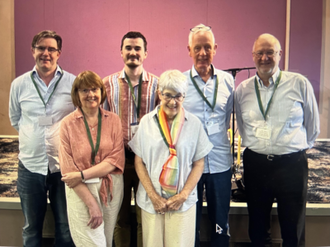
Paul Morrison, Billy Vaughan, Quakers in Britain, Brian O' Toole, NJPN, John Battle, former MP, Liz Archibald, Anne Peacey NJPN
More than one hundred people gathered at The Hayes Conference Centre in Swanwick for the 48th National Justice and Peace Network (NJPN) Conference. The theme was deceptively simple: Just Talk.
But over the course of the weekend, it became clear that these two words carried a challenge. At a time when public conversation can so easily become angry, polarised and unforgiving, how do we continue to talk to one another? How do we listen to people whose views trouble us? And, perhaps most importantly, how do we find the courage to speak when silence in the face of injustice is no longer enough?
Opening the conference, Brian O'Toole returned to a question that had stayed with him throughout the previous year: "What breaks your heart?"
His answer was a very human one: those moments when we hear prejudice, misinformation or hatred and simply do not know what to say. Many of us know that feeling. We may recognise that something is wrong, yet find ourselves caught between remaining silent and responding in a way that might only deepen the division.
Perhaps there is another way.
Instead of beginning with confrontation, the conference invited us to begin with curiosity, compassion and a willingness to listen. Justice, we were reminded, does not always begin with winning an argument. Sometimes it begins with listening deeply enough to hear the story of the person sitting opposite us.
The weekend gathered momentum through an inspiring keynote address from Billy Vaughan and a panel discussion chaired by former MP John Battle. Together, they explored what dialogue might mean in an increasingly divided society and challenged those present to become peacemakers, not somewhere far away, but in our own homes, churches and communities.
Again and again throughout the weekend, we heard stories of what can happen when people are prepared to cross the distance between themselves and another person.
The Quakers spoke movingly of the distress caused by police raids on places of worship and of the need to defend the democratic right to peaceful protest. Protestant and Catholic speakers from Northern Ireland shared the same platform, their presence together quietly demonstrating something that words alone could not: relationships can grow when people choose to work alongside one another rather than remain separated by history and difference.
Stories from Kosovo and the West Bank carried that same message. We heard of ordinary acts of cooperation and solidarity in places where division can sometimes seem impossible to overcome. There was a particularly human moment when the experiences of Palestinian farmers found an unexpected echo among farmers from Donegal. Across very different landscapes and circumstances, people recognised something of themselves in the lives of others.
That, perhaps, was one of the gifts of the weekend: the discovery that when we truly listen, the distance between "us" and "them" can begin to shrink.
The workshops gave delegates practical ways of putting this into action: how to challenge misinformation and recognise disinformation, how to understand the narratives that drive division, and how to find the confidence to stay in conversation with people whose opinions may be very different from our own.
And one lesson kept returning: the most important part of talking is listening.
A single conversation may not change someone's mind. Perhaps we place too much pressure on ourselves when we expect it to. But one respectful encounter can open a door. It can become the first of several conversations. A seed can be planted, even when we are not there to see what eventually grows from it.
Another conviction ran quietly but persistently through the conference: there is far more that unites us than divides us.
If we begin with disagreement, it is easy to see an opponent. If we begin instead by looking for what we share - our hopes for our children, our concern for our communities, our desire to belong, to be heard and to live in peace - the conversation changes.
Quality encounter matters.
We were challenged to create spaces where people can genuinely meet; to put people before positions; to work with others rather than simply for them; and to recognise that compassion and respectful listening are not signs of weakness. They require courage.
The conference itself offered a glimpse of the kind of community it was calling us to create. The presence and full participation of members of the Deaf community, supported by British Sign Language interpreters, enriched the entire weekend. From the opening gathering to the final liturgy, their presence was a visible reminder that genuine dialogue cannot simply mean inviting people into a room. It means making sure that everyone in that room can participate, contribute and be heard.
Among the ideas which prompted lively discussion was the suggestion that Britain might establish a Minister for Peace, investing as intentionally in the work of peacebuilding as it does in defence. Participants also reflected on Pope Leo's call to become builders of peace: protecting the right to peaceful protest, strengthening democratic participation and making sure that those whose voices are so easily overlooked are not forgotten.
Sunday morning brought two further contributions which seemed to gather many of the strands of the weekend together.
Fay Pretty of PeaceJam offered practical tools for reframing and navigating difficult conversations - not simply telling us that we ought to have them but helping us think about how we might actually do so.
Michael Thompson of Tyne and Wear Citizens then spoke about building connection across difference. His experience of community organising offered a hopeful reminder that we do not need to agree with someone about everything before we can begin a relationship with them. There is almost always something on which we can meet.
And when we make the effort to meet people across difference, we can sometimes discover a richness that would have remained hidden had we simply stayed among those who already think as we do.
Both contributions brought us back to the heart of Just Talk. Challenging divisive narratives begins with encounter: meeting those with whom we disagree, discovering what we share and ensuring that the passion we rightly feel for our own convictions never prevents us from hearing the humanity of the person before us.
As the conference drew towards its close, delegates came together to prepare a collective statement in the form of an open letter to Andy Burnham, who had been due to deliver the keynote address but was unable to attend. The letter wished him well while drawing together themes not only from Just Talk, but from the previous NJPN conferences, Just Peace and Just Politics.
It encouraged courageous leadership, dialogue and peacebuilding in public life and extended a warm invitation to join the conference in 2027.
Then, as people prepared to leave Swanwick and return to their homes and communities, the real challenge of the weekend began.
It is relatively easy to talk about dialogue in a conference room surrounded by people committed to justice and peace. It is much harder when we encounter the angry comment, the prejudice casually expressed, the piece of misinformation passed on as fact, or the person whose view of the world seems impossibly far from our own.
Those are the moments when Just Talk matters.
We left reminded that we do not have to have all the answers. We do not have to win every argument. But neither should we underestimate, what can happen when ordinary people refuse to retreat into silence or hostility and instead create spaces for encounter, protect the right to peaceful protest, listen with compassion and seek first what unites rather than what divides.
Perhaps peace rarely begins with grand gestures.
Perhaps, more often, it begins when two people who might easily have walked away from one another decide instead to sit down and talk.
For peace grows not around walls, but around tables.
Brian O'Toole, NJPN
 Facebook
 Twitter
 LinkedIn
 Print
Print Email
Email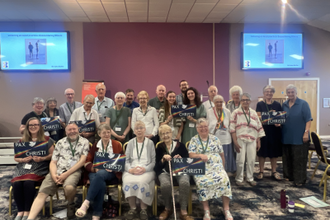








 Facebook
 Twitter
 YouTube
 LinkedIn
 Pinterest