


Wigan: Unique Catholic church given Grade II* listed status
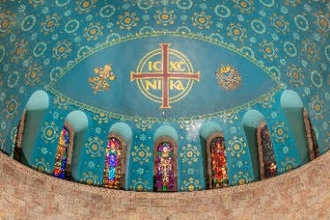
An extraordinary Catholic church in Ashton-in-Makerfield, Wigan, considered one of the finest early-20th century churches in England, has been upgraded from Grade II to Grade II* listed status by the Department for Digital, Culture, Media and Sport (DCMS), on the advice of Historic England. The upgrade is in recognition of its remarkable architectural and historic significance.
The Roman Catholic Church of St Oswald & St Edmund Arrowsmith, built between 1925 - 1930, is judged the masterwork of architect J Sydney Brocklesby and contains an unrivalled collection of stained glass by Harry Clarke, an artist whose influence on early modernist religious glass was profound.
From the outside, the church has walls of pink and buff Darley Dale and Parbold stone which are carved with a variety of Norman-style detail including grotesque faces of angels and demons and decorated arches - no two carvings are the same. Most striking of all is the spiky stone conical roof of the circular stair tower.
Finest Harry Clarke stained glass windows
The church holds 19 intensely coloured stained glass windows by Harry Clarke, the Dublin-born artist celebrated for his jewel-like colours and wide-eyed, sharp-chinned painted faces. The stained glass in Expressionist style was installed between 1930 and 1937. It represents the largest and most significant collection of his work in the UK. Eight of the windows were installed before Clarke's early death in 1931, with others completed by his studio.
A shrine to a local martyr
The church was built to house the Holy Hand of St Edmund Arrowsmith - a relic of the Jesuit priest born near Haydock around 1585, who was executed at Lancaster in 1628 and canonised in 1970. A shrine to house the relic was designed in 1934 by FX Velarde, one of the leading Catholic church architects of the 20th century.
Emma Squire and Claudia Kenyatta, Co-CEO of Historic England said: "This remarkable church with its spiky stone conical tower and jewel-like stained glass by celebrated artist Harry Clarke thoroughly deserves its elevation to Grade II*. Inspired by the Romanesque churches in the south of France, it is widely considered to be J Sydney Brocklesby's masterpiece."
Parish Priest Canon John Gorman, Roman Catholic Church of St Oswald & St Edmund Arrowsmith commented: "As a parish community, we are delighted at the news that St Oswald & St Edmund Arrowsmith Church is now considered to be of more than special interest, and we are most grateful to all those who have helped bring about this Grade II* listing.
"We are, of course, only custodians of what has been handed down to us, and this church is a testament to the faith of those who have gone before us, both those who held on to the faith during penal times, like St Edmund Arrowsmith, and those whose faith led them to build such a magnificent building to the glory of God in the midst of the 1920s depression.
"Our task now is to care for and enhance what we have been given in order to hand on to future generations."
Why this upgrade matters
Grade II* listed status is awarded to fewer than six per cent of listed buildings in England. They are considered particularly important and of more than special interest. This upgrade ensures the church receives the highest level of consideration in any future planning or development decisions.
Protecting remarkable places like St Oswald & St Edmund Arrowsmith Church supports Historic England's commitment to safeguarding the nation's heritage, ensuring that communities can continue to access and benefit from historic buildings and places that connect people to their past.
LINK
St Oswald & St Edmund Arrowsmith Church: https://stoswaldandstarrowsmith.org.uk/
 Facebook
 Twitter
 LinkedIn
 Print
Print Email
Email













 Facebook
 Twitter
 YouTube
 LinkedIn
 Pinterest