

Gospel in Art: Dedication of the Basilica of Saint Mary Major
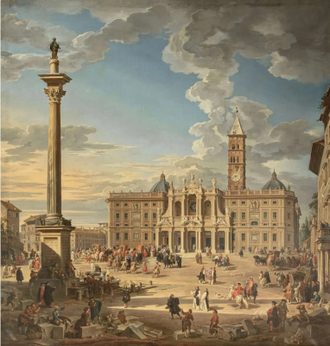
View of Piazza Santa Maria Maggiore, by Giovanni Panini, 1742 © Quirinale Palace, Rome
Source: Christian Art
Gospel of 5 August 2026
Matthew 15:21-28
At that time: Jesus went away and withdrew to the district of Tyre and Sidon. And behold, a Canaanite woman from that region came out and was crying, 'Have mercy on me, O Lord, Son of David; my daughter is severely oppressed by a demon.' But he did not answer her a word. And his disciples came and begged him, saying, 'Send her away, for she is crying out after us.' He answered, 'I was sent only to the lost sheep of the house of Israel.' But she came and knelt before him, saying, 'Lord, help me.' And he answered, 'It is not right to take the children's bread and throw it to the dogs.' She said, 'Yes, Lord, yet even the dogs eat the crumbs that fall from their masters' table.' Then Jesus answered her, 'O woman, great is your faith! Be it done for you as you desire.' And her daughter was healed instantly.
Reflection on the painting
The Dedication of the Basilica of Saint Mary Major is an optional memorial that the Church celebrates each year on the 5th of August. In earlier editions of the General Roman Calendar, today's memorial is called the Dedication of the Basilica of St Mary of the Snows (Dedicatione Basilicae S. Mariae ad Nives), a reference to the legendary story about the foundation of the basilica. For the same reason the feast is also known popularly as Our Lady of the Snows.
The reference to the legend was removed in the 1969 revision of the General Roman Calendar. The 1911 Catholic Encyclopedia summarises ( Ott, Michael. "Our Lady of the Snow." The Catholic Encyclopedia. Vol. 11. New York: Robert Appleton Company, 1911): During the pontificate of Liberius (352 - 366AD), the Roman patrician John and his wife, who were without heirs, made a vow to donate their possessions to the Virgin Mary. They prayed that she might make known to them how they were to dispose of their property in her honour. On 5 August, at the height of the Roman summer, snow fell during the night on the summit of the Esquiline Hill. In obedience to a vision of the Virgin Mary that they had the same night, the couple built a basilica in honour of Mary on the very spot that was covered with snow. From the fact that no mention whatever is made of this alleged miracle until a few hundred years later, not even by Sixtus III in his eight-line dedicatory inscription ... it would seem that the legend has no historical basis." In any case, on 5 August each year, during the celebration of the liturgical feast of the Dedication of the Basilica of Saint Mary Major, a custom that commemorates the story of the miraculous snowfall, is still maintained: at the conclusion of Solemn Mass, a shower of white rose petals is dropped from the ceiling.
Our painting by Giovanni Paolo Panini depicts the Basilica of Saint Mary Major and the square in front of it. It is a charming scene painted in 1742. Giovanni Paolo Panini (1691-1765) was an Italian painter and architect known for his detailed and grandiose paintings of Roman architecture and urban scenes, rendered with exquisite detail. We can see how meticulous he was in his representation of the basilica's architecture. In the background we see a papal procession arriving. Elsewhere in the square are groups of secular faithful and religious, such as Franciscans and Dominicans.
The basilica was built in the 5th century under Pope Sixtus III (432-440). It was constructed to commemorate the declaration of Mary as Theotokos (Mother of God) by the Council of Ephesus in 431. This council affirmed Mary's role in the divine nature of Jesus Christ. The column standing in front of the Basilica of Santa Maria Maggiore (which we see on get left of our painting) is the Colonna della Pace (Column of Peace). Erected in 1614 by architect Carlo Maderno for Pope Paul V, this 14-meter-high marble pillar is the only surviving intact column from the ancient Basilica of Maxentius. It is topped with a bronze statue of the Virgin and Child. An inscription on the column states: EX CVIVS VISCERIBVS PRINCEPS VERAE PACIS GENITVS EST: From whose womb was born the Prince of True Peace.
LINKS
Christian Art: www.christian.art
Today's image: https://christian.art/daily-gospel-reading/matthew-15-21-28-2026/
 Facebook
 Twitter
 LinkedIn
 Print
Print Email
Email











 Facebook
 Twitter
 YouTube
 LinkedIn
 Pinterest