

Gospel in Art: Feast of Saint Ignatius Loyola, Priest
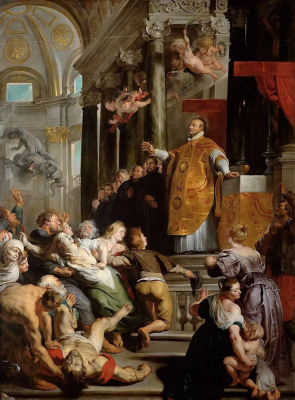
The Miracles of St.Ignatius of Loyola by Pieter-Paul Rubens, 1617/18 © Kunsthistorische Museum, Vienna
Source: Christian Art
Gospel of 31 July 2026
Luke 14:25-33
At that time: Great crowds accompanied Jesus, and he turned and said to them, 'If anyone comes to me and does not hate his own father and mother, and wife and children, and brothers and sisters, yes, and even his own life, he cannot be my disciple. Whoever does not bear his own cross and come after me cannot be my disciple. For which of you, desiring to build a tower, does not first sit down and count the cost, whether he has enough to complete it? Otherwise, when he has laid a foundation and is not able to finish, all who see it begin to mock him, saying, "This man began to build and was not able to finish." Or what king, going out to encounter another king in war, will not sit down first and deliberate whether he is able with ten thousand to meet him who comes against him with twenty thousand? And if not, while the other is yet a great way off, he sends a delegation and asks for terms of peace. So therefore, any one of you who does not renounce all that he has cannot be my disciple.'
Reflection on the painting
Today we celebrate the feast day of Saint Ignatius of Loyola (1491-1556). The Miracles of St. Ignatius of Loyola by Peter Paul Rubens, painted around 1617-1618, is a Baroque canvas that brims theatrical drama, typical of Rubens. Originally commissioned for the Jesuit church of St. Charles Borromeo in Antwerp, this painting was part of a pair, its counterpart being The Miracles of St Francis Xavier (also kept at the Kunsthistorisches Museum in Vienna), both intended to glorify the missionary zeal of the Jesuit order. Rubens, himself educated by Jesuits, delivers a powerful visual sermon in these two canvasses, capturing not just the miraculous deeds of St. Ignatius but the very triumph of divine grace over physical and spiritual suffering.
At the centre of the composition stands St. Ignatius, robed in richly flowing vestments, elevated on a platform above the crowd, bathed in celestial light. His outstretched hand radiates divine power, while the other rests gently on the altar - the very place where he has just celebrated Mass. It is as if, having drawn down the graces of heaven through the Eucharist, he now extends them outward to the suffering crowd before him. Rubens crowds the lower half of the canvas with the sick, the possessed, and the dying: bodies twisted in pain, faces contorted in desperation, and figures reaching upward with hope. The scene is chaotic yet meticulously composed. Light floods down from the upper background, where angels and cherubs hover, illuminating the saint and suggesting that these miracles are sourced in divine grace, not mere human power.
Our painting doesn't depict one specific miracle from St Ignatius' life. Instead, it presents a theatrical, generalised depiction of the kinds of miracles that were attributed to him after his death, particularly exorcisms and healings (of body and soul) performed through his intercession.
The theatricality, muscular figures, and emotional intensity are all typical of Rubens' Baroque mastery. But beyond its style, the painting is a powerful piece of Jesuit communication: it proclaims the holiness of their founder and the Church's authority to heal both body and soul. As such, it would have deeply moved and inspired the faithful entering the Jesuit church in Antwerp, reminding them not only of St Ignatius' miracles, but of the living power of the Church itself.
LINKS
Christian Art: www.christian.art
Today's image: https://christian.art/daily-gospel-reading/luke-14-25-33-2026/
 Facebook
 Twitter
 LinkedIn
 Print
Print Email
Email














 Facebook
 Twitter
 YouTube
 LinkedIn
 Pinterest