


A British Childhood. How Our Children Live Now
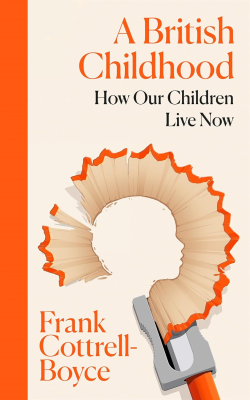
A British Childhood. How Our Children Live Now. Publisher: Picador, Dublin 2026
No teacher needs to read this book - unless they wish to marvel at the extraordinary work that they do, guiding their young charges through the post-Austerity, post-Covid, over-stimulated, over-connected and yet strangely isolated mlieu we have created. The rest of us would benefit enormously from engaging with Frank Cottrell-Boyce's reflections on 'How Our Children Live Now'.
The book is the fruit of two years spent working with the educational charity, 'The Book Trust' during his time as Children's Laureate. It is drawn from diary entries made during his tour of schools up and down the country, from little infant schools to large secondaries, taking in a Young Offenders' Institution on the way and more or less tracing the path from preschool to post-pubescent. The exoskeleton for his ruminations is constructed using one children's book (or poem) per chapter, from 'The Very Hungry Caterpillar' to 'The Railway Children'.
All is delivered in the easy cadences of the Cottrel-Boyce voice, a voice familiar both from the author's radio work and from his own children's writings - not to mention the opening ceremony of the 2012 Olympic Games. Maybe that event was the last time when the British nation seemed at peace with itself, even if the myth-making smoothed over cracks already opening up as a result of George Osborne's austerity programme. That policy gets frequent negative attention in this book, since it robbed the young of all the Sure Start Centres, many public libraries, health centres and youth clubs and the attendant professional youth workers. It was the teachers who were left to pick up the pieces. "Now in many neighbourhoods the school is the last evidence of the civic sphere - the Alamo of services." And yet, "These losses were not beyond our control. They were policy choices. They can be reversed."
The book often feels like a velvet glove, an easy read recording delightful encounters and wonderful moments, and yet when it needs to it packs a real punch and calls us to account with a quiet anger. Each chapter (there are ten) has sentences which deserve long contemplation, quirky facts about the children's authors whose narratives framed our own childhoods (the connection between the Wounded Knee Massacre and The Wizard Of Oz, for instance) and present-day stories which appal.
"When did our children become invisible?" he wonders near the beginning. And on an early school visit wonders how children could possibly be sad at the prospect of the summer holidays. (Teacher's answer: "School is where our kids feel secure. It's where they're fed. It's their happy place. They don't like the summer.") Again, who knew that there was such a thing as 'furniture poverty', the re-housed poor typically ending up in unfurnished flats? ("No one is going to believe that there might be snow and Turkish Delight in the wardrobe, if there is no wardrobe.") And, more positively, he offers the aphorism: "Shared fun creates trust. Trust creates community. Community is strength."
As you might expect, the author writes with a passionate belief in the value of reading for children. It gives them social capital, creates neural pathways, offers them a sense of self and security, and creates ritualised experiences of belonging in the bed-time story. He cites modern understandings of child development and neurology, anecdote and sociological studies to sustain his argument. Thus: "The number of pre-school children being read to dropped from 69% in 2013 to under 50% now. 28% arrive at school without knowing even how to handle a book."
He doesn't blame parents, nor settle for sheer moral panic over the advent of the world of small screens or the coming prospect of AI-generated content, but he still wrily says of the algorithms delivering content to the young: "it is not that kids are watching too much in absolute terms but that they are watching too much of the same thing .. When we go down a YouTube rabbit hole, we mostly don't have adventures in Wonderland. We mostly just lose a lot of time." Again, he calls us to take stock and to assert control over what our children are absorbing: "If we vacate the story-teller's chair by the campfire, another storyteller will take our place. If we don't tell our own stories, someone else will tell theirs … we become the stories we tell."
This book is all about stories - the stories we tell our children and the stories they are telling us (if we'll just listen): "We live by stories. It's probably best to live by the true ones."
Canon Rob Esdaile is parish priest of Woking & Knaphill Catholic Community
 Facebook
 Twitter
 LinkedIn
 Print
Print Email
Email












 Facebook
 Twitter
 YouTube
 LinkedIn
 Pinterest