

Liverpool Interfaith Walk brings communities together
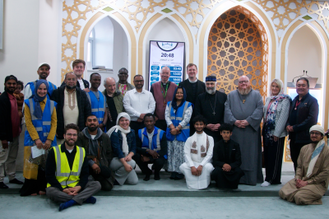
On a balmy summer evening, faith leaders and community organisers hosted a simple yet profound interfaith walk through L8, an inner-city Liverpool neighbourhood enriched by a vibrant mix of students alongside long-established and newly arrived migrant communities.
Now in its fourth year, the event attracted more than 230 participants, with some travelling from well beyond the Liverpool region. "In the first year, when the first 20 people arrived, we thought that was a decent number, but then more kept coming and we ended up with 120! We called Al Rahma and said we'll need more food," recalled one of the organisers, Piara Miah of Faiths4Change.
The idea for the walk emerged after the then Rector of Liverpool, Rev Canon Crispin Pailing, approached Joe Ramsden (previously of Kuumba Imaani) about organising an interfaith walk in Liverpool 8 ahead of the Coronation of King Charles III in 2022, reflecting the King's long-standing commitment to interfaith dialogue and religious diversity. Although the walk was not held that year, the initiative subsequently took shape through collaboration with Faiths4Change and other local partners. Over the past two years, the event has been supported by the Duchy of Lancaster Benevolent Fund, with this year's walk also receiving support from Councillor Rahima Farah.
The event began at St Philip Neri Roman Catholic Church, now home to the University Chaplaincy. After introducing the history of the building, including its recent appearance in This City Is Ours, starring Sean Bean, Fr Neil Ritchie, the chaplain, answered questions from participants. He spoke about efforts to build relationships across faith communities through both social outreach and dialogue. During university term time, students from Catholic and other Christian traditions volunteer at the soup kitchen run by the Missionaries of Charity Sisters. The chaplaincy also hosts interfaith panels where representatives from the Jewish, Christian, Muslim, and Hindu communities answer students' questions, while regularly welcoming visits from student groups of other faiths. Fr Ritchie emphasised the Church's desire to become more outward-looking and to engage positively with people of different religious traditions.
Will Kelly, a Liverpool resident, commented, "The first thing that stuck me about this event, and what I will remember for months to come, is the number of people that attended. It's a rare enough thing when you get to see a church, a synagogue and a mosque packed with so many different souls all brought together by this amazing expression of solidarity amongst the faiths in Liverpool."
From there, Fr Stavros led the group to the Greek Orthodox Church of St Nicholas, dedicated to the patron saint of sailors and merchants in honour of Liverpool's maritime heritage. Born and raised in Liverpool, Fr Stavros explained several aspects of Orthodox tradition, including the customary seating arrangement in which men and women sit separately, with unmarried women traditionally seated in the upstairs gallery behind a low screen. He also described the bishop's visits, which occurs around three times a year, when the usual three-hour Mass can extend to five hours. One comment particularly captured the audience's imagination. After hearing that women do not enter the sanctuary, several Muslim women jokingly asked, "If women aren't allowed in the sanctuary, who does the cleaning?"
Afterwards, the group, led by Rabbi Warren Elf, made the short walk to the Grade I-listed Princes Road Synagogue, passing the striking mural of Nelson Mandela bearing his famous words, "Education is the most powerful weapon you can use to change the world."
The visit coincided with the Jewish fast of the Seventeenth of Tammuz, commemorating the breach of Jerusalem's walls before the destruction of the Second Temple. It marks the beginning of the Three Weeks, the period of mourning leading to Tisha B'Av. Participants were respectfully reminded not to eat inside the synagogue, and the men were provided with kippah before entering.
Dr Peter Grant, a member of the synagogue's board, guided visitors around the magnificent building, which celebrated its 150th anniversary in 2024. He shared that when Liverpool's Jewish community commissioned their flagship synagogue, seven architectural firms submitted designs, six of them Jewish. The winning design, however, came from the Scottish Presbyterian Audsley brothers. Visitors admired the richly decorated interior, adorned with intricate geometric and floral patterns but notably free of human images, a feature immediately recognised by several Muslim participants. This provided an interesting contrast with St Nicholas Greek Orthodox Church, whose walls are filled with icons of Christ, the Holy Family, and saints.
Questions naturally followed about Jewish traditions, including the differences between Orthodox and Progressive Judaism, particularly concerning the role of women and practices surrounding ritual purity, such as immersion in the mikveh. The highlight came at the end of the tour, when Dr Grant drew back the heavy curtains to reveal the Ark containing the Torah scrolls, a breathtaking sight that drew audible admiration from the crowd.
The final stop was the Al Rahma Mosque. Here, women covered their heads and everyone removed their shoes before entering the prayer hall. Dr Badr Abdullah, Chairman of Liverpool Muslim Society (LMS), recounted how Liverpool's Muslim community began in 1953 when Al-Haj Ali Hizzam, a Yemeni sailor, opened a prayer room in his own home. Over the decades, that small beginning has grown into today's mosque, which has undergone several expansions and can now accommodate up to 3,000 worshippers.
The journey towards deeper interfaith understanding has not always been easy. Mustafa Abdul Yassir of LMS reflected:
"There are people who want us to fear our differences rather than celebrate them. They want to convince us that there cannot be a church, a synagogue, and a mosque on the same street, let alone share the same vision of a peaceful community. But look around you today-this interfaith walk is our answer to that. When we open our doors to one another, fear evaporates. When we discover that mercy, charity, and love of neighbour are woven throughout the Torah, the Gospel, and the Qur'an, we realise just how much we truly share."
Rocio, a participant from Mexico, agreed, "We are all brothers and sisters as we are all sons of God. This walk was a reminder of the similarities rather than what could make us different. I had the honour to hear about other people's experiences of meeting God which reminded me of His Greatness and Highness."
The evening concluded with an impassioned reflection from the community chaplain, Abdulwase Sufian, "If the hearts are united, the people will be united!"
Perhaps the greatest sign of that unity came afterwards, as everyone gathered around a shared meal at the recently opened World Faith Café. Conversations continued long into the evening, proving once again that friendship often begins with simply walking together, and sharing a table.
 Facebook
 Twitter
 LinkedIn
 Print
Print Email
Email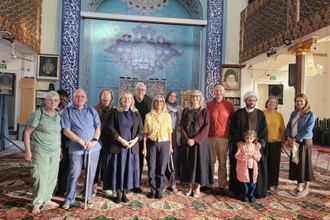






 Facebook
 Twitter
 YouTube
 LinkedIn
 Pinterest