


Cardinal Czerny's Message for Sea Sunday: A ship must never be a place of isolation
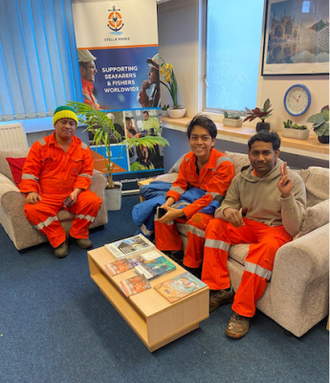
Crew on a recent visit to Stella Maris Seafarers Centre in Hull
In his message for Sea Sunday 2026, Cardinal Michael Czerny SJ, highlights the complex challenges maritime workers face today as the sea today is "increasingly marked by tension, insecurity, war, and fear."
Each year on the second Sunday of July, Christian Churches around the world mark Sea Sunday-a day dedicated to praying for maritime workers and their families. In 2026, the day falls on July 12 and the theme is 'Harbours of Hope: The Church Alongside Seafarers.'
Cardinal Michael Czerny, Prefect of the Dicastery for Promoting Integral Human Development, wrote a message for Sea Sunday with the title, 'Beyond Cargo and Commerce: The Human Face of the Sea'.
In his message, the Prefect highlighted how the world continues to rely on seas, lakes, rivers, and waterways. However, he made sure to place the emphasis on the faces behind the maritime businesses: the more than 1.8 million people whose work is tied to waterways.
So many livelihoods, communities, and families rely on these men and women. "The crisis of the Strait of Hormuz has reminded the world of how deeply humanity depends on the sea and those who work upon it," Cardinal Czerny explained.
That is why on Sea Sunday, the Catholic Church "remembers these men and women not merely for the work they perform or the goods they transport, but as human persons created in the image and likeness of God and endowed with inviolable dignity."
Each maritime worker or seafarer has a story and, the Cardinal stressed, deserves to be "seen, honored, and cherished."
However, Cardinal Czerny pointed out that maritime workers still face uncertainty as the sea, "which has long connected peoples and nations, is increasingly marked by tension, insecurity, war, and fear." Not only do crews have to confront the dangers of the water, but now they also face the consequences of conflict-food shortages, their confinement, and fear for their own lives.
This shift has increased their feeling of being isolated from society as a whole, their time apart from their families, and their emotional fatigue.
Even with technology, the Cardinal Prefect argued many feel even greater isolation, as "human closeness is becoming rarer." Maritime workers see their crews getting smaller, shorter time ashore, constant pressure, and tight schedules.
As Pope Leo XIV's encyclical Magnifica Humanitas stresses, technological and economic systems must never reduce people to "data, a cog in a machine or a commodity." Instead, human dignity and freedom must be preserved.
A ship, therefore, must never be a place of "silent isolation or indifference, a modern Babel where people live side by side yet remain unseen and unheard."
Life at sea, rather, can be an example of people of different nations, cultures, and beliefs living in fraternity, solidarity, and respect.
Cardinal Czerny highlighted how the sea can teach humanity that "we belong to one another. Oceans do not divide people; they connect them." The Catholic Church is working to remind every maritime worker that they are never alone or forgotten.
Moreover, the oceans are not simply commerce routes, but they are God's creation, which was entrusted to humanity to care for. Yet, the world's waterways suffer from pollution, environmental degradation, and exploitation. About 88% of the sea's surface is polluted by plastic waste. In 2018, almost 90% of the world's fish supply had been exploited or depleted.
But this is not just a marine life or maritime worker problem. As the Cardinal Prefect stressed, "when the oceans suffer, humanity suffers with them." It is the responsibility of all to protect marine life, promote ethical and sustainable practices, defend dignity and safety of maritime workers, and develop spirit of global responsibility to care for our seas.
The Church cannot be distant from this responsibility either. Rather, the Church must be close to maritime workers and seafarers. "She is called to enter the boat: to accompany, to listen, to console, to defend human dignity, and to become a visible sign of hope and home amid the storms of human life."
Through chaplaincies and ministries dedicated to these men and women, the Church can continue this "long tradition of the Apostleship of the Sea (Opus Apostolatus Maris)", focused on reminding each "seafarer, fisher, maritime worker, and inland navigation worker that they are remembered, valued, and never alone."
Read the full 2026 Message for Sea Sunday
Stella Maris (formerly known as the Apostleship of the Sea) Stella Maris is the largest ship-visiting network in the world, and the official maritime charity of the Catholic Church, supporting seafarers, fishers, and their families in the UK and around the world.
For more information see: www.stellamaris.org.uk
 Facebook
 Twitter
 LinkedIn
 Print
Print Email
Email









 Facebook
 Twitter
 YouTube
 LinkedIn
 Pinterest