

Pope Leo closes Consistory with appeal for peace
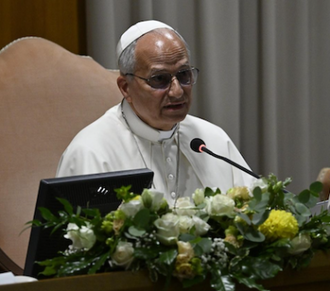
Image: Vatican Media
Source: Vatican Media
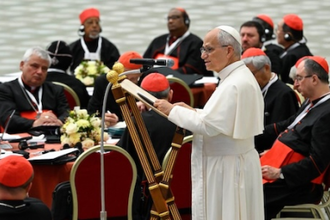
Pope Leo XIV gave his closing address to the Extraordinary Synod of Cardinals, on Saturday, focusing on hope, synodality, and the Church's responsibility in a world marked by war and a crisis in human relationships.
Before beginning his reflection, the Pope expressed his closeness, together with the entire College of Cardinals, to the people of Venezuela, which has been struck by severe earthquakes.
"We assure our prayers for the victims, for their families, and for all those suffering the consequences of this tragedy. We also entrust to the Lord all those involved in rescue operations, and we ask that the solidarity of the international community toward that beloved nation may not falter.," the Pope said.
Pope Leo began his wide-ranging address by emphasising: "We now come to the end of these days with a deep sense of gratitude. I thank you for the freedom, fraternity, and ecclesial spirit with which you took part in our work. I carry with me not only the content of your reflections, but also the experience that made them possible."
"We have sought together the will of the Lord, convinced that Christ continues to act in his Church: it is He who goes before us, gathers us, speaks through our brothers, and leads us in mission. Everything comes from Him and everything returns to Him," he continued. For this reason, he said that "seeing Cardinals from such diverse Churches, cultures, and situations listening to one another and seeking together what best serves the Gospel has been for me a source of consolation and hope."
At the heart of his reflection, the Pope insisted that synodality must not be understood as an organizational method or a sequence of meetings, but as a way of being Church.
The real question of synodality is not who has the power to decide, but 'how do we together safeguard the gift that the Lord has entrusted to his Church?'" he stated.
Pope Leo said this journey is born of encounter, grows through mutual listening, and matures through discernment guided by the Holy Spirit. He therefore asked the cardinals to promote the implementation of the synodal process in their particular Churches, fostering an authentic understanding of it.
Pope Leo also noted that during the Consistory the cardinals shared their concern for the wars, poverty, injustices, and violence affecting many peoples around the world. However, he said that behind these tragedies lies an even deeper crisis: "loneliness, the crisis of relationships, the loss of hope, and the difficulty of recognising one another as brothers and sisters."
The Pope particularly highlighted the situation of young people, whose search for meaning and authenticity-and, in some cases, suffering that even leads to taking one's own life - represents "one of the deepest wounds of our time."
He also underlined the importance of the family as a school of relationships, solidarity, and hope. In this context, he announced a meeting in October with the leaders of the Eastern Churches and the presidents of episcopal conferences to evaluate the reception of Amoris Laetitia, in which families will also take part.
One passage of the address was dedicated to peace. In it, Pope Leo stated that the cardinals clearly grasped one of the insights of the encyclical Magnifica humanitas: War does not arise only from conflicts between states, but from a "culture of power" that permeates human relationships, economics, politics, technology, and even religion.
In response, he proposed rebuilding a culture of cooperation and dialogue, strengthening multilateralism, and promoting the participation of lay people in public life inspired by the Church's social doctrine.
The Pope also defended non-violent response as a profoundly evangelical option, clarifying that it does not mean passivity, but rather confronting conflicts without reproducing the logic of hatred.
In this context, he revealed that several working groups had requested deeper theological and pastoral reflection on legitimate defence in light of the changes affecting contemporary conflicts.
Pope Leo insisted that the renewal of the Church does not depend only on structural reforms, but above all on the witness of communities capable of living the Gospel credibly.
"The Church is called to become ever more fully what it proclaims," he said, emphasising that all institutional reform will bear fruit only if it arises from encounter with Christ and sacramental life.
The Pope also reiterated his intention to continue this annual gathering starting next year. He clarified that the date has not yet been set, but he hopes to announce it by the end of this year.
At the conclusion of his address, Pope Leo fully adopted as his own the unanimous appeal that emerged from the Consistory and invited the cardinals to pass it on to all the churches and peoples of the world.
"God continues to open paths of reconciliation and peace in history. We have the responsibility to walk them with courage and to help the world recognise them," he said.
He thanked everyone for their contribution, "as well as the Relators, the Moderators, and all those who, with generosity and discretion, made these days of work and fraternity possible."
"Thank you for helping me, once again, to recognise the work that Christ continues to accomplish among his people and in the world. We entrust the fruits of this Consistory to the intercession of the Virgin Mary, Mother of the Church. May she teach us to preserve unity in diversity and to serve the Gospel of peace with humility, courage, and hope. Thank you!"
Read the full text of Pope Leo's address: https://press.vatican.va/content/salastampa/it/bollettino/pubblico/2026/06/27/0557/01052.html
 Facebook
 Twitter
 LinkedIn
 Print
Print Email
Email








 Facebook
 Twitter
 YouTube
 LinkedIn
 Pinterest