


Eightieth anniversary of the Crusade for Reconciliation
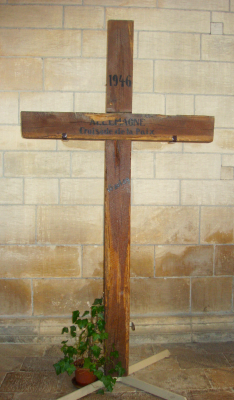
The German Vézelay Cross
Eighty years ago, under the hot summer sun of 1946, a great peace pilgrimage converged on Vézelay in France, as war-weary people turned to the Cross in their longing for pardon, reconciliation, and peace for their children and the world.
'Cross of Christ, give us peace' became the constant refrain of the British pilgrims who walked across France that summer. Their destination, the Abbey of Vézelay, 225 km south-east of Paris, and dedicated to St Mary Magdalen, had been on the pilgrim route to Compostela since medieval times.
In 1946, the initiative for this momentous pilgrimage had come from the Benedictine monks of Vézelay to commemorate the 800th anniversary of the second crusade, preached by St Bernard of Clairvaux to thousands of armed knights gathered there in March 1146.
During the Second World War, Pope Pius XII had appealed for Christian 'crusaders' who would courageously reject vengeance when hostilities ceased, and put their strength into creating 'a new world in which all nations, healed from the wounds inflicted by violence… would advance in concord along the path of goodness'.
If the word 'Crusade' had come to evoke ruthless bloodshed, this peace crusade, the Benedictines proposed, would reclaim its Christian meaning derived from the 'cross'. The plan was for 14 crosses representing the Stations of the Cross to be brought to Vézelay from the extremities of France and abroad in a fervent prayer for reconciliation.
Marthe Dortel-Claudot, who, with Bishop Théas, had founded Pax Christi in France just the year before, was quick to pledge its support. Their newsletter for Easter 1946 called on members to pray with and join the pilgrimage if they could. She also wrote to Cardinal Griffin of Westminster, asking whether one of the 14 crosses might be brought from England.
It was Fr Gerald Vann OP who picked up the invitation. He had established in 1937 the 'Union of Prayer for Peace' (much more acceptable to the bishops than PAX, founded in 1936) and his book Morality and War (1939) had helped many Catholic conscientious objectors. In 1946 hundreds replied to his appeal in the Catholic press for men willing to walk 300 miles carrying a heavy cross - and donations quickly covered the expenses. Thirty volunteers were selected, aged between 22 and 65, from all parts of the UK, and from various trades and professions. Many had been recently demobbed from the armed forces. An ex-miner ex-publican from Blackburn walked in his wooden clogs. Two young Dominicans, Columba Ryan and Simon Blake, were part of the group.
They all met for the first time on 29 June at St Dominic's Priory in London where they were commissioned, and the solid oak cross, six foot high and weighing 90 lbs, was blessed. After a 5am Mass the next morning the pilgrims set off. In Dieppe an unexpected but triumphant reception greeted them, with religious and civic dignitaries, flags flying and bells ringing, as thousands of people lined the route: small girls in white, Young Christian Workers, scouts and guides forming a guard of honour. At midnight Mass over 1000 received Communion. Bowled over by the fervour of French Catholics as they venerated the cross, it dawned on the pilgrims that they were embarking on something very significant.
In some regions, more secular or Communist, no one came out to meet them, but for much of the journey they were accompanied by local people and often handed on from the boundary of one parish to another. Flowers - lilies, roses, cornflowers, marguerites, carnations, dahlias - were brought to wreath the cross or carpet the road. In one place a parish priest came barefoot; in another two girls helped to carry the cross; villagers shared their rations; some knelt in the road as the cross passed by. 'It is a pilgrimage of perpetual adoration,' wrote the group's diarist, with the rosary being said or sung the entire way, and rousing French hymns alternating with their English and Latin repertoire. ('Faith of our Fathers' they found too slow for the pace they kept up.) They stopped at wayside shrines, village churches, and diverted one day to bring the cross to the bedside of a dying woman.
The scars of war were everywhere: buildings in Rouen with huge jagged rents from Allied bombing, ruined churches, prayers by the roadside grave of a Resistance member and by the wooden crosses over two buried British soldiers.
It was a truly penitential journey. The diarist recorded that taking one's ten-minute turn at carrying the cross was 'an ordeal for the toughest of us'. The edges of the cross cut their clothes and bruised their shoulders. On the longest day they walked 36 km. By the end 'the heat, the burden of the cross, sore and aching feet and downright illness - all have taken their toll'. When they stopped some could hardly stand up.
After eighteen days, the British pilgrims looked down on Vézelay from the hill assigned for their final night's vigil. As some knelt around the cross, others gathered wood for a bonfire beacon. When the abbey clock struck ten a monk sent up a flare, and rockets responded from the neighbouring hills. 'The pilgrim groups had answered: "All present".'
On Saturday 20 July all the crosses were brought in a silent torchlit procession to the basilica. Five came from Belgium, Luxembourg, Austria, Switzerland and England; the rest from different parts of France. But 'a fifteenth cross was raised that evening with the shout of "Germany". It was a rough-hewn, heavy cross, made by German prisoners of war working in Vézelay. Grouped behind it were the soldier prisoners in field-grey.' To this day the crosses stand around the basilica walls as a reminder of that sacrificial and historic pilgrimage of faith and hope in the peace that Christ promised.
 Facebook
 Twitter
 LinkedIn
 Print
Print Email
Email














 Facebook
 Twitter
 YouTube
 LinkedIn
 Pinterest