


The mystery of the Walsingham statue
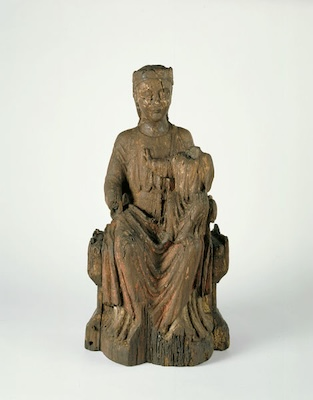
Langham Virgin & child. Image: V&A
Source: Diocese of East Anglia
A fascinating illustrated talk in Walsingham has reignited debate over one of the greatest mysteries in English Catholic history: what really happened to the original statue of Our Lady of Walsingham?
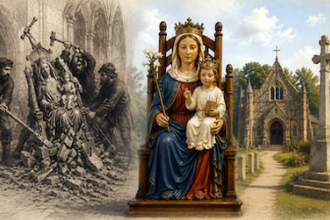
During the final week of May, a flyer appeared around the village featuring an image of the great Chelsea bonfire, where countless religious statues were destroyed on the orders of Thomas Cromwell during the Reformation. The flyer posed a provocative question: "In July 1538 the revered statue of Our Lady of Walsingham was destroyed. But was it? Has it survived?"
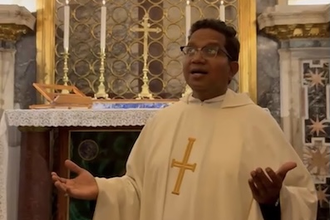
The talk, delivered by Fr Michael Rear in the Walsingham Parish Hall, was originally arranged at the request of a group of Sisters on pilgrimage. Interest soon spread, however, and the event was opened to the public. By the time Fr Michael began his presentation, the hall was filled to capacity.
Over the course of an engrossing hour, Fr Michael set out the evidence supporting his belief that a 13th-century English oak statue of the Virgin and Child, now housed in the Victoria and Albert Museum, could in fact be the original statue of Our Lady of Walsingham. While he has previously published several articles on the subject, the talk offered local residents and pilgrims the opportunity to hear his case presented in person, accompanied by a series of detailed slides.
Although the statue in the V&A is heavily damaged, Fr Michael highlighted its striking resemblance to the image of Our Lady depicted on the medieval Priory seal. He noted several intriguing features, including a carved band around the Virgin's head, indicating that a crown was once attached. Could this have been the crown presented by King Henry III? Dowel holes in the figure suggest it was once fixed to a throne, while evidence of deliberate alteration at the base raises further questions. Something valuable appears to have been chiselled away from beneath Our Lady's feet. Fr Michael suggested this may have been the famous 'toadstone' described by the Dutch scholar Erasmus during his visit to Walsingham.
Erasmus also recorded that the statue of Our Lady of Walsingham was relatively small. The V&A's 'Virgin and Child' measures just 46 centimetres in height, adding another intriguing point of comparison.
Whatever its true origins, Fr Michael argued that the statue must have been highly prized. If it is indeed the original image, someone would have taken a tremendous risk to preserve it during the upheaval of the Reformation. Hidden away for centuries, it eventually came into the possession of the Victoria and Albert Museum in 1925.
Known today as the 'Langham Virgin and Child', uncertainty remains about the meaning of its title. Does 'Langham' refer to Langham in Essex, or Langham in Norfolk, just six miles from Walsingham and historically associated with prominent recusant Catholic families?
The possibility remains that a substitute statue was surrendered to Cromwell's agents while the original was secretly saved. Yet, as Fr Michael readily acknowledged, definitive proof remains elusive. Without new evidence, the mystery may never be conclusively resolved.
What was beyond doubt, however, was the enduring attraction of Our Lady of Walsingham herself. The packed hall reflected the continuing power of her shrine to bring people together, young and old, pilgrim and villager, Anglican and Catholic alike, united by a shared devotion to England's Nazareth.
 Facebook
 Twitter
 LinkedIn
 Print
Print Email
Email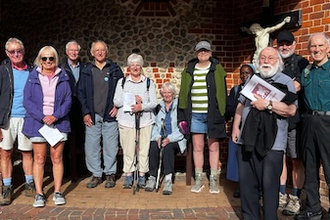
















 Facebook
 Twitter
 YouTube
 LinkedIn
 Pinterest