


Gosprl in Art: Saint Alban, first martyr of England
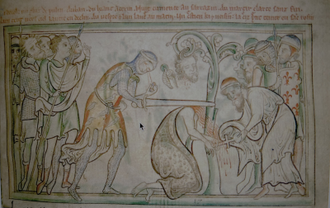
Sanctus Albanus decapitatus, 13th Century manuscript of The Life of St. Alban, 1250. Trinity College Dublin Library, nr MS E. I40, folio 38r
Source: Christian Art
Gospel of 20 June 2026
Matthew 6:24-34
At that time: Jesus said to his disciples, 'No one can serve two masters, for either he will hate the one and love the other, or he will be devoted to the one and despise the other. You cannot serve God and money.
'Therefore I tell you, do not be anxious about your life, what you will eat or what you will drink, nor about your body, what you will put on. Is not life more than food, and the body more than clothing? Look at the birds of the air: they neither sow nor reap nor gather into barns, and yet your heavenly Father feeds them. Are you not of more value than they? And which of you by being anxious can add a single hour to his span of life? And why are you anxious about clothing? Consider the lilies of the field, how they grow: they neither toil nor spin, yet I tell you, even Solomon in all his glory was not arrayed like one of these. But if God so clothes the grass of the field, which today is alive and tomorrow is thrown into the oven, will he not much more clothe you, O you of little faith? Therefore do not be anxious, saying, "What shall we eat?" or "What shall we drink?" or "What shall we wear?" For the Gentiles seek after all these things, and your heavenly Father knows that you need them all. But seek first the kingdom of God and his righteousness, and all these things will be added to you.
'Therefore do not be anxious about tomorrow, for tomorrow will be anxious for itself. Sufficient for the day is its own trouble.'
Reflection on the manuscript page
Saint Alban is venerated as the first recorded British Christian martyr and, therefore, as the British protomartyr (a Christian protomartyr is the first person to die as a martyr for the Christian faith in a particular country or region). Along with fellow Saints Julius and Aaron, Alban is one of three named martyrs recorded in Roman Britain. He is believed to have lived during the 3rd century in the Roman city of Verulamium, which is modern-day St Albans, Hertfordshire.
Alban was a pagan Roman soldier who converted to Christianity. The pivotal moment in his life came when he sheltered a Christian priest, known as Amphibalus, who was fleeing persecution. Deeply moved by the priest's faith and piety, Alban converted to Christianity and was baptised. When Roman soldiers came searching for the priest, Alban exchanged clothes with him to allow the priest to escape. As a result, Alban was arrested and brought before the Roman authorities. Despite being threatened, he refused to renounce his new faith. Alban was sentenced to death. As he was led to his execution, various miracles were reported, such as the drying up of a river to allow him to cross. At the execution site, a miraculous spring of water appeared, and the executioner's eyes reportedly fell out after he executed Alban. He was beheaded on what is now known as Holywell Hill, around 250 AD.
This is the scene being depicting in our manuscript of circa 1250 AD. As the beheading takes place, the dove of the Holy Spirit is flying off, the soldier's eyes are popping out and the head is hanging on a tree. In legends, after his execution Alban's head rolled downhill and hung from a tree; below the head a well sprang up. Upon hearing of the miracles, the astonished judge ordered further persecutions to cease and he began to honour the saint's death. St Albans Cathedral now stands near the site of his execution on Holywell Hill and there still is a well at the bottom of the hill.
The earliest mention of Alban's martyrdom is believed to be in Victricius's De Laude Sanctorum (The Praise of Saints), circa 396 AD. Victricius had just returned from settling a dispute among the bishops of Britain. He does not mention Alban by name but includes an unnamed martyr, who, "in the hands of the executioners told rivers to draw back, lest he should be delayed in his haste." Saint Bede then gives a much fuller account in his Ecclesiastical History of the English People, circa 730 AD.
Saint Alban. Pray for us.
LINKS
Christian Art: https://christian.art/
Today's reading: https://christian.art/daily-gospel-reading/matthew-6-24-34-2026/
Video: How art called me to the priesthood: www.indcatholicnews.com/news/55096
 Facebook
 Twitter
 LinkedIn
 Print
Print Email
Email






 Facebook
 Twitter
 YouTube
 LinkedIn
 Pinterest