


Care Not Killing disappointed by 'ideological' decision to bring back deeply flawed assisted dying bill

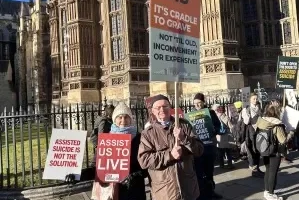
image: ICN/JS
Care Not Killing announced this evening that it is deeply disappointed at the 'ideological' decision to bring back the deeply flawed assisted dying bill, despite poll after poll confirming the public do not see it as a priority.
The Assisted Dying Bill for England and Wales is set to return to parliament after Labour MP for Rochester and Strood, Lauren Edwards said she wanted to give the legislation another chance after it ran out of time in the House of Lords on its first attempt.
Edwards came second in the private members ballot, in which MPs' names are drawn at random to determine who gets a chance to introduce a bill of their own design. She voted in favour of assisted dying when Kim Leadbeater tried to pass her bill in the last session of parliament.
The plan now is to bring back exactly the same legislation, in the hope that MPs will back it this time round.
Dr Gordon Macdonald, CEO of Care Not Killing, commented: "We are obviously disappointed by this illogical and ideological decision to bring back the a deeply flawed bill. A bill that was so riddled with errors not a single doctors' group or disabled group supported it. A bill that even before it went to Committee in the Commons saw an important safeguard removed, namely the High Court overseeing each application. A bill that was so poorly drafted even it's sponsor in the House of Lords had to table 74 amendments."
He continued: "Trying to introduce an assisted dying law is a complex and technical matter that must not be rushed, because if is, vulnerable people will pay the price with their lives. Indeed when the main arguments are put to members of the public, support for changing the law drops to just 13 per cent. And why polling consistently shows the public would rather Members of Parliament to concentrate on fixing the palliative, addressing the housing crisis, easing the cost of living crisis, tackling immigration and many other issues over introducing a law to allow people to kill themselves."
Dr Macdonald also went on to highlight the lack of democratic mandate for the Bill, as Labour did not include it in its manifesto ahead of the last election. A recent mega poll by Whitestone Insight for The Other Half group showed that 60 per cent of the public oppose Parliamentary scrutiny being curtailed in both houses to force the Bill into law by use of the Parliament Acts, including a clear majority of Lauren Edward's own constituents. Indeed, only 34% percent of the electorate voted for Labour at the last election, so the Labour MP would be wrong to suggest that the Labour Government has a democratic mandate to support the bill being forced through by use of the Parliament Acts.
And he concluded by restating the catalogue of problems exposed by the House of Lords in the detail scrutiny they undertook in the last session of Parliament.
Problems include:
- The Delegated Powers and Regulatory Reform Committee described the Bill as "skeleton legislation" with "sweeping, unspecified and unjustified" powers given to ministers.
- The Equality and Human Rights Commission said it cannot be guaranteed that access will not be expanded by the courts.
- 23 per cent of people given a six-month prognosis will be alive three years later. Many may end their lives prematurely. Lord Falconer dismissed the error rate as "not massive".
- The Government will have to divert money from existing NHS budgets to fund assisted dying. Health Minister Stephen Kinnock said that the Government will have to 'reprioritise spending' to fund assisted dying.
- The health service will be incentivised to prioritise cheap assisted deaths over expensive palliative care. Lord Simon Stevens, former Chief Executive of the NHS, warned that the Bill is a 'Trojan horse' for fundamental change to the NHS by the back door. He warned that it will encourage "self-coercion in the name of altruism" where vulnerable patients might choose to die early out of a misguided desire to prevent their being a burden and 'protect the NHS'. We have seen reference to this in the most recent Covid inquiry report.
- Doctors, nurses and hospices are inadequately protected. Instead of medics being given the choice to "opt in" to the new system, the Bill assumes they are willing to help end patients' lives unless they opt out. Hospices and care homes have not been given the right to say they will not participate- which could see them lose funding if they do not. Meanwhile, if medics do participate and say something to a patient that makes them feel pressured to choose an assisted death, even if this is completely unintentional, they could face up to life in prison.
- Children do not need to be told before the life of a parent is ended. Lord Falconer said that parents should not have to tell children, nor do there need to be arrangements made for the child's care after a parent's death.
- Those being kept in care homes or hospitals over concerns for their safety or that they are suicidal could qualify for an assisted death. That includes people who are suicidal.
- Those with conditions such as Bulimia and Type 1 Diabetes could qualify for an assisted death. Whilst the anorexia loophole has been acknowledged, Lord Falconer has not addressed other conditions.
- Professional bodies have said the safeguards are inadequate. Organisations ranging from Mind to the British Association of Social Workers have said the safeguards are inadequate. No member of the panel will have the power to access local authority or police records to detect domestic abuse.
- A terminal diagnosis could be given to an elderly person suffering from a combination of frailty and pneumonia. The Government has admitted that a combination of "non-fatal" conditions could result in a terminal diagnosis, representing a very slippery slope to widening the breadth of conditions that might qualify.
- Virtual assessments, which are very poor at spotting coercion, could become the norm. This increases the risk of vulnerable people being coerced into an assisted death.
- The dependents of victims of industrial diseases, such as mesothelioma, could lose out on financial compensation, if their loved one has an assisted death. The Bill breaks the "chain of causation" both required in government legislation and by insurance companies and could leave bereaved families destitute.
- Pregnant women at any stage of pregnancy will be able to access an assisted death.
While other jurisdictions have comprehensive rules and processes on pregnancy and assisted death, no consideration has been given to the complexity of this issue in this Bill, nor how the physiological changes will alter the absorption of lethal drugs, potentially leading to a prolonged death.
- Financial considerations could influence a terminally ill person's choice to seek an assisted death. Lord Falconer noted that such pressures "might well apply because there is only a limited amount of money to go around". He argued that doctors and review panels should not be required to work out these specific motivations.
- The Equality and Human Rights Committee said the Government has not done enough on safeguarding and coercion. The Impact Assessment focused mainly on access issues.
- The Bill is silent on what drugs will be used to end people's lives and their regulation. There are no licensed lethal drugs or evidence base within the UK for the use of medication to end people's lives, meaning any new Assisted Dying system will be entirely reliant on experimental drugs or reliant on the use and protocol associated with death row drugs as used in the execution of prisoners in the US, China and Vietnam.
- The process is not simple or safe, with other jurisdictions, such as Oregon, recording complications in 7% of cases annually, with a peak of 14.8% in 2015.
-The Bill also allows for a future Secretary of State for Health to decide to use other as yet "undefined" substances, such as personalised gas chambers.
Care Not Killing is a UK-based alliance bringing together over 40 organisations - human rights and disability rights organisations, health care and palliative care groups, faith-based organisations groups - and thousands of concerned individuals.
We have three key aims:
to promote more and better palliative care;
to ensure that existing laws against euthanasia and assisted suicide are not weakened or repealed;
to inform public opinion further against any weakening of the law.
If you would like to talk with someone about issues raised in this article, the Samaritans are available 24 hours a day. Call free on 116 123 or visit: www.samaritans.org
Read more about Care Not Killing: https://carenotkilling.org.uk/
 Facebook
 Twitter
 LinkedIn
 Print
Print Email
Email














 Facebook
 Twitter
 YouTube
 LinkedIn
 Pinterest