

Pope Leo gives historic address to Spanish Parliament
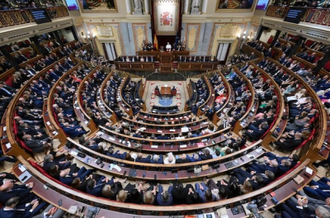
Image: Vatican Media
Source: Vatican Media
Pope Leo addressed members of Parliament in Spain on Monday, marking the first time a Pope has ever addressed the institution. In his address, the Pope said freedom of thought, conscience, and religion are decisive issues for every truly democratic society.
At the heart of Pope Leo's discourse was the message that every truly just society must be founded on the recognition of the inviolable dignity of the human person. Such dignity, he reaffirmed, precedes any concession of the State and cannot be subordinated to changing social consensus or the fluctuations of momentary majorities.
On this basis, Pope Leo said he wished to address a calm and decisive word to those who bear the grave responsibility of legally organizing social coexistence, which, he warned, can be threatened by a "throwaway culture," as Pope Francis repeatedly noted.
Pope Leo asked what future can our societies have if life ceases to be recognized as a fundamental value, and if a community leaves in the shadows the unborn child, the elderly, the sick, those who suffer in silence, or those entirely dependent on the care of others.
He said the defense of human life is neither a matter of private interest nor confessional concern, but a goal of civilisation.
In particular, Pope Leo said that every human life must be recognized and safeguarded from conception to its natural end, in every circumstance of its existence. When this certainty is obscured, he explained, the most vulnerable are the first victims, and the law loses its deepest meaning: to serve and protect every person.
The Holy Father suggested that the moral greatness of a nation manifests itself in its capacity to accompany, protect, and cherish those lives marked by greater fragility.
When the common good ceases to be a shared horizon, he warned that public action risks fragmenting into partial interests, incapable of safeguarding what belongs to all.
The Pope said that the family is of particular importance, also constituting the first human reality and natural foundation of the community.
Within the family, Pope Leo recalled, generations intertwine and a living memory is transmitted that gives inner continuity to society.
Where the family is supported, he stated, the spiritual and social stability of nations is also strengthened.
He reminded those before him that the family will always be the first school of humanity, where one learns, before anywhere else, the elementary grammar of coexistence, and how to welcome life, care for others, forgive, serve, and belong.
The Pope also noted that educational institutions also play a decisive role in this task. In them, he reflected, new generations can learn to seek and love truth, to question the meaning of life, and the dignity of every person.
The Holy Father acknowledged the numerous people are forced to leave everything behind in search of peace, security, and a future. The tragic drama of migration, he said, challenges today the conscience of nations and the ethical foundation of the international order.
The Pope also decried whenever a person is discriminated against because of his or her national, ethnic, religious, or linguistic origin, or because of economic or social condition, noting that when this happens, the universal principle of the equal dignity of all human beings is gravely violated.
The situation of migrants and refugees, Pope Leo stated, requires a response that places persons at the center, addresses the causes that force them to leave, and goes beyond the mere management of flows. From this, he noted that a twofold demand of social justice arises.
While he said there is the need to offer safe and legal pathways, respectful reception, and genuine opportunities for integration, Pope Leo added that at the same time there is the need to promote the right to remain in one's own homeland.
He said this requires working to ensure that no one is forced to abandon his or her home because of a lack of peace, security, or dignified living conditions, because of economic inequalities, or because of the effects of the climate crisis.
In recent years, he lamented, that increasingly dangerous routes have highlighted the tremendous cost of this reality, often hidden or ignored, with many people falling victim to traffickers and smugglers who exploit their desperation.
For this reason, the Pope said it is necessary to strengthen prevention, rescue operations, and assistance to victims, especially within the framework of regional and multilateral cooperation.
He underscored that no nation can face a challenge of this magnitude alone. And so, he stressed, a coordinated, supportive, and effective response is indispensable, one capable of guaranteeing protection, reception, and real opportunities for integration to those who migrate.
The Pope also stressed that the world is experiencing a profound spiritual and cultural crisis, which manifests itself in multiple forms of violence, polarisation, and mutual distrust.
In this context, he said that peace presents itself as a political aspiration and, even more, as a genuine moral necessity. He said it requires public discourse that respects those who think differently, institutions at the service of encounter, a historical memory that seeks truth and reconciliation, and a social life capable of sustaining civic friendship and mutual respect even amid disagreement.
At the international level, he insisted, peace requires diplomatic courage, ethical responsibility, and a vision of the future founded on respect for the identity of every people and on the obligation of States to resolve their disputes through the peaceful means offered by international law.
Pope Leo stressed that every war constitutes, ultimately, a painful defeat of the capacity to negotiate and also of that common human consciousness that recognizes bonds of justice among nations. Weapons, he observed, may impose a temporary silence; but they can never build a genuine and lasting peace.
He called it troubling that, in various parts of the world including Europe, rearmament is once again being presented as an almost inevitable response to the fragility of the international situation. True security, by contrast, he said, stems from justice, patient dialogue, respect for international law, and a policy capable of placing the lives of peoples above the interests that profit from war.
The Pope said that the development of new technologies and artificial intelligence in the military sphere also demands rigorous ethical oversight, so that decisions regarding life and death are never left to automated systems nor removed from the moral responsibility of the human person.
Thus, he said, the international community is called to rediscover the indispensable value of dialogue as a patient path toward just and lasting agreements, founded on respect for treaties, transparency in diplomatic action, and the sincere will to place peace before recourse to force.
The Pope stressed that peace is not only a political or institutional reality, but is also born in the conscience, where resentment, indifference, and hatred give way to reconciliation. For this reason, he said it is established and safeguarded also through language. Words can open paths or close them; they can illuminate reality or distort it to the point of making encounter impossible. He warned that those who exercise public responsibility accordingly have a special obligation to safeguard speech in order to "disarm language."
He added that firmness does not require contempt and disagreement does not entail humiliation. From this respect for others, the Pope said, arises the duty to safeguard the space in which their convictions, their conscience, and their relationship with God mature. Pope Leo said that attention to this interior realm allows a better understanding of a decisive issue for every truly democratic society: freedom of thought, conscience, and religion, a fundamental right that protects the most intimate sphere of persons.
The freedom upon which the modern State is founded, if it is authentic, Pope Leo noted, recognises the religious dimension of the human being, respects it, and protects it juridically.
Moreover, he said that it avoids forcing anyone to renounce contributing to the society in which he or she lives because of faith.
Pope Leo said that, without confusing the juridical and moral spheres, it is worth recalling that freedom requires a full understanding of itself. To be free, he noted, does not mean merely to live without constraints or to possess many options from which to choose, but means being able to recognize the good and adhere to it responsibly.
Therefore, he insisted, every genuinely free society also requires a proper limitation of public power, so that the freedom of persons, communities, and associations is not unduly restricted.
From this perspective, he noted that the legitimate autonomy of the temporal order must never be interpreted as hostility toward the religious phenomenon.
Faith, he underlined, does not seek to impose itself through privileges or coercion; nevertheless, neither can it be relegated to silence as though it were irrelevant to public life.
In this context, he said, the sacramental seal of confession holds special importance for the Catholic Church.
Pope Leo explained that it is part of the broader sphere of religious freedom, which guarantees communities their own space of life, organization, and internal discipline, and is protected in international practice through analogous legal safeguards.
To protect it juridically, as is done analogously in certain professions, he noted, means preserving a sacred space of interior freedom, where the believer can open his or her soul to God without fear of external pressures, as is also recognized by international norms.
Finally, the Pope invited the members of Spain's Parliament to lift their gaze, not to distance themselves from reality, but to remember that every decision of public authorities concerns flesh-and-blood persons.
He called on them to look more deeply at what is at stake in every public decision, noting that alongside technical solutions and legislative reforms, moral renewal is also necessary.
Pope Leo called on Spain to never lose the memory of its roots nor the courage to look toward the future and to continue to be a land of encounter, culture, solidarity, and hope.
And, he prayed that God grant peace to all the nations of the earth, concord to families, and serenity to consciences, and that days of prosperity, peace, and justice fall upon the Kingdom of Spain, marked by the apostolic imprint of Saint James and by the maternal presence of Our Lady of the Pillar.
The Holy Father's address was met with more than seven minutes of applause.
Watch Pope Leo's address on the Vatican Youtube channel: www.youtube.com/watch?v=8LeR4oJ9Oco
Read the full text:
www.vatican.va/content/leo-xiv/en/speeches/2026/giugno/documents/20260608-spagna-parlamento.html
 Facebook
 Twitter
 LinkedIn
 Print
Print Email
Email








 Facebook
 Twitter
 YouTube
 LinkedIn
 Pinterest