


Bishop Hudson celebrates Feast Day of St Boniface: 'A Veritable Luminary whose mission speaks to our age
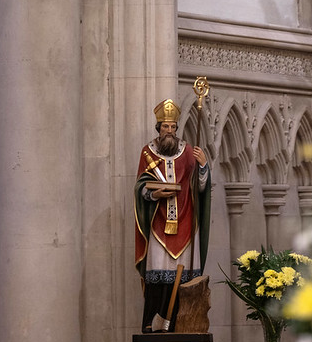
Statue of St Boniface in Cathedral Church of St Mary and St Boniface, Plymouth ©Mazur/cbcew.org.uk
At his first Mass to celebrate the Feast Day of St Boniface, one of the Patrons of the Diocese of Plymouth, the new Bishop of Plymouth, the Right Reverend Nicholas Hudson, reflected on the extraordinary legacy of one of Devon's most distinguished sons.
Preaching at the Mass, the Bishop drew attention to the missionary character of the territory: "All of our diocesan patrons are martyrs. It reflects, I think, the very missionary nature of this territory."
Boniface - born Winfrid, traditionally in Crediton - went on to become one of the most important figures in eighth-century European Christianity. The Bishop described him as "a pastor who knew the risk he was taking and yet was prepared to lay down his life for the sheep."
Bishop Nicholas quoted Boniface's own words, written shortly after his arrival on the Continent, highlighting the saint's sense of urgency: "We are not mute dogs or taciturn observers or mercenaries fleeing from wolves. On the contrary, we are diligent pastors who watch over Christ's flock."
Among Boniface's many accomplishments, the Bishop recalled his felling of Donar's sacred oak at Geismar, his founding of the Abbey of Fulda, his establishment of many dioceses, and his crowning of Pepin as King of the Franks at Soissons - achievements that shaped the Christian character of early medieval Europe.
Boniface's life ended in martyrdom. At the age of 73, in Utrecht, he crossed into unevangelised territory to await new converts when a hostile band descended upon his camp. He saw the danger coming and told his attendants not to resist and was among the first to fall.
The Late Pope Benedict XVI, "identified three pillars of Boniface's achievements - all of which can be summarised under the banner of unity," the Bishop shared. He went onto share those pillars:
"1. Boniface's commitment to the unity of faith, to the presentation of doctrine and Scripture as a united whole;
"2. Boniface's commitment to call into unity with the Supreme Pontiff and with one another the churches of England, Germany & France;
"3. Boniface's nurturing of a cultural unity - a continuity with the Benedictine instinct to assimilate Christian-Roman Culture into the Germanic."
"This Diocese is rightly proud to have produced such a figure," the Bishop said and concluded with a call to renewed mission for the Diocese today: "In an age when we know the need for our own mission to be deepened, at a time when many shadows fall across our world, we should call on Boniface with increasing fervour - to bless our endeavours, to help us begin to be the Diocese the Lord desires us to be."
Full Homily
It's interesting to note that all of our diocesan patrons are martyrs. It reflects, I think, the very missionary nature of this territory. What we see in Boniface is how coming from such a territory engendered within him a desire also to bear that mission abroad. It is striking that southern England itself had welcomed only a century earlier Benedictines led by St Augustine. Yet the faith in these lands had taken deep enough root for missionaries to set forth from this territory to bring the faith to mainland Europe. By far the most distinguished of all these missionaries was Boniface - a pastor who knew the risk he was taking and yet was prepared to "lay down (his) life for the sheep", a sacrifice we find ourselves recalling here some twelve centuries later.
It's moving to hear Winfrid, as Boniface was called then, express that sense of mission in a letter composed soon after his arrival on the Continent: "We are united in the fight on the Lord's day," he writes, "because days of affliction and wretchedness have come … We are not mute dogs or taciturn observers or mercenaries fleeing from wolves! On the contrary, we are diligent pastors who watch over Christ's flock, who proclaim God's will to the leaders and ordinary folk, to the rich and the poor … in season and out of season."
Tradition holds, of course, that he came from Crediton. It's perhaps not surprising that the Guardian of the National Shrine is keen to make the case. You may have heard him on the subject. The authority he cites is the 14th century Bishop Grandison, the longest-serving Bishop of Exeter by a long shot: 42 yrs. Grandison was an historian and a keen researcher of the Saints of Devon and Cornwall. He was understandably keen to find a distinguished saint to be associated with Exeter. But the most famous he could settle upon was Saint Sitwell.
The reason being that he was convinced that Boniface was born in Crediton. Grandison might easily have argued the case for Exeter on the basis that we know that Winfrid entered a monastery near Exeter at the age of seven. But Grandison found no evidence to counter the tradition that Winfrid came nevertheless from Crediton. The Crediton tradition was reinforced by the fact Crediton, not Exeter, was at the heart of an Anglo-Saxon advance which took place at that time from Exeter into Devon, an advance with which Winfrid's parents were associated as aristocrats.
Whatever we make of all that, what is not in doubt are Winfrid's diverse accomplishments, which, as priests of this Diocese you will doubtless have often recounted: his contribution to monastic life here in Devon and east from here too: his going to Nursling Abbey near Winchester at the age 14; his composition there of the first Latin Grammar to be compiled in English; how he heard in Nursling the call for help from Bishop Willibrord to call into relationship with Christ other "sheep not (yet) of his fold."
How he felt the need to go to Rome to seek and get a papal mandate to preach to the heathen; how that was when he changed his name to Boniface; how he was consecrated in Rome a regionary Bishop with general jurisdiction over Germany; how he received from the Frankish Prince Charles Martel a sealed pledge of protection.
Dear Canons, you must have recounted to schoolchildren countless times the felling of Donar's sacred oak at Geismar; how Boniface established many dioceses, to which he appointed many English bishops; and established most notably the Abbey of Fulda; how he held synods to restore the Church of Gaul; and crowned Pepin King of the Franks at Soissons.
How at 73 he sailed to Utrecht, where he was joined by St Eoban; how they crossed the river to bear their message to unevangelised tribes; how it was that he was reading in a tent to await the arrival of new converts when a hostile band descended upon them. Boniface "saw the wolf coming"; and told his attendants not to resist. He wished that there be realised in them the prophecy made by Jesus himself that the Christ t must suffer and rise so as to "proclaim light to both our peoples and gentiles". How the group was attacked, Boniface being among the first to fall; and how his body was taken to Fulda, where it remains.
It is interesting to hear the first German Pope - Pope Benedict XVI - comment generously on Boniface's achievement. Benedict identifies three aspects to that achievement - all of which can be summarised under the banner of unity:
1. Boniface's commitment to the unity of faith, to the presentation of doctrine and Scripture as a united whole;
2. Boniface's commitment to call into unity with the Supreme Pontiff and with one another the churches of England, Germany & France;
3. Boniface's nurturing of a cultural unity - a continuity with the Benedictine instinct to assimilate Christian-Roman Culture into the Germanic.
This latter Pope Benedict argues in terms of Boniface's commitment to the Benedictine ideal of monasteries fostering the interplay of the humanities and the secular arts with the fullness of the Christian intellectual patrimony.
Boniface was a leading light in early 8th-century Europe - a veritable luminary in a world emerging from the first Dark Age and soon to enter a second. This Diocese is rightly proud to have produced such figure; and it is so right we celebrate him. In an age when we know the need for our own mission to be deepened, at a time when many shadows fall across our world, we should call on Boniface with increasing fervour - to bless our endeavours, to help us begin to be the Diocese the Lord desires us to be - to be ourselves a light to enlighten the Gentiles and increase the fervour of those who already profess Christ.
 Facebook
 Twitter
 LinkedIn
 Print
Print Email
Email








 Facebook
 Twitter
 YouTube
 LinkedIn
 Pinterest