

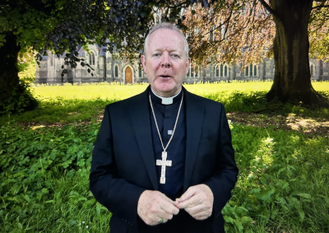
Archbishop Eamon Martin welcomes 'Magnifica Humanitas'
Screenshot
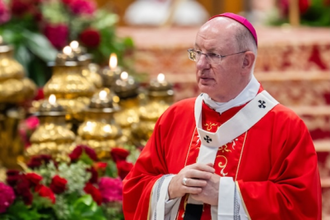
Archbishop Eamon Martin, Primate of All Ireland and chair of the Bishops' Council for Communications, has welcomed Pope Leo XIV's first encyclical letter: 'Magnifica Humanitas: On the Protection of the Human Person in the Age of Artificial Intelligence' with the following statement:
I warmly welcome the publication of Pope Leo XIV's first encyclical letter, Magnifica Humanitas: On the Protection of the Human Person in the Age of Artificial Intelligence.
This is a much needed intervention from the Holy Father at a time when Humanity stands at a "historic crossroads." We are at a phase in human history when artificial intelligence is already shaping our personal lives, homes, workplaces, schools and communities, hospitals, public services, economies and democracies.
Magnifica Humanitas asks us to look carefully at the ongoing development of Artificial Intelligence asking not just, 'What can AI do for us?' but more profound questions like, 'What kind of people are we becoming, and what kind of world are we building?'
Choices
Human creativity is a gift from God. When technology protects life, relieves suffering, supports learning, strengthens good work and helps us care for the vulnerable and for our common home, we welcome it with gratitude. We must therefore work to ensure that AI brings good, and assists real advances in medicine, education, accessibility, public services, scientific discovery, environmental protection and care for those often forgotten by society. Still, many people are rightly asking what Artificial Intelligence will mean for their children, their work, their privacy and freedoms, their relationships and their future.
Today, Pope Leo XIV's first encyclical places before us two contrasting biblical images and choices for humanity: Babel, and The City of God.
Babel is what happens when human power turns in on itself. It is the world of control, pride, domination and confusion. It is what we build when we forget God, or want to be "gods" ourselves; when we ignore our neighbour and neglect the poor. Magnifica Humanitas offers, on the other hand, a vision of the holy 'City of God', built upon foundations of peace and reconciliation, love and fraternity, which is always deeply respectful of human dignity for all. This vision reaches for the transcendent and opens our hearts to building the Kingdom of God where every voice matters and the vulnerable are not pushed aside.
At the heart of Pope Leo's encyclical lies the conviction of faith that the human person is made in the image and likeness of God, and that in the Incarnation of Jesus Christ, 'the Word became flesh, and lived among us.' God did not communicate with us from a distance but came among us with a human voice, a human face and a human heart. A human person can therefore never be reduced to data to be copied or manipulated. In a world of screens, artificial voices and digital masks, the Church defends the dignity of the human person with a real face and authentic voice.
AI can do remarkable things. It can sort through vast amounts of information, recognise patterns, and create words, images and voices that feel very real. It can even at times mimic human behaviour and qualities, but AI does not have a conscience. It cannot care, love, suffer, forgive, pray or hope as humans can, nor can it be truly "wise". Wisdom grows in human hearts and minds, in families and communities and in society through the growth of truth, humility, mercy, good judgement and love of neighbour, and sometimes also through bitter experiences and mistakes. As Pope Leo puts it: "artificial intelligences do not experience life, do not possess a body, do not experience joy and pain, and do not know from within what love, work and responsibility mean."
Truth Work Freedom
In particular, Magnifica Humanitas reflects on how three priorities: Truth, Work and Freedom are already being affected by AI. Truth is fragile when images, voices and information can be changed or invented, and narratives are manipulated and polarised. Work is put under pressure when people are expected to keep up with machines, rather than machines being used to assist workers and support human dignity. Freedom is weakened when data, surveillance or hidden systems shape people's choices without them fully knowing it.
War and Peace
Pope Leo warns against the delegation of "life-and-death decisions to automated systems", in a way that "the protection of civilians is subordinated to strategic logic." This is especially urgent where AI and machines are used for war and violent purposes. Pope Leo is clear: Human responsibility and discernment regarding the use of force can never be "reduced to a technical calculation". "No algorithm can make war morally acceptable."
AI on the island of Ireland - Questions for Reflection
I encourage as many people as possible across the island of Ireland to read and reflect upon Pope Leo's first encyclical Magnificent Humanity. From Ireland's point of view, the development of Artificial Intelligence is not an abstract issue or something happening far away. AI is being hosted, shaped, governed and developed here on this island. It is already shaping the lives of our people in real and significant ways. My hope is that Pope Leo's Magnifica Humanitas will open a serious, honest and practical conversation across Ireland about AI, one that will involve Church, State, universities, schools, legislators and public bodies, technology companies, workers, families, young people and wider society.
Christians - and all people of goodwill - must ask of AI: 'Is it true? Is it just? Does it honour the person made in God's image? Does it protect the vulnerable and serve the common good, or is it used to accumulate wealth and power in the hands of a few? What is its impact on human life and dignity, solidarity, justice, care for creation, and the Common Good. Does it serve human persons or, instead, tend to dehumanise or aim to replace them?'
The Church does not claim to have a technical answer to every AI question, but she does offer ethical principles to guide integral human development. The Church has faced technological revolutions before. Each time the question returns: 'What does it mean to be human?' The choice before us is therefore, not whether to accept or reject technology, but whether we will use AI advances to nurture a world grounded in fraternity and cohesion. Will we be architects of Babel, or builders of the City of God?
For that reason, I invite leaders in public life, technology, education, business, healthcare, research and faith communities here in Ireland to take up this encyclical with seriousness and courage. We must ask together: 'What responsibilities do governments, companies and citizens have in shaping ethical AI on the island of Ireland, and beyond? In a rapidly changing technological environment, how do we defend the dignity of workers and every human person, especially the most vulnerable among us?'
These critical questions cannot be left only to markets, machines or private interests. We must bring them into the light and discuss AI with honesty and hope, and with care for those whose faces and voices are too often hidden. As Pope Leo's new encyclical urges us: "Let us protect our magnificent humanity."
LINK
Read a summary of Encyclical, with links to the full text and a video: www.indcatholicnews.com/news/55073
 Facebook
 Twitter
 LinkedIn
 Print
Print Email
Email








 Facebook
 Twitter
 YouTube
 LinkedIn
 Pinterest