


Church leaders celebrate Sir David Attenborough's 100th birthday
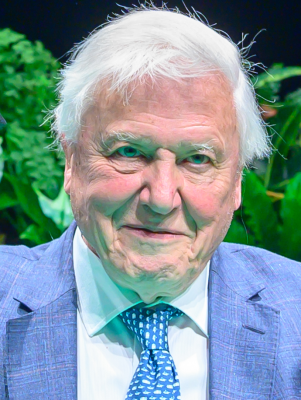
David Attenborough 2019, Wiki image
Source: CoE Media, ICN
Warm tributes were offered by church leaders and environmental campaigners as Sir David Attenborough marked his 100th birthday recently, celebrating a life that has brought the beauty of the natural world into homes across generations.
Bishop John Arnold, Lead Bishop for the Environment for the Catholic Bishops Conference told ICN: "Sir David Attenborough's 100th Birthday gives us a worthy opportunity to recognise his life-long contribution to our understanding of our world and the complexity of creation. We owe him a debt of gratitude for his calm explanation of nature and its intricacies, inviting us always to grow in our appreciation of the world that has been entrusted to us.
"Largely due to his dedication, this present generation has grown in its understanding of the rich diversity of our planet at a moment when we have the urgency of protecting it and repairing the damage we have done. He has done much to awaken us to our duty of care. We are thankful for all he has achieved for us and our world. We must continue and further develop his work for the good of future generations."
The Anglican Archbishop of York, Stephen Cottrell, posted: "Happy 100th birthday, Sir David Attenborough. Thank you for helping us to see the wonder of creation, and the responsibility we share to protect it. Many blessings and prayers on this special day."
The Bishop of Norwich, Graham Usher, the Church's lead bishop for the environment, said: "Today, I join people across the world in wishing Sir David Attenborough a very happy 100th birthday.
"As a broadcaster, he has done more than anyone to communicate the joy, wonder and fragility of the natural world. His message about protection, conservation and restoration needs to be heard - and acted on - for the good of us all and the care of God's creation. But today, I give thanks for this rare 'Attenboroughus' species, which for decades has inhabited our TV screens and made such welcome evening appearances!"
Laudato 'si Animator Patricia O'Donnell said: "David Attenborough's work began long before Laudato 'si was published. I remember watching his 1992 interview with the Dalai Lama during which they discussed Buddhist perspectives on nature, compassion and the environment. It was truly inspiring."
MaryAnne fcJ, NJPN Environment Group said: "We join all who cherish our beautiful Common Home to congratulate Sir David Attenborough on his 100th birthday. Thank you Sir David for awakening us to the beauty of this planet, and for courageously highlighting the harm caused by human activity. Echoing Pope Francis' wisdom that "the natural environment is a collective good" (Laudato Si', #95), we join our commitment with yours to speak on behalf of all who share this Earth community, and to do what we can to preserve and protect it. Happy Birthday and thank you!"
Paul Kelly, Chair of the NJPN Environment Working Group wrote: " Long before Laudato Si was published Sir David was engagingly showing us the wonder and fragility of our common home. In more recent years he has shone a light on human impact, habitat destruction and extinction risk. We owe him a huge debt of gratitude for his skilful storytelling that laid the ground for so many people to hear and begin to understand the wisdom of Pope Francis' call to an integral ecology. What better plaudit could we make about this great man than to commit ourselves to the church's mission of ecological conversion."
Sir David Attenborough, born on 8 May 1926 in Isleworth, Middlesex, has become one of the most recognisable voices in broadcasting. A natural historian, writer and presenter, his career has spanned more than eight decades, beginning with the BBC in the early 1950s. He first came to public prominence through the series Zoo Quest in 1954, and went on to create and present landmark wildlife documentaries including Life on Earth, The Living Planet, The Blue Planet and Planet Earth.
Educated at Clare College, Cambridge, where he studied natural sciences, Attenborough later held senior roles within the BBC, including Controller of BBC Two and Director of Programmes, before returning to full-time programme-making. Over the course of his career, he has helped to shape natural history broadcasting, with a body of work that has travelled across every continent and explored the diversity of life on Earth.
His work has earned numerous honours and awards, including a knighthood in 1985 and both BAFTA and Emmy recognition. He has also been widely noted for his advocacy on environmental issues, including biodiversity loss, climate change and conservation.
Alongside his broadcasting career, Attenborough has spoken on questions of belief and faith. In 2002, Attenborough joined an effort by leading clerics and scientists to oppose the inclusion of creationism in the curriculum of UK state-funded independent schools which receive private sponsorship. In 2009, he stated that the Book of Genesis, by saying that the world was there for people to control, had taught generations that they can "dominate" the environment and that this has resulted in the devastation of vast areas of it. He further explained to the science journal Nature, "That's why Darwinism, and the fact of evolution, is of great importance, because it is that attitude which has led to the devastation of so much, and we are in the situation that we are in.
In 2012, when invited back to BBC Radio 4's Desert Island Discs to mark the programme's 70th anniversary, he reflected on his own position. While describing himself as agnostic, he spoke about the relationship between scientific understanding and belief.
"I don't think an understanding and an acceptance of the four billion-year-long history of life is any way inconsistent with a belief in a supreme being," he told presenter Kirsty Young. "And I am not so confident as to say that I am an atheist."
 Facebook
 Twitter
 LinkedIn
 Print
Print Email
Email

















 Facebook
 Twitter
 YouTube
 LinkedIn
 Pinterest