

The God Who Sings: Music and Cosmic Reconciliation

Image: The God Who Speaks
Source: The God Who Speaks
To speak of creation as music is to marry physics and theology with awe: the cosmos is the score for God's ongoing song.
"The morning stars sang together and the heavenly beings of God shouted with joy." (Job 38:7).
Before light in creation, there was sound: the symphony of atoms and molecules vibrating and dancing to the rhythm and beat of Abba (Mark 14:36; Romans 8:15; Galatians 4:6), the composition of the enigmatic 'I Am' (Exodus 3:14; John 8:58). If Christ is Word made flesh, the universe is music made visible, each electron a note on the Composer's score of creation. Yet our modern and fallen world hums (and often shouts!) with dissonance, spiritually deaf to the harmony that underlines existence. To speak of creation as music is to marry physics and theology with awe: the cosmos itself is the score for God's ongoing song.
The Psalms in the Hebrew Bible (Old Testament) are a gift to the Church from our parent tradition, those of the Jewish faith. The Psalter has become, essentially, the hymnal of the Roman Catholic and Anglican traditions. As the psalmist writes, "Behold, how good and pleasant it is when kindred dwell together in unity" (Psalm 133:1). God longs to inscribe a deep shalom on the hearts of his children, and for there to be unity among them. Each year on St Cecilia's Day, Westminster Cathedral Choir, Westminster Abbey Choir, and St Paul's Cathedral Choir gather to sing Vespers. There is a somewhat magical quality about singing God's praises together, which enables denominations divided by doctrinal differences to glimpse the eschatological unity that God longs for his people. It might only be an evensong, but it is certainly a foretaste of heaven.
Across the Abrahamic traditions, the Muslim muezzin chants the call to prayer from the minaret of the mosque. Anyone who has heard this sound will know its haunting resonance. Muslims believe that reciting the Qur'an vocalising the words is essentially sounding the divine, a kind of vocal calligraphy tracing divine speech. The muezzin chants to God, the Westminster Cathedral chorister sings polyphony to God, and the Jewish cantor recites the Torah to God. The instinct behind the act is the same: humankind longing to be heard by the One who first spoke creation into being. As the Lord promises in the Hebrew Bible, "through you all the families of the earth shall be blessed" (Genesis 12:3). Pope Leo affirmed this universal blessing in his recent visit to our Islamic cousins in Lebanon, emphasising the importance of peace and respectful coexistence with other Abrahamic traditions on God's earth.
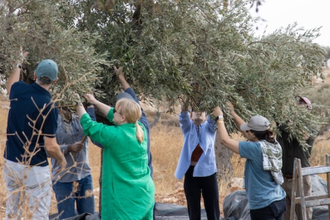
And God, the Creator of the universe whom we now meet intimately in the person of Jesus is the God Who Sings. "He will rejoice over you with singing" (Zephaniah 3:17). The Hebrew word here is rann, which is perhaps better translated as 'shouting in jubilation'. In the ancient Near East, deities did not sing; they commanded or destroyed. Zephaniah's poetic and captivating image of the God Who Sings is therefore radically countercultural, implying that creation itself is sung with delight and profound gladness. In Zephaniah's third chapter, there is a turning point where God uses song as a form of cosmic healing: fear becomes joy, and exile becomes homecoming. Thus, every act of ecological attention becomes an attempt to tune our lives back to the pitch of divine joy and to engage in cosmic healing. We, as God's people, join Zephaniah's vision of a God who restores both people and land through song. A powerful contemporary articulation of this is the new ecumenical project with Kew Gardens which is an initiative seeking to deepen the Church's theological engagement with the climate crisis.
In Genesis, the blessing that God bestows on Abraham and his family is not a private possession but the extension of divine creativity. God's generosity resonating outward into the world. Music becomes one of its most striking media: a form of blessing that crosses boundaries, restores dignity, and gathers what has been scattered. The Holy Spirit, the Spirit of harmonisation, draws this blessing into human history, tuning discordant lives toward communion.
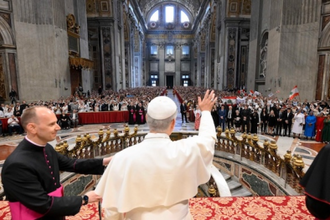
In a time of global crisis, we cannot ignore Pope Francis' prophetic words from 2014: "Even today, after the second failure of another world war, perhaps one can speak of a third war, one fought piecemeal, with crimes, massacres, destruction." Against such dissonance, human singing whether psalm, hymn, or call to prayer becomes a small echo of the creative delight with which God first sang the world into being. In these fragile days, we pray for the peace of the Holy Land and for the Spirit of harmonisation to breathe blessing where violence has torn the fabric of hope. Psalm 122:1-4 invites us to seek peace and unity in pilgrimage and worship "Jerusalem is built like a city that is closely compacted together".
In an age marked by fracture, noise, and what Pope Francis called a "war fought piecemeal," the Christian vocation is not to outshout the world but to live attuned to a deeper music: the song of the Holy Spirit. If creation is sung into being and sustained by divine joy, then our task is to become people who listen for that melody and embody it in the ordinary patterns of our lives. Harmony, in this sense, is not naïve optimism, rather it is a disciplined posture: choosing patience and hope over the cynicism that corrodes public life. The Spirit of harmonisation continues to work within and between us, drawing disparate lives into a shared resonance. To pray for the peace of the Holy Land, to bless rather than curse, to care for the earth and for one another: these are acts of resistance against the world's dissonance. They are the notes by which we join the great song of reconciliation that God is still singing over creation.
James Gordon Reid Haveloch-Jones is an educational consultant, applied theologian, and author of an Amazon Top 50 Study Skills bestseller. He is an Honorary Associate Fellow of St George's House, Windsor Castle, and a trustee of the Heythrop Association at the University of London. His work has also appeared in the Church Times, National Catholic Reporter, Premier Christianity, ICN, and is featured in the NJPN network. Internationally he has written for BuddistdoorGlobal and is featured in Instituto Humanitas Unisinos
Visit his website: www.jamesgordonreid.co.uk
 Facebook
 Twitter
 LinkedIn
 Print
Print Email
Email













 Facebook
 Twitter
 YouTube
 LinkedIn
 Pinterest