

Giving Flesh To God's Word In Our Today - The Challenge of Oscar Romero's Preaching
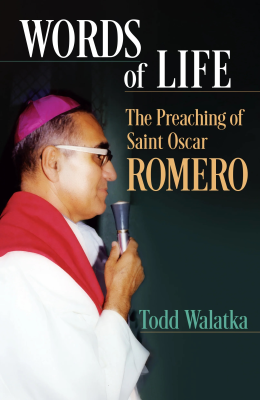
Todd Walatka, Words of Life. The Preaching of Saint Oscar Romero. Publisher: Maryknoll Orbis Books, 2026
At the beginning of March, Professor Todd Walatka came to the UK to speak at a series of events organised by the Archbishop Romero Trust during 'Romero Week', ahead of the 46th anniversary of his martyrdom on March 24, 1980.
Walatka is a real expert on Romero's theology and witness, being the founding chair of the Romero Studies Working Group at the Kellogg Institute in Notre Dame University. At the start of his visit he very generously agreed to lead a workshop for the Catholic Association of Preachers at St George's Cathedral, Southwark, looking at Romero's preaching and its significance for us today.
At one level, the lesson to be drawn from Romero's homilies might be 'Don't try this at home!' because he broke most of the rules that might be imparted in any contemporary seminary homiletics class. He preached at great length (occasionally exceeding an hour). He would include expositions of the teaching of the Second Vatican Council or of documents of Pope Paul VI, whom he greatly admired, in fulfilment of his understanding of his role as 'chief catechist' of his flock. Moreover, in addition to (typically three) themes drawn from the readings of the day or from the season of the liturgical year, he would include commentary on 'events of the week' These could combine the awful and the wonderful in a short space - details of the latest killings by death-squads and critique of political events in the country sitting alongside greetings to individual campesinos and to parish groups which had sent greetings or were celebrating special fiestas.
He was also very clear that what he had to say was addressed very specifically to his own country in a time of crisis - on the verge of the civil war which would claim the lives of more than 75,000 in a population of six million in the decade after the Archbishop's death: 'My preaching should not be the same here in El Salvador as it would be in Africa or at some other time in history.' His purpose was to 'incarnate' the Word of God in his people's 'Hoy!' (their 'today') and he saw preaching as the instrument by which that Word really came alive in the Salvadorean context, illuminating their reality with the Gospel message.
The demands of the moment meant that his preaching must simultaneously offer consolation for those who suffered, denunciation of the injustice that caused the violence and a call to conversion for all - especially those who were the direct perpetrators of violence or the beneficiaries of the 'structures of sin' embedded in the patterns of land ownership and employment laws, opponents whom he repeatedly told he was challenging out of love for them, not hatred. Most famously, in his last Sunday homily he made an appeal to the men of the military, calling them to take personal responsibility: 'No soldier is obliged to obey an order against the law of God It is time now for you to reclaim your conscience … I beg you, I beseech you, I order you in the name of God: Stop the repression!' Those words sealed his death sentence and he was shot while saying mass the next day.
While Romero's context may seem so other than ours (although we also face the grim reality of world leaders who think that might is right and that violence can be used as a weapon of social policy), the power of his lonely witness - so often setting him at odds with his fellow bishops in El Salvador and met with hostility by curial officials in the Vatican - continues to inspire. His call to conversion and to structural change is no less relevant today than it was half a century ago. And his preaching includes a searing examination of conscience for the ecclesial community as well as for secular institutions.
Moreover he has left a 'canon' of homilies delivered during his period as Archbishop of San Salvador, running from March 1977 to his death three years later, which effectively provide a complete commentary on the three-year cycle of the Church's Sunday lectionary, a rich resource for anyone wishing to break the Word today, albeit daunting in its scale and far from being immediately usable in our own here and now.
Fortunately Todd Walatka, in his new book, Words Of Life. The Preaching of Saint Oscar Romero (Maryknoll (NY), Orbis Books, 2026) has given us a sure guide to Romero's witness and message. If one were to limit oneself to the introductory material before each of the twelve homilies reproduced in this volume, this would itself be an excellent primer on the Saint and on the tragic history of El Salvador during the last three years of his life. But the real power of the book is, unsurprisingly, the ability to hear the Archbishop speak to us directly - one of the great witnesses to the liberating potential of Catholic faith and teaching in the last quarter of the twentieth century.
This book can be commended to anyone as spiritual reading and to those charged with breaking the Word Sunday by Sunday in our parishes and communities as both gift and challenge. It asks preachers today: what does it mean to 'incarnate' the Word of Christ in our 'Today', in Britain in 2026? And as we ponder that question, let us all invoke the Bishop's prayers: St. Oscar Romero, pray for us.
 Facebook
 Twitter
 LinkedIn
 Print
Print Email
Email













 Facebook
 Twitter
 YouTube
 LinkedIn
 Pinterest