


Shrewsbury: Easter Homily of Bishop Mark Davies
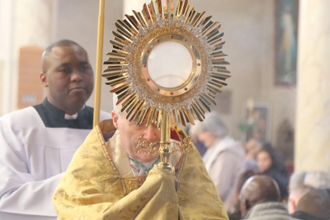
This Easter morning, many thousands of adults - mainly young adults mostly from no religious background - have made their way through the shadows and darkness of our time like the women and the apostles on the first Easter morning to "see and believe" that Jesus Christ is risen from the dead and truly present in His Church, supremely in His Eucharist (Cf. Jn. 20: 8).
They have searched through the chaos and shallowness of contemporary life to find the "the cornerstone" that is Christ Himself, as the Psalm declares on Easter morning (Ps. 118).
This new phenomenon across our country and across the whole western world, may not statistically offset the overall decline of Christianity during this past half century. Professor John Curtice and others are surely correct in suggesting this will require a shift of millions rather than of tens of thousands in Britain. Yet, as the first conversion of England was accomplished one by one during the course of a hundred years, likewise, each convert is the promise of a new springtime for Christianity that will be more faithful, however, statistically numerous.
For us who have been 'converts' from the very first days of our lives, this is a cause of some humility because those who have been baptised and received into the Church this Easter have come through no special initiative on our part. In finding their own way into the life the Church they say what often mattered most is they found the Church standing firm in her witness amid the turmoil and disorientation around her. This they found in the constancy of her teaching and worship, and that vital spiritual union with Christ Himself in prayer, in the confession of our sins and above all in the Holy Eucharist. They sought and asked nothing of us except that you and I should, should in the words of Apostle Peter be "witnesses to all (Christ) has done" (Acts 10: 39).
England's newest Saint, John Henry Newman, said something surprising at the end of his life. Amid the loss of faith and disorientation he foresaw in what he called "liberalism" and we might today call "relativism" by which all beliefs and moral paths would be held as being true, meaning nothing in the end can be true. This Newman lamented would inflict great harm on souls, but he insisted the Church has nothing more to do than to "stand still."
By "standing still" Newman did not mean inaction or ignoring the challenges of modernity and post-modernity. Rather he explained, "commonly the Church has nothing more to do (in every crisis of history) than go on in her proper duties, in confidence and peace; to stand still and see the salvation of God" (Biglietto Speech, 12th May 1879). These "common duties" allow us to remain on firm, unshifting ground in our witness to the Gospel and the Catholic faith; in the constancy of worship and prayer, supremely in the Mass, and in living out our own conversion in every Christian vocation.
In this way we will look not to ourselves and our own resources rather in Saint John Henry Newman's words to seeing: "the salvation of God." This is the lesson of 'faith-fulness' we must each draw from Holy Week 2026 and from the stream of new converts entering the life of the Church. We look to one and the same cornerstone in Jesus Christ whether we received the gift of faith in the first days of our lives; or are living the first day of our Catholic Christian life this Easter Sunday.
 Facebook
 Twitter
 LinkedIn
 Print
Print Email
Email





 Facebook
 Twitter
 YouTube
 LinkedIn
 Pinterest