


Gospel in Art: Easter Sunday
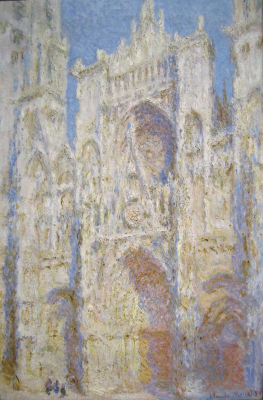
Rouen Cathedral, West Facade, Sunlight, by Claude Monet, 1894 © National Gallery of Art, Washington
Source: Christian Art
Gospel of 5 April 2026
Matthew 28:1-10
After the Sabbath, towards the dawn of the first day of the week, Mary Magdalene and the other Mary went to see the tomb. And behold, there was a great earthquake, for an angel of the Lord descended from heaven and came and rolled back the stone and sat on it. His appearance was like lightning, and his clothing white as snow. And for fear of him the guards trembled and became like dead men. But the angel said to the women, 'Do not be afraid, for I know that you seek Jesus who was crucified. He is not here, for he has risen, as he said. Come, see the place where he lay. Then go quickly and tell his disciples that he has risen from the dead, and behold, he is going before you to Galilee; there you will see him. See, I have told you.' So they departed quickly from the tomb with fear and great joy, and ran to tell his disciples. And behold, Jesus met them and said, 'Greetings!' And they came up and took hold of his feet and worshipped him. Then Jesus said to them, 'Do not be afraid; go and tell my brothers to go to Galilee, and there they will see me.'
Reflection on the painting
A strange darkness settles over the world at the hour of the Cross. The evangelists speak of it not merely as a passing shadow, but as something that seems to touch the very fabric of creation. They describe it as if the light itself recoils at the sight of Love rejected. A very powerful image. Calvary is not only a place of suffering; it is a moment when hope appears eclipsed. We recognise that darkness. It is the darkness of grief, of confusion, of prayers unanswered, of jobs lost, of financial struggles... the darkness that visits every human heart at some point along our journey. And yet...
... and yet, the Gospel never leaves us there. Almost quietly, almost tenderly, it introduces a new light: the light of dawn. As the women in today's Gospel reading walk towards the tomb in the early morning, the light is gently introduced again. It is still fragile light; the soft, hesitant light of first daybreak, but it is enough. Enough to take a step. Enough to spark hope. And then, suddenly, that gentle light gives way to something far brighter: the light of the Resurrection. Their sorrow in that moment is not erased, but transformed. Their fear becomes awe. Their mourning becomes worship. The darkness has not had the final word. It never does. Easter proclaims that even the deepest night can become the birthplace of light.
Artists have always explored this mystery of light. Across centuries, they have taken brush to canvas to wrestle with darkness and light, not simply to depict a scene, but to reveal something deeper. In the artist's brush, light is never accidental. It gets applied deliberately. The canvas itself comes alive through light. The artists who perhaps most consciously chased light were the Impressionists. Painters such as Claude Monet, Pierre-Auguste Renoir, Camille Pissarro, and Edgar Degas considered light not simply as important, but light became the very subject of their works. They painted outdoors, standing before rivers, fields, cathedrals, and city streets, trying to capture the changing moments of light. If I dare say, in their work, light becomes almost sacramental: something invisible made visible.
As many of us will go to church today to celebrate Easter, our image is a canvas depicting a church, Rouen Cathedral, West Façade, Sunlight by Claude Monet. Painted in 1894, it belongs to a series of more than thirty canvases Monet created between 1892 and 1894, all focused on the same façade of Rouen Cathedral. He set himself an almost impossible task: not to paint the building itself, but to paint the light that falls upon it, ever shifting, shimmering, never still. Moving from canvas to canvas as the hours passed, he tried to capture how morning light, midday brightness, and evening glow would transform the very same stone into something entirely new.
It is a beautiful painting for Easter. The church, like the tomb, is not simply a structure of stone; it is a place where light breaks in and transforms everything. Monet shows us that even the most ancient, immovable walls can be transfigured by light. In the same way, the Resurrection does not replace the world: it fills it, slowly, gently, gloriously, with light... and changes everything!
LINKS
Christian Art: https://christian.art/
Today's reading: https://christian.art/daily-gospel-reading/matthew-28-1-10-2026-2/
 Facebook
 Twitter
 LinkedIn
 Print
Print Email
Email











 Facebook
 Twitter
 YouTube
 LinkedIn
 Pinterest