


Ian Linden: The quiet faith of Gordon Brown
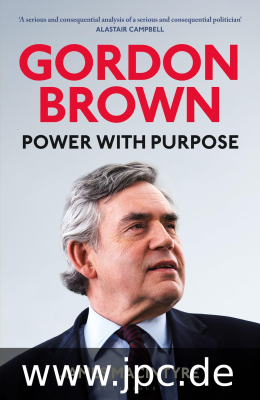
Anger and apathy, Bankers and BREXIT, Corruption and COVID, the ABC of Britain's decline, has determined our recent history. The Venerable Bede wrote in the 8th century that history should record the "evil of wicked men" to avoid sin, while describing the "good things of good men" to encourage virtue. James Macintyre's insightful and balanced Gordon Brown: Power with Purpose, Bloomsbury 2026, falls into Bede's 'good men' category encouraging virtue even though as the work of a journalist this biography is 'a first rough draft of history', and Gordon Brown remains a consequential figure.
Whoever is Prime Minister, the moral and the expedient often clash. Gordon Brown's political misfortunes arose from tipping the balance towards morality and social justice. Like Angela Merkel and Theresa May, his father was a Protestant Minister. Rev Dr John Brown served as Church of Scotland Minister, from 1954 in Kirkcaldy for 13 years, revered enough by Gordon Brown to present a book of his sermons to Pope Benedict XVI in September 2010. But arguably his religious commitments also strongly influenced his political life.
At the Labour Party Conference in Manchester, September 2009, with polls dropping fast following his indecision over calling a general election, Prime Minister Brown deliberately challenged popular assertions that all parties were the same. He listed the impressive achievements since the 1997 General Election that he had been involved in: half a million children taken out of poverty, Sure Start, child benefit at record levels, numbers of pensioners below the poverty line halved, the Disability Discrimination Act, the minimum wage, the Winter fuel allowance, trebling of foreign aid, debt cancellation for the poorest countries. Then "crime cut by a third, "the shortest NHS waiting times in history" and a "legally enforceable right to early cancer screening and treatment within one week". For ten years, of course, he had shared these achievements with Prime Minister Tony Blair. He was responsible, as Prime Minister himself, for the first ever Climate Change Act in 2008, and the Equality Act 2010, transposed from EU law, protecting everyone in Britain from discrimination in work, education, housing and provision of services. Compared with these achievements progress during 2010-2023 comes as a shock.
In the 2008-2010 global economic crisis Gordon Brown rallied the G7 and G20 around his plan for a $1.1 trillion recovery package taken from national budgets - and taxpayers known as 'quantitative easing' to recapitalise the banks, boost demand and counter recession. He admitted responsibility for too light regulation of financial services, failure to spot the dangers of the market for sub-prime mortgages and the banks' casino culture whilst the Conservative Party wanted less regulation.
Brown's dithering, his fall from grace in the public eye by 2009 and resultant electoral failure, illustrate a number of perennial features of British politics: the influence of the right-wing press such as the Daily Mail and, in the Murdoch empire, notably The Sun, on a public tired and suspicious of politicians, giving no second chances to political leaders it turns against.
Labour leaders have always faced headwinds. Clement Attlee, who sustained a radical socio-economic programme for six years despite post-war bankruptcy, was defeated only in 1951. Later Labour governments walked a tightrope: policies promoting a more just society on one side, the imperative of winning general elections to implement such policies on the other. And Brown had a strong moral compass, combined with only a modest ability to connect with, and breakthrough to, a fractious public. Change 'moral' to 'legal' above and this could be said of Sir Keir Starmer.
The turn of the millennium heralded a particularly sharp national decline in Christian faith and church attendance. No politician could safely 'do God'. Kate Forbes, contender for the SNP leadership, and Tim Fallon, Liberal Democrat leader 2015-2017, were both damaged by disobeying Alistair Campbell's golden rule.
Reviewers have been positive about Power with Purpose focusing on issues of interest to themselves. Thus tensions between Brown and Blair over the years feature prominently, but the chapter "Joy in the Morning: Gordon Brown's quiet faith" does not. There is only a passing mention even in the Church Times. Yet few doubt Brown's religious upbringing was influential in his politics.
Brown became known for phoning NGOs to coordinate public advocacy for overseas aid and debt reduction with his own diplomacy and government action. He was also quite open in his relationship to the Churches and religion. If there is one speech - missed by Macintyre - which illustrates Brown's Christian motivations and their significance for government policy as Chancellor of the Exchequer, it is 'Economics of Hope', his address to the Church of Scotland's 1999 General Assembly, dedicated to his recently deceased father, a passionate call for debt relief to the poorest nations, increased aid, and the pursuit of the millennium development goals. "For it is our Christian teaching - the faith I was brought up in - that when some are poor, our whole society is impoverished; that when there is an injustice somewhere it is a threat to justice everywhere; that what - as Dr. King said - selfish men tear down, selfless men and women must build anew".
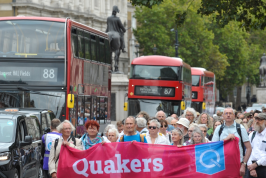
On 24 July 2008, after the ecumenical Walk for Witness in central London led by Archbishop Rowan Williams, Gordon Brown spoke on the moral imperative to reduce global poverty in the courtyard at Lambeth Palace. Brown and the march were promoting the millennium development goals (MDGs) lagging as the half-way mark passed to the 2015 closing date for reaching them. Some 650 Anglican bishops, politicians attending the 2008 Lambeth Conference, plus heads of NGOs were present. This was no sudden embrace of the Churches and NGOs.
Brown has even joked about the wrong sort of approach to religion and politics recounting how his father told a story about a fellow minister's choice of hymns after local elections: "Sometimes the congregation was asked to sing the hymn, 'Now Thank We All Our God'. When the other party won he announced the hymn, 'Dear Lord and Father of Mankind Forgive our Foolish Ways'. And in the event of "no overall control" he could always perform "God works in Mysterious Ways His Wonders to Perform".
Gordon Brown would be the first to say secular values could equally have motivated, and been in play, in government policies that prevailed from 1997-2010. And a quiet faith does not eliminate bad mistakes. But faith values truth in the exercise of power and enhances clarity of purpose. James Macintyre should be applauded for a good title, a good book, and daring to write sympathetically about religion and high political office.
See: www.ianlinden.com/latest-blogs/the-quiet-faith-of-gordon-brown
Professor Ian Linden is Visiting Professor at St Mary's University, Strawberry Hill, London. A past director of the Catholic Institute for International Relations, he was awarded a CMG for his work for human rights in 2000. He has also been an adviser on Europe and Justice and Peace issues to the Department of International Affairs of the Catholic Bishops Conference of England and Wales. Ian chairs a new charity for After-school schooling in Beirut for Syrian refugees and Lebanese kids in danger of dropping out partnering with CARITAS Lebanon and work on board of Las Casas Institute in Oxford with Richard Finn OP. His latest book was Global Catholicism published by Hurst in 2009.
 Facebook
 Twitter
 LinkedIn
 Print
Print Email
Email










 Facebook
 Twitter
 YouTube
 LinkedIn
 Pinterest