

COLUMBAN SCHOOLS COMPETITION 2026 - Winning Article

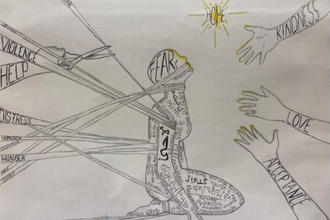
Second place winning image by K.of Sacred Heart of Mary Girls' School, Upminster
'Blessed are the Meek'
by A. (18) St Thomas Aquinas Catholic School and Sixth Form, Birmingham
The winner says: "The theme of this competition was not only about refugees, but it was about us, and I hope we can soon create a world in which everyone is treated with the dignity they deserve. Great things will come from people doing what they truly enjoy, as I have done in writing this piece."
No one plans to become a refugee. No child dreams of crossing borders in the dark, carrying only a schoolbag filled with documents instead of books. No parent chooses to leave behind the house they built, the neighbours they loved, or the language that shaped their childhood. To become a refugee is not an ambition, a lifestyle, nor a preference. It is the consequence of danger so great that staying becomes impossible And yet, whilst those forced to flee have no choice, we - those who receive them - do.
Our response is the part of the story that is still in our hands.
Across Britain and Ireland, public debate often reduces refugees to statistics or headlines. However, behind every statistic, there is a person whose life has been disrupted. As of late 2022, over 43 million children were estimated to be forcibly displaced, including those displaced by conflict and violence (UNICEF). It is too easy to throw around statistics; to actually envision one of these children, who has enjoyed the thrill of playing football in a courtyard or who has fought with their sibling over who would get the last biscuit is to truly stand in solidarity. Catholic Social Teaching asks that we do exactly this: to picture the child and not the statistic. This principle of human dignity taught to us by St Catherine of Siena tells us to see the refugee as someone who has been made 'Imago Dei' and therefore deserves safety, respect, and hope.
My own understanding of this did not come from personal displacement, but from the environment I grew up in. As a white boy in a primary school where most of my classmates were from Middle Eastern or African backgrounds, I was, unusually, in the minority. Many of my friends had parents or grandparents who had fled conflict in Pakistan, Syria, or Afghanistan. One family I knew had left Iran after political unrest made it unsafe to stay. At the time, I did not understand the profundity of their stories. To me, they were just the guys I played cricket with and exchanged snacks with, sat next to in lessons. Now I look back and realise that their presence shaped my sense of community long before words could describe it.
Growing up in that environment taught me something hugely important: refugees are not "others." They are classmates, neighbours, and friends. Their cultures, languages, and histories were part of the very fabric with which I grew up. So when I think I hear those debates currently, and I think I hear refugees portrayed as enemies or strangers, I think of the people I grew up with, the people who lived the story of resilience, of hope, and of safety.
"Welcome the stranger," is a moral imperative grounded in Scripture itself: "I was a stranger, and you welcomed me"(Matthew 25:35). This moral imperative needs to be taken up with solidarity, as reminded by Pope Leo XIV in 2025, who noted that "our unity will then value each person's history, as well as the social and religious culture of every people," combating, as it does, the fear of the stranger as outside threat and embracing diversity as blessing in itself.
Across Britain and Ireland, there are countless examples of ordinary people choosing compassion. Parish halls converted into warm spaces for asylum seekers. Schools organising uniform drives for newly arrived pupils. Community sponsorship groups preparing homes for families they have never met. These acts may seem small, but they form a culture of encounter - one in which strangers become neighbours.
Still, our response is not always generous. Public discourse can be shaped by suspicion, misinformation, or political rhetoric. Some argue that offering sanctuary is a burden. Yet Catholic Social Teaching reminds us of the common good: the idea that society flourishes when the most vulnerable are protected. Refugees are not drains on our communities; they are contributors. Many become nurses, engineers, teachers, entrepreneurs. Their resilience is not only personal: it strengthens the places where they settle.
Moreover, the Church teaches the principle of preferential option for the poor, urging us to prioritise those in greatest need. Refugees, who have lost homes, livelihoods, and often family members, are among the most vulnerable people in the world. To turn them away is not neutrality; it is a choice that contradicts the Gospel. Many tend to even preach religion in countries such as the US, however many of us forget that Jesus himself was a refugee from areas within modern-day Palestine, as well as most of the Israelites being refugees escaping slavery and persecution from Egypt in Exodus.
The question, then, is not whether refugees deserve help: they do. The question is what kind of people we choose to be. Do we construct walls of indifference or bridges of compassion? Do we allow our policies and our approach to be dictated by our fears, or our loves?
To be a refugee is not one's choice. To be empathetic is. Responding with justice is. Responding with welcome is. And these choices define not only the lives of those who seek sanctuary, but the moral character of the societies they enter.
In the end, the theme of this competition is not only about refugees. It is about us. It is about whether we believe that every person, regardless of birthplace or circumstance, carries an unchanging dignity, as Pope Leo XIV said, a dignity that remains whether we are "living in our native land or in a foreign country." It is about whether our communities of faith will choose to embody the love we profess.
Refugees do not choose their journeys. But we can choose to walk beside them. And in doing so, we may discover that welcoming the stranger does not diminish us, but it transforms us.
COMMENTS
"We are delighted that A, a student in our 6th form, has written so passionately and eloquently about supporting refugees….. Alf has shown real faith in action by reflecting on what refugees encounter by fleeing their homes and we should welcome each person into a new and strange environment."
Chris Martin, Headteacher, St Thomas Aquinas
"We were delighted to hear that one of our Year 13 students has won the national Columban Competition in Britain, an outstanding achievement that reflects both his talent and the values that shape our community. As a School of Sanctuary, we encourage students to live out the virtues of integrity, compassion and service, rooted in the teachings of Christ."
Richard Miastowski, Core RE, St Thomas Aquinas
 Facebook
 Twitter
 LinkedIn
 Print
Print Email
Email





 Facebook
 Twitter
 YouTube
 LinkedIn
 Pinterest