


Gospel in Art: A woman from Samaria came to draw water
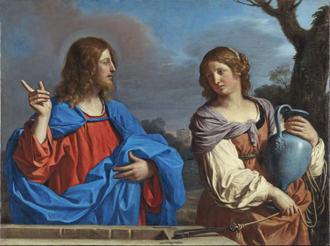
Christ and the Woman of Samaria at the Well, by Il Guercino, 1640 - 1641 © Thyssen-Bornemisza National Museum, Madrid
Source: Christian Art
Gospel of 8 March 2026
John 4:5-42
At that time: Jesus came to a town of Samaria called Sychar, near the field that Jacob had given to his son Joseph. Jacob's well was there; so Jesus, wearied as he was from his journey, was sitting beside the well. It was about the sixth hour.
A woman from Samaria came to draw water. Jesus said to her, 'Give me a drink.' (For his disciples had gone away into the city to buy food.) The Samaritan woman said to him, 'How is it that you, a Jew, ask for a drink from me, a woman of Samaria?' (For Jews have no dealings with Samaritans.)
Jesus answered her, 'If you knew the gift of God, and who it is that is saying to you, "Give me a drink", you would have asked him, and he would have given you living water.' The woman said to him, 'Sir, you have nothing to draw water with, and the well is deep. Where do you get that living water? Are you greater than our father Jacob? He gave us the well and drank from it himself, as did his sons and his livestock.' Jesus said to her, 'Everyone who drinks of this water will be thirsty again, but whoever drinks of the water that I will give him will never be thirsty again. The water that I will give him will become in him a spring of water welling up to eternal life.' The woman said to him, 'Sir, give me this water, so that I will not be thirsty or have to come here to draw water.'
Jesus said to her, 'Go, call your husband, and come here.' The woman answered him, 'I have no husband.' Jesus said to her, 'You are right in saying, "I have no husband"; for you have had five husbands, and the one you now have is not your husband. What you have said is true.' The woman said to him, 'Sir, I perceive that you are a prophet. Our fathers worshipped on this mountain, but you say that in Jerusalem is the place where people ought to worship.' Jesus said to her, 'Woman, believe me, the hour is coming when neither on this mountain nor in Jerusalem will you worship the Father. You worship what you do not know; we worship what we know, for salvation is from the Jews. But the hour is coming, and is now here, when the true worshippers will worship the Father in spirit and truth, for the Father is seeking such people to worship him. God is spirit, and those who worship him must worship in spirit and truth.' The woman said to him, 'I know that Messiah is coming - he who is called Christ. When he comes, he will tell us all things.' Jesus said to her, 'I who speak to you am he.'
Just then his disciples came back. They marvelled that he was talking with a woman, but no one said, 'What do you seek?' or, 'Why are you talking with her?' So the woman left her water jar and went away into town and said to the people, 'Come, see a man who told me all that I ever did. Can this be the Christ?' They went out of the town and were coming to him.
Meanwhile the disciples were urging him, saying, 'Rabbi, eat.' But he said to them, 'I have food to eat that you do not know about.' So the disciples said to one another, 'Has anyone brought him something to eat?' Jesus said to them, 'My food is to do the will of him who sent me and to accomplish his work. Do you not say, "There are yet four months, then comes the harvest"? Look, I tell you, lift up your eyes, and see that the fields are white for harvest. Already the one who reaps is receiving wages and gathering fruit for eternal life, so that sower and reaper may rejoice together. For here the saying holds true, "One sows and another reaps." I sent you to reap that for which you did not labour. Others have laboured, and you have entered into their labour.'
Many Samaritans from that town believed in him because of the woman's testimony, 'He told me all that I ever did.' So when the Samaritans came to him, they asked him to stay with them, and he stayed there two days. And many more believed because of his word. They said to the woman, 'It is no longer because of what you said that we believe, for we have heard for ourselves, and we know that this is indeed the Saviour of the world.'
Reflection on the painting
We are blessed to live in a country where clean water flows so easily. We turn a tap and it is there. Yet it has not always been so. Some may still remember the days of drawing water from a communal pump. And even today, in many parts of the world, that remains a daily reality. Often it is women who walk long distances to fetch water, carrying it home for their families. In some places, even that is not possible, which is why one of the most vital works of aid organisations is the digging of wells, quite literally bringing life to communities.
In the time of Jesus, drawing water from the well was a daily and communal task, a place of encounter, conversation, and unexpected meetings. Water has always been precious because it is essential for life itself. We can survive far longer without food than without water. For the people of Israel, this life-giving quality of water pointed beyond itself to God. The prophets spoke of God as a source of "living water," and human thirst became a powerful image of our soul's deeper longing for God. As the psalmist expresses so beautifully: just as a deer longs for flowing streams, so the human heart longs for God.
In today's Gospel we meet Jesus sitting beside a village well, weary from his journey, resting in the heat of the midday sun, and clearly thirsty. When a woman comes to draw water, he asks her for a drink, relying on her to draw from the well. Yet this simple request is anything but ordinary. Jesus is a Jew speaking to a Samaritan, and Jews and Samaritans kept their distance from one another. More than that, in that culture, a man would not usually address a woman in public, unless she was part of his own family. But as the conversation unfolds, it becomes clear that Jesus' thirst is not only physical. There is a deeper longing at work: a desire to draw this woman, and through her many others, into the love of God. And he recognises in her, too, a deeper thirst: a longing for a love that transcends any cultural divides.
Thirst is what helps us grow closer to God. It is good to be thirsty for knowledge, deeper faith, thirsty to get to know more about Scripture,... thirst is what can propel us forward in our faith. Without that thirst, we remain static. Our painting by Guercino, depicts up close the intimate moment between Christ and the Samaritan woman at the well. The two figures are placed close to the foreground, engaged in an almost urgent conversation. The woman leans slightly away, her body still tied to the physical act of drawing water, while Christ gestures toward her with calm authority. There is a quiet tension between them, not hostility, but distance, as if she is only just beginning to grasp what Jesus is offering. The simplicity of the setting (not even depicting the well itself) allows all attention to rest on their faces and hands, where the true drama unfolds: a meeting of two worlds. And at the heart of the painting is thirst. Jesus sits there tired and thirsty, yet his deeper longing is to draw this woman to faith. At the same time, we see in the woman a different kind of thirst: a questioning, searching desire to understand who this man is and what he is offering.
LINKS
Christian Art: https://christian.art/
Today's reading: https://christian.art/daily-gospel-reading/john-4-5-42-2026/
 Facebook
 Twitter
 LinkedIn
 Print
Print Email
Email















 Facebook
 Twitter
 YouTube
 LinkedIn
 Pinterest